
Industrial Ghosts: Stories of Copper, Coal, and Gold
Catalina Cabral-Framiñan visited three sites in Japan to understand how post-industrial regions confront their histories of extraction and try to revitalize their communities.
February 23, 2026
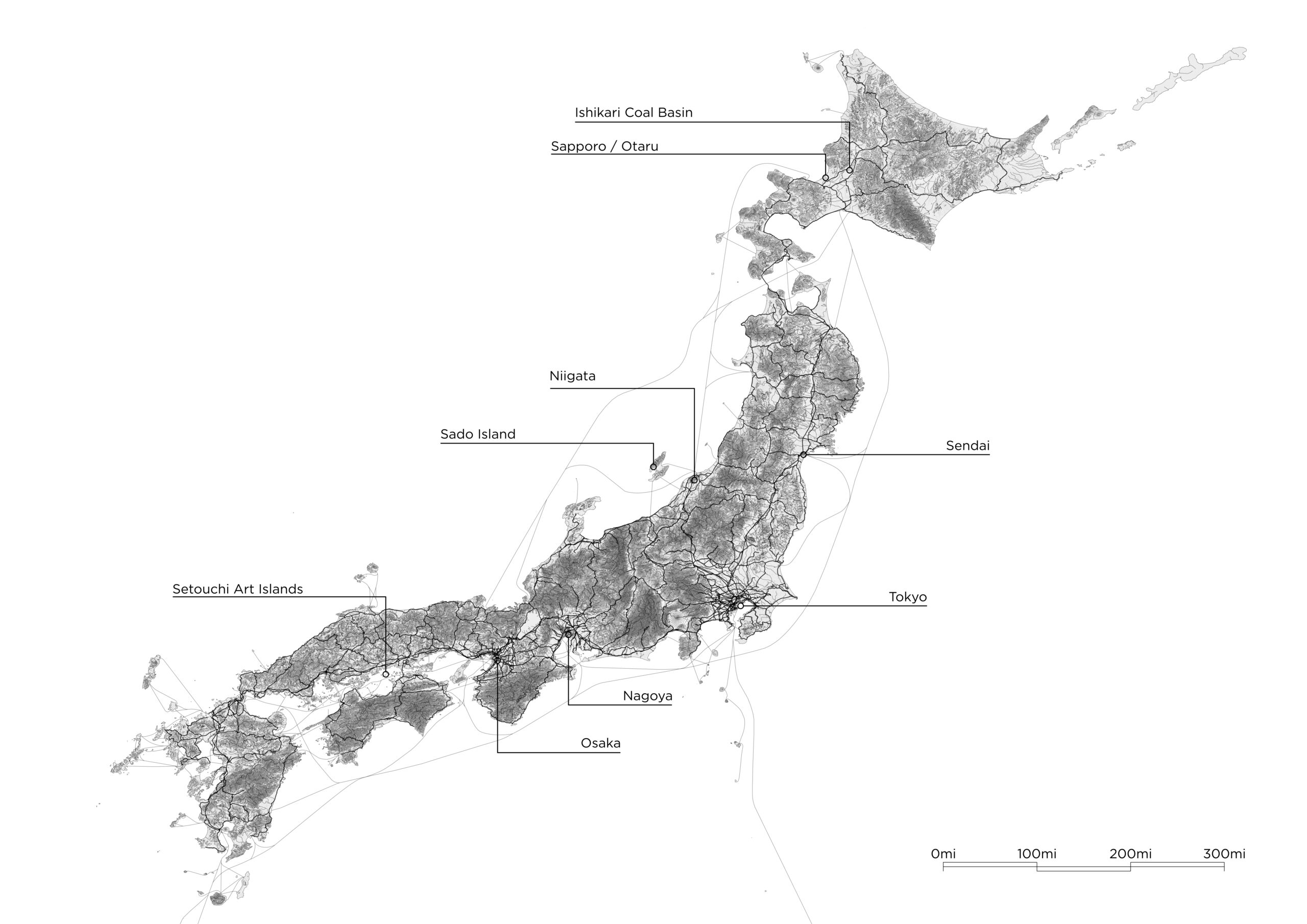
Map of Japan and locations visited on study trip. Image credit: Catalina Cabral-Framiñan
The Deborah J. Norden Fund, a program of The Architectural League of New York, was established in 1995 in memory of architect and arts administrator Deborah Norden. Each year, the competition awards up to $5,000 in travel grants to students and recent graduates in the fields of architecture, architectural history, and urban studies.
Catalina Cabral-Framiñan received a 2025 award.
Introduction
Industrial Ghosts traces a triangle of former extraction sites in Japan: copper in the Seto Inland Sea’s “Art Islands,” coal in Hokkaido’s Ishikari Coal Basin, and gold on Sado Island. The goal is to understand how post-industrial regions confront their histories of extraction and try to revitalize their communities, now plagued by a lack of job prospects and increasing depopulation, once the economic engines that fueled their growth have died.
Copper and Concrete: Setouchi Art Islands
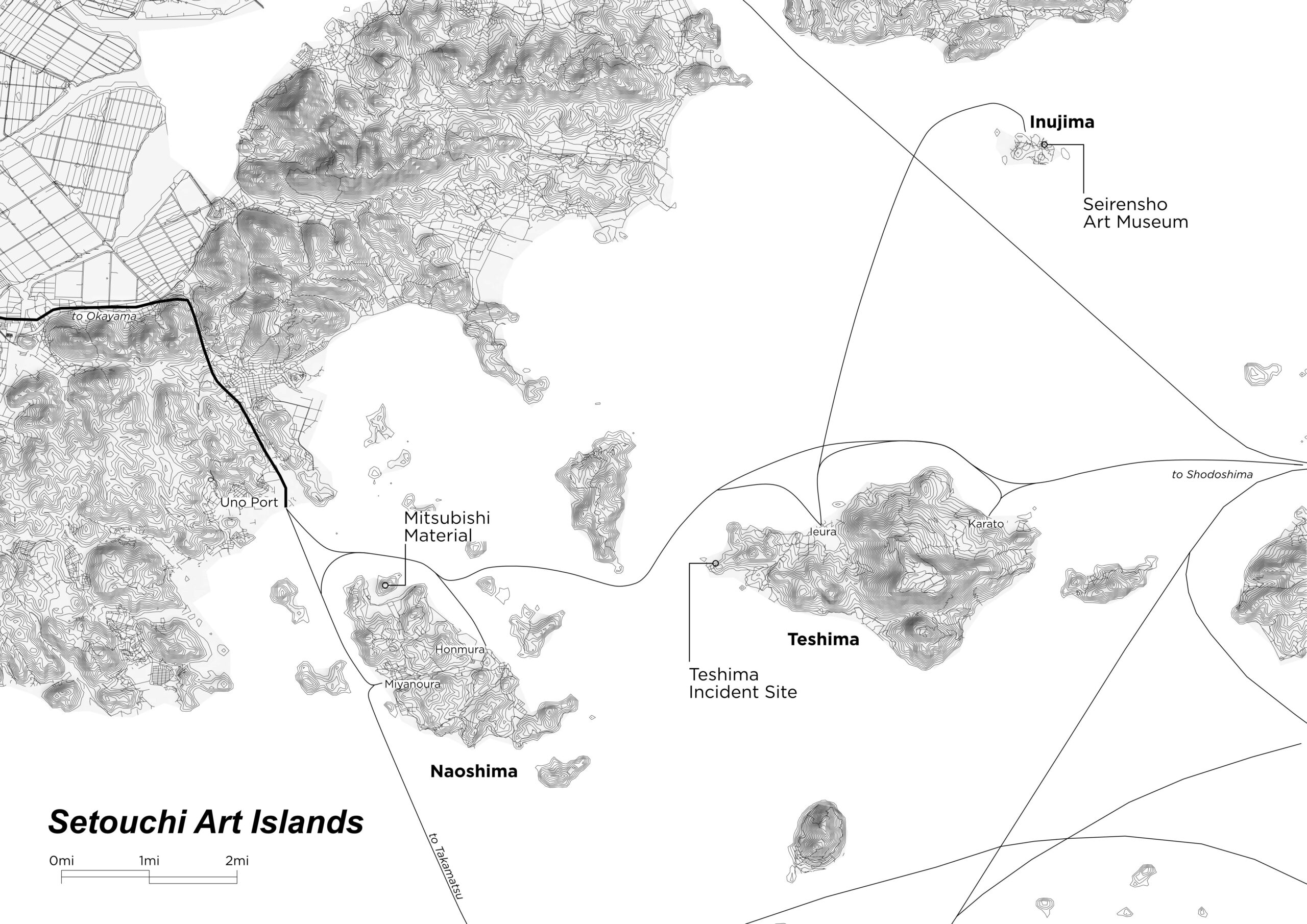
Map of the Setouchi focused on the islands of Naoshima, Teshima, and Inujima. Image credit: Catalina Cabral-Framiñan
Naoshima is the most well-known of the three “art islands,” likely due to hosting the largest number of arts/cultural projects and its higher frequency of ferry connections from Uno port and Takamatsu (Teshima also has ferries from both, but with less frequency; Inujima is connected to neither). It is here that the vision for the “art islands” really began, first with Tetsuhiko Fukutake, the founder of the company which would later become the Benesse Corporation, and Naoshima’s mayor at the time, Chikatsugu Miyake, who planned to open a campground for children in the southern portion of the island.
By then, Naoshima had acquired a bad reputation due to pollution from the copper refinery at its northern tip. Tetsuhiko Fukutake unfortunately passed away before seeing the completion of the campground, but a version of his mission was taken up by his son, Soichiro Fukutake, who saw a larger vision for the island’s revitalization and the already purchased land, and decided it would become a place dedicated to art. Fukutake sought the help of Tadao Ando to design museums and a hotel that became the new heart of the island in the area now known as the Benesse Art Site. What was initially considered a far-fetched idea at the time evidently worked. The islands are now known worldwide, with over half a million visitors a year to Naoshima and around a million visitors when the Setouchi Triennale is running. Over half of the visitors are from abroad, as you can tell simply from the amount of French, Spanish, and German you hear on the ferries there, coming from either side of the inland sea, and with most of the domestic tourists being of the younger demographic.
Accessibility was a primary concern when the project was first initiated. Who would go out of their way to go there just for art? After all, even forty years later and at a peak of interest, it’s around a three-hour Shinkansen ride from Tokyo to Okayama, then an hour on a local train to get to the small port of Uno, and then another ferry ride just to get to Naoshima. Yet, the journey itself feels like an accomplishment. Fukutake’s vision for the island was distinctly anti-metropolitan in a decade where everything in the country revolved around Tokyo. “Tokyo was supposedly building Japan, yet Tokyo was destroying Japan,” he stated in an interview series with Ando on the creation of the Benesse Art Site a few years ago.
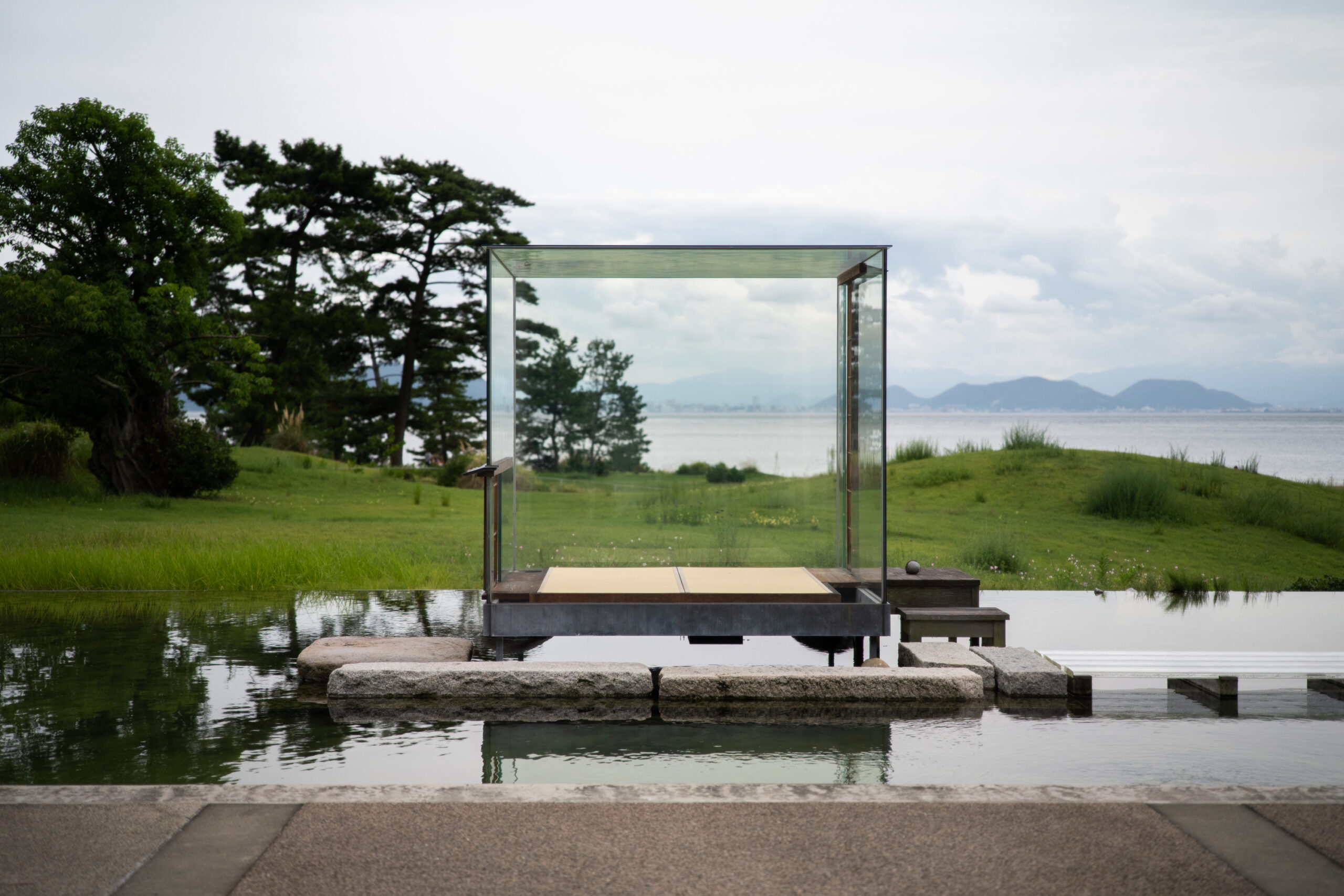
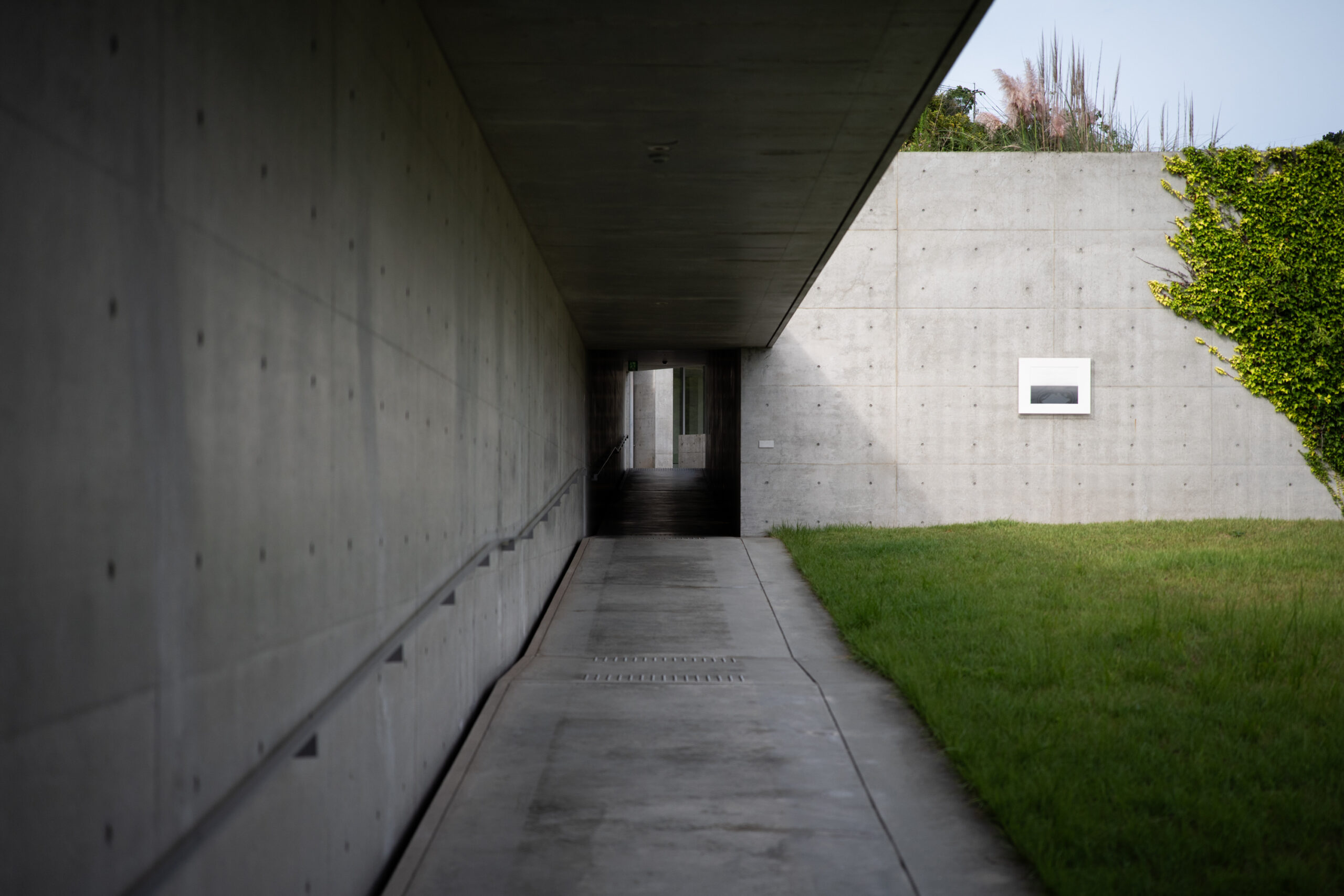
Nature as the backdrop for art, Hiroshi Sugimoto Gallery, Naoshima. Image credit: Catalina Cabral- Framiñan
When you land on the island, you don’t really see any of the contaminated history, per se. You’re immediately faced with fragments of architecture set in pristine landscape and within two towns that feel as removed from the chaos of the city as one can be. And it is in the destination that Fukutake’s genius vision is really seen, with architects of the caliber of Ando, Fujimoto, and SANAA. As impressive as the permanent collections containing work from Hiroshi Sugimoto, Walter de Maria, Lee Ufan, and James Turrell (among others) are, they don’t take center stage on the island, at least not as compared to the museums themselves. Even Yayoi Kusama’s famous yellow pumpkin becomes only a stop along the way between several museums in Naoshima. In each one you go to, it’s impossible not to notice the visitors focusing on the architectural spaces as much as (if not more than) the artworks themselves. Ando himself is the main artist of the island, creating incredible sculptures of concrete set into the rocky coastline. Some, like the Chichu Art Museum, are beautiful in how hidden they are, and some, like the Benesse Art House, are visible from afar, with massive linear forms protruding from the lush landscape.
Yet within the entire experience of Naoshima, you wouldn’t realize that less than an hour bike ride away on the northern tip of the island still stands the same smelter and refinery that gave the island a bad reputation forty years ago, which has been operating since 1918, first as a copper refinery on the island which later turned to other related industry as copper production declined, and currently focused on waste recycling: specifically, the approximately 600,000 tons of toxic waste that was illegally dumped on nearby Teshima from the ’70s to the late ’80s, and which was a national scandal as Japan’s worst case of illegal dumping of industrial waste, with cleanup operations only beginning in 2003. The aftermath of industry is more evident in descriptions of Teshima, where the story of the dumping scandal and ongoing cleanup efforts is present in every history in every museum on every one of the “art islands.” Yet, apart from the story itself, the presence of industry isn’t as apparent in either Naoshima or Teshima as a visitor. You only really get a glimpse of it when on the passenger boat or ferry shuttling between Miyanoura in Naoshima and Teshima as you pass by the northern tip of Naoshima and see the pale yellow of the deforested area and a mountain of black material marring what seemed like a pristine island from the other side.
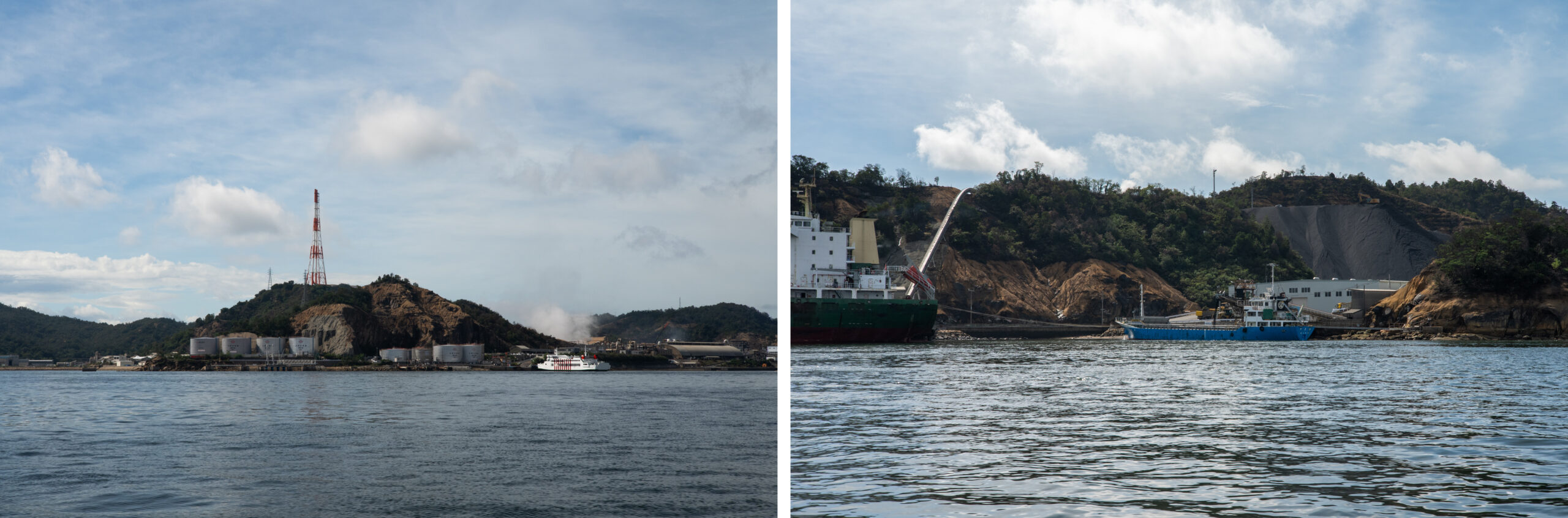
Mitsubishi Materials on the northern tip of Naoshima as seen from the passenger boat between Naoshima and Teshima. Image credit: Catalina Cabral-Framiñan
Industry is most present in Inujima, the smallest island by far, and the most difficult to reach, with only three ferries a day from Naoshima/Teshima and no actual accommodation. It first became known for its granite, with its quarries providing the stone for several castles in the region, including in Osaka and Tokyo. Later, during the Meiji and Taisho periods, the island prospered within the copper smelting industry when the refinery opened in 1909. Yet, the refinery was forced to close its doors only 10 years after it opened due to a sharp drop in copper prices. At its peak of industry, the island had about 5,000 people living there, but now the island has a population of less than 50, and an average age demographic of 75.
Approaching the island, the impact of the refinery is immediately evident. From the relatively flat landscape, several brick towers jut out, visible from afar like chimneys on a skyline. On closer approach, you can tell they are in various stages of decay: some more complete, while others are Kudzu-covered nubs and barely identifiable as brick chimneys. Disembarking, there is a small ticket center and cafe, more low-key than the ferry terminal and information center in Naoshima, and the small village, with the same yukisugi-clad houses present in the other islands in various states of disrepair or straight up abandonment. Here, the houses take on an even greater relationship between art and disrepair with the presence of the “Art House Project”, similar to that in Honmura in Naoshima, in which abandoned houses are repaired and turned into installations through collaborations with artists. Some serve simply as galleries for the art with rotating artists, while others fully integrate it into the house itself.
But the Inujima Seirensho Museum is where the relationship between industry and art is best integrated in all the islands. The museum is the product of a collaboration between artist Yukinori Yanagi and architect Hiroshi Sambuichi, and weaves the story of copper and industry through the entire design and exhibition. Beginning with the material: the path to approach the museum is a somewhat labyrinthine, made of black stone ruins. At first glance, they just seem like any other dark stone, yet they aren’t. Sambuichi used the copper slag bricks that littered the island to create the main walls of both the craggy exterior path as well as parts of the museum itself. In addition to this use, the Inujima granite that first made the island well known forms grand slanted walls that seem to act as retaining walls to the sunken-like volume that forms the main section of the museum. It is these three materials that make up the palette of the museum: karami (copper slag), Inujima stone, and the brick of the crumbling towers. Thus, the very materials of the copper industry on the island are present in the materials of the museum, connecting the design of the museum with the island and its history in a way not really present in Naoshima or Teshima.
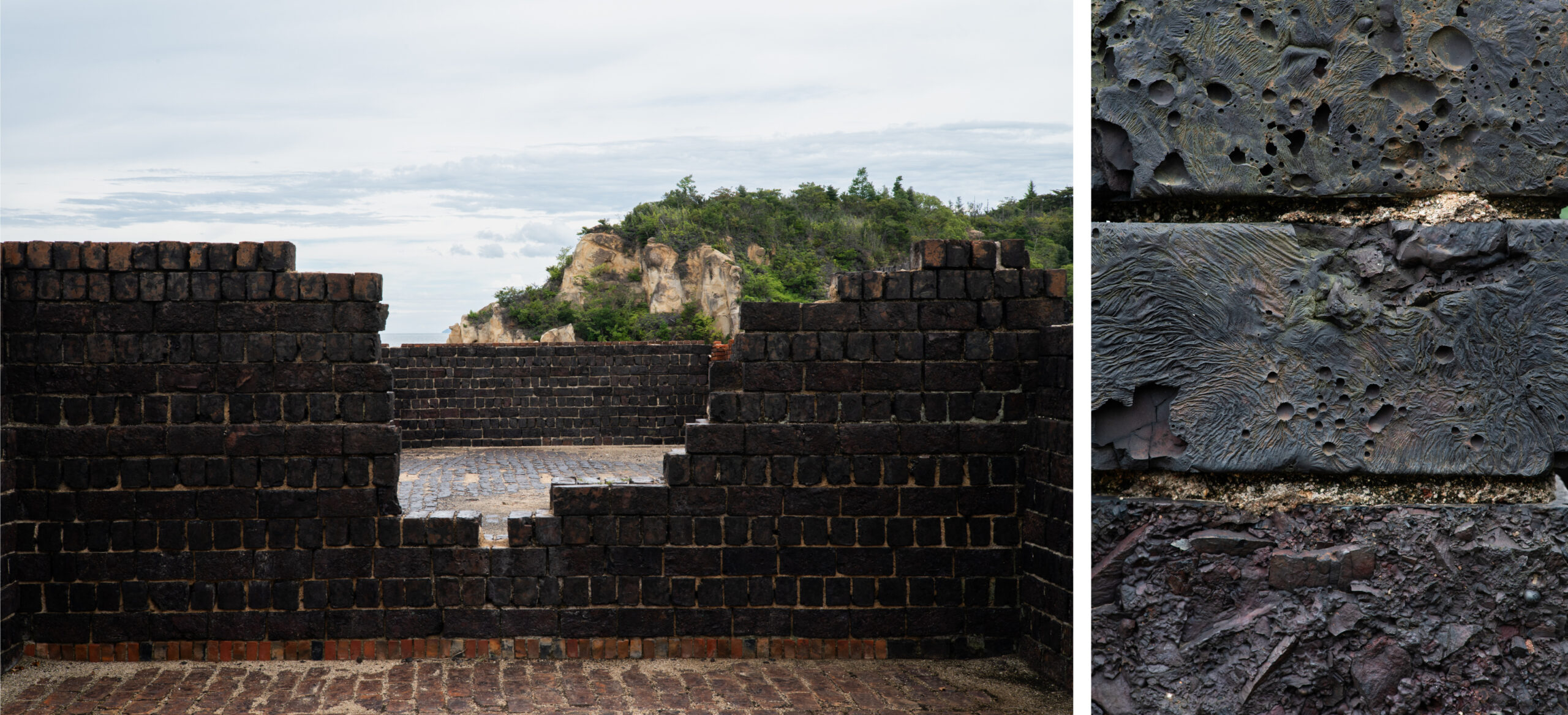
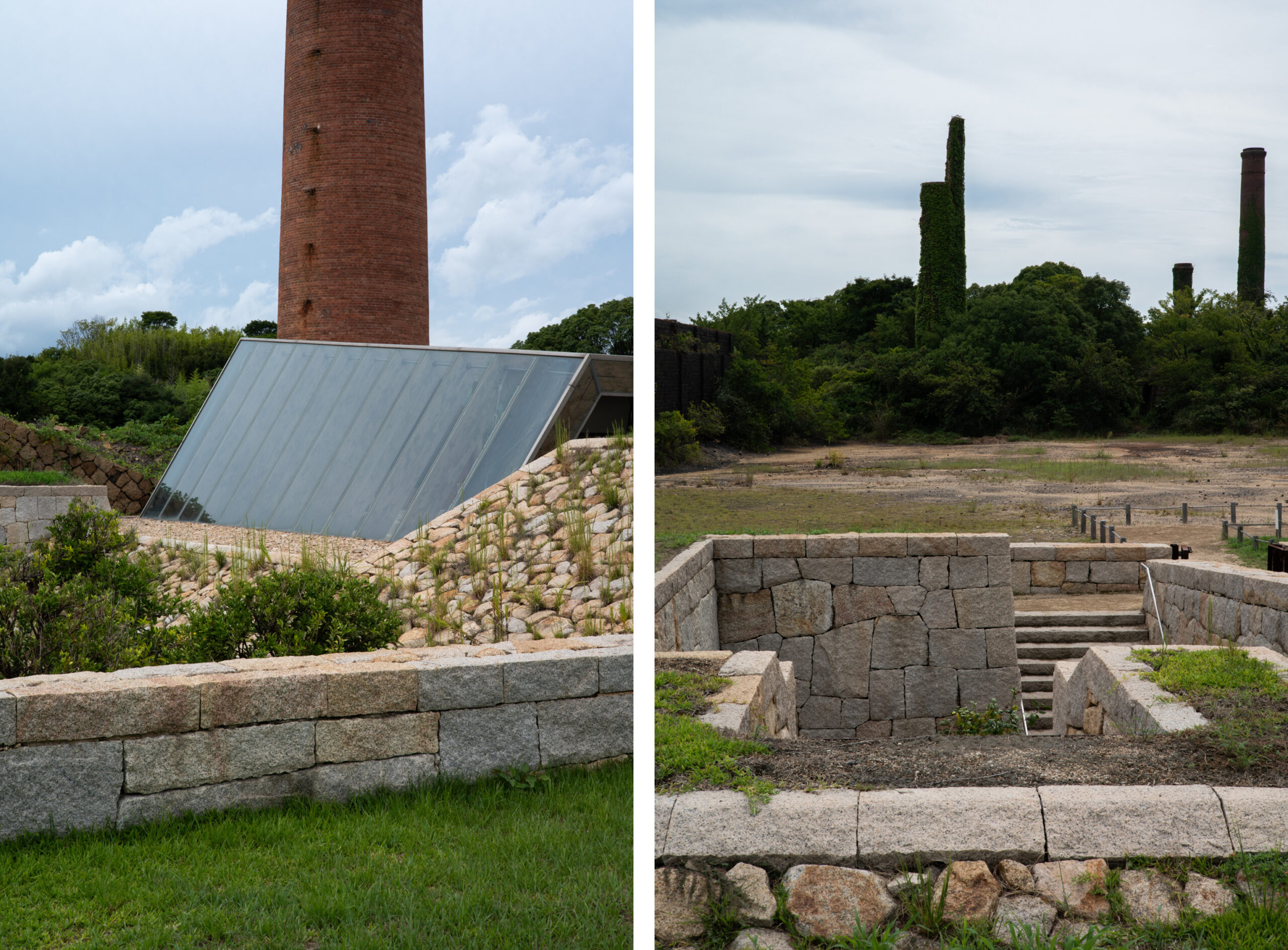
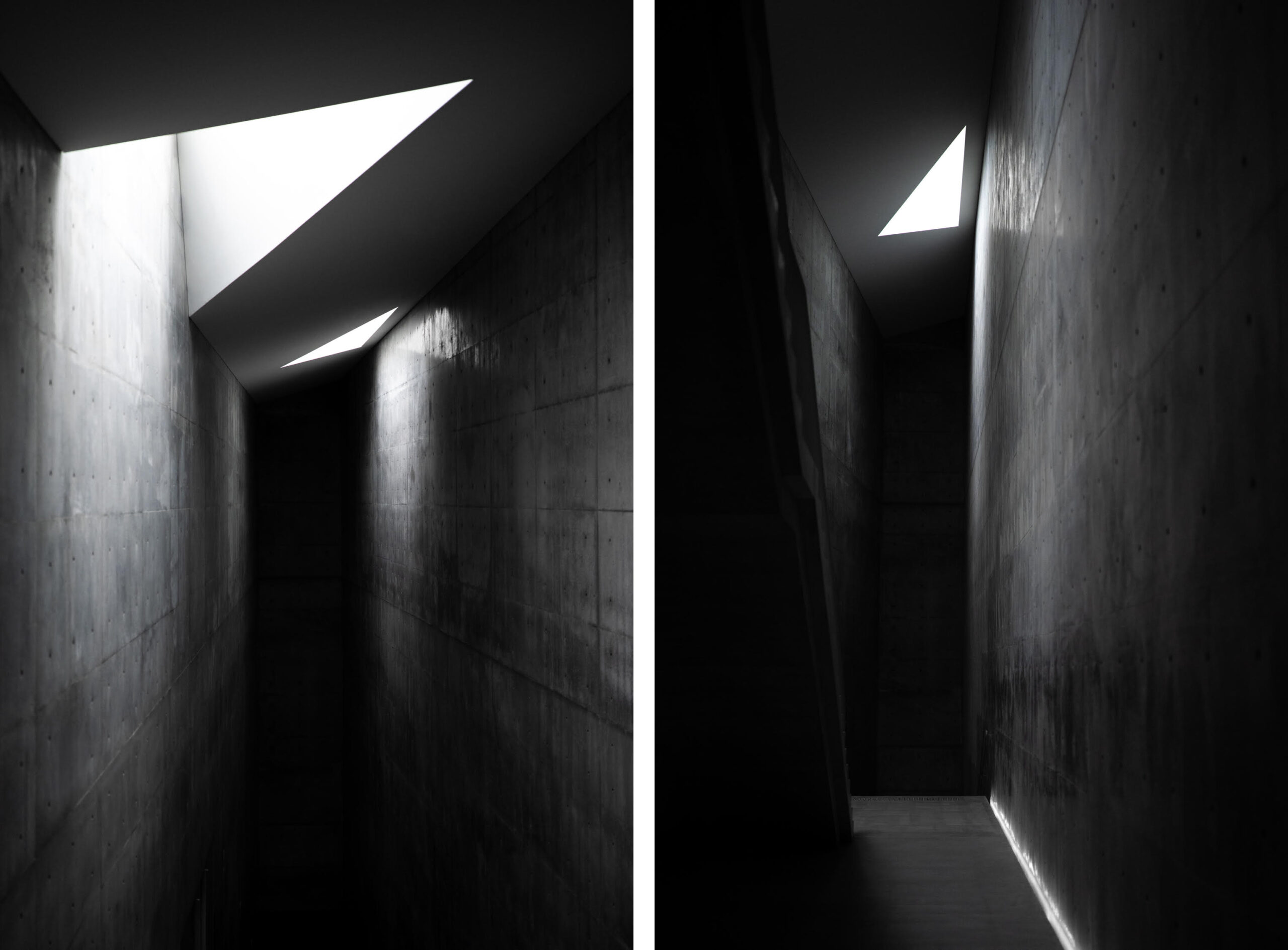
The interior of the museum and its exhibition are not different. Yukinori Yanagi designed the path and exhibit through the lens of the island’s history of industry. You enter the museum through dark sheet pile tunnels with two-way mirrors on either end, always showing a burning sun on one side and light on the other. It feels like a mineshaft, meant to disorient until you finally reach the end, where all you see is a light well with a mirror showing the sky. The rest of the exhibit follows this line, until you reach the end, where a path takes you through the ruins of the actual refinery, the crumbling towers and free-standing walls nestled in the forest as much part of the exhibit as the artwork inside.
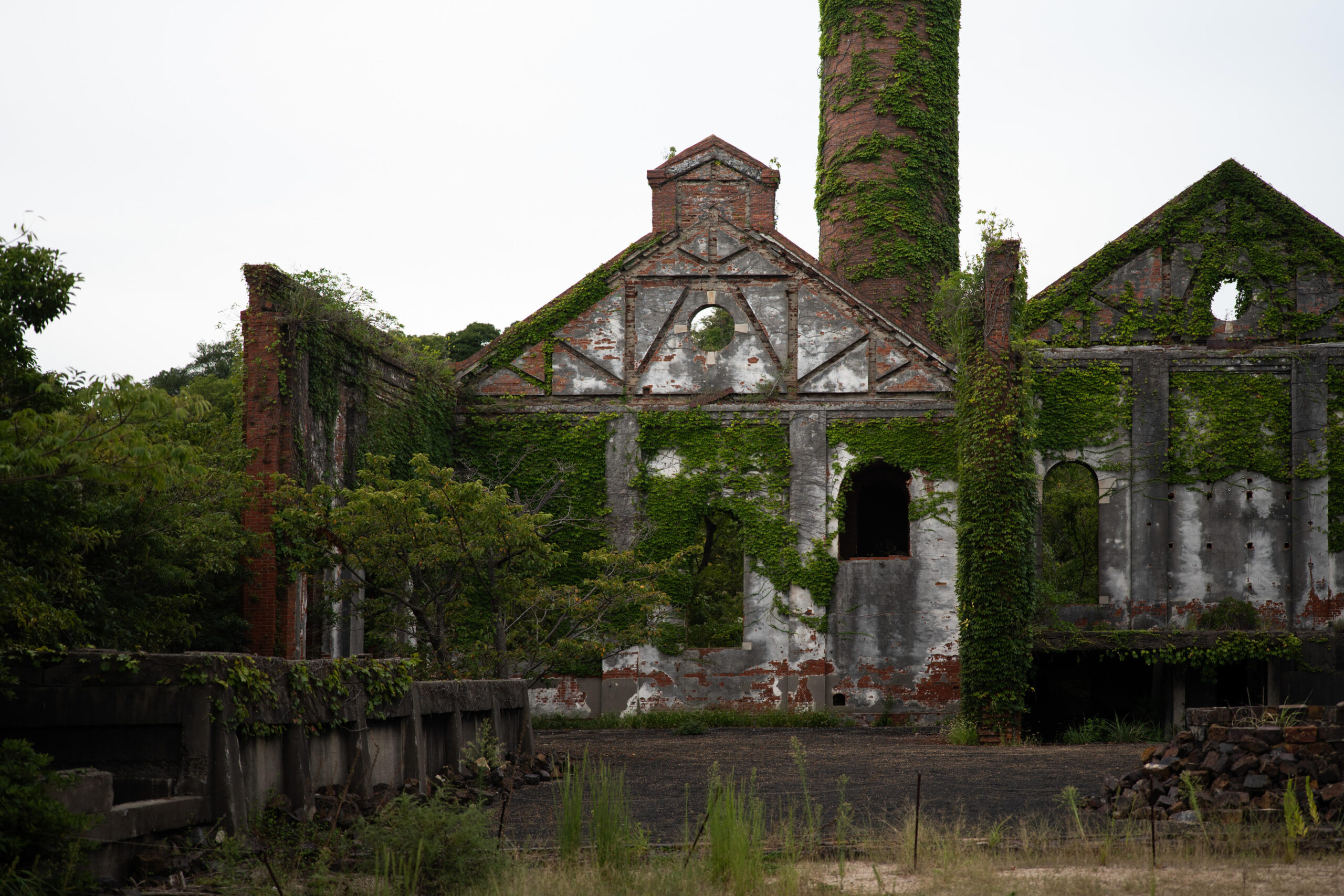
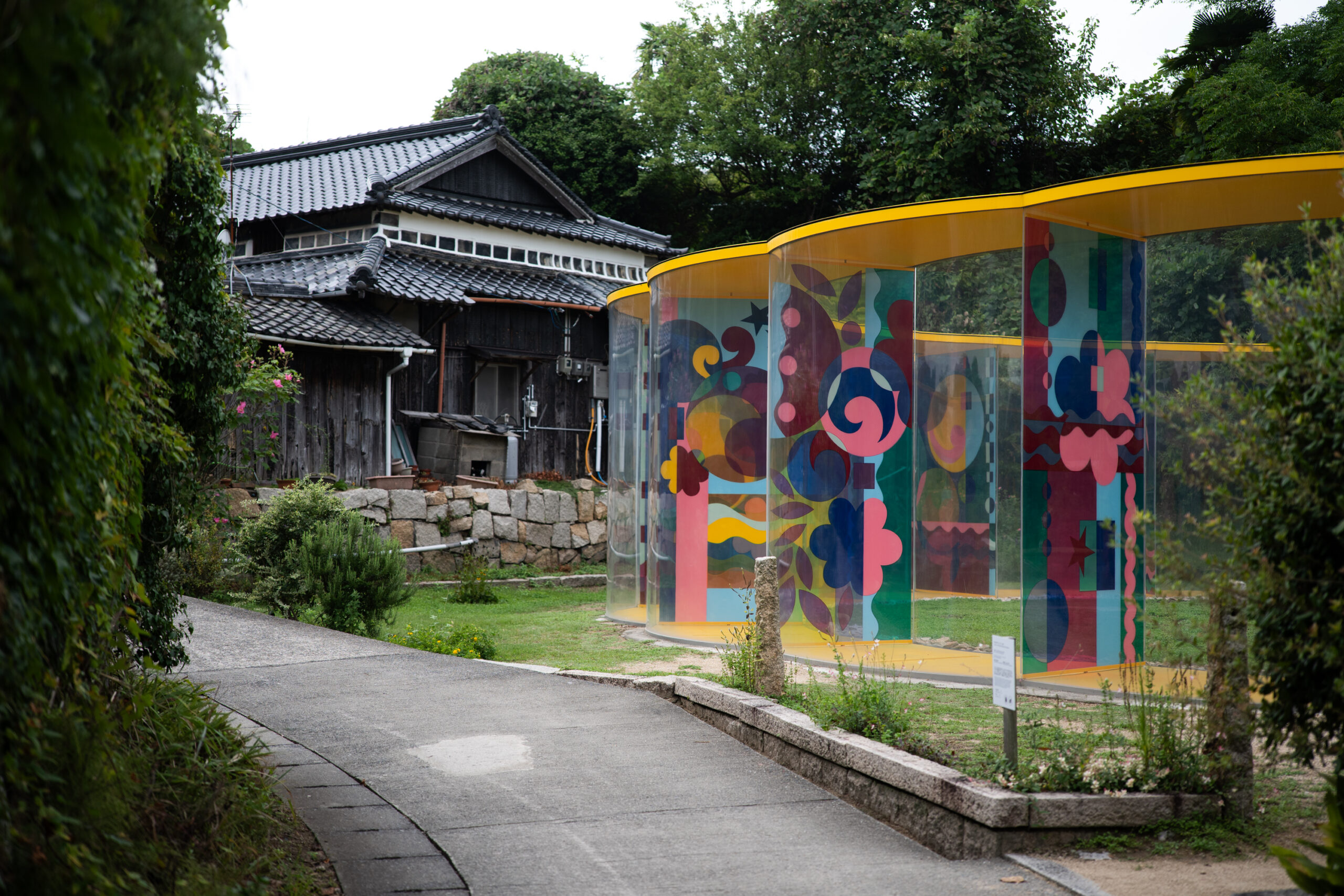
Thus, as Naoshima masks its heritage of industry and contamination underneath beautiful concrete minimalism, and Teshima lives with it as a cautionary tale present in the memories of residents, Inujima wears it openly, creating an architecture and exhibition that could not exist anywhere else, refusing to erase or minimize its legacy. Perhaps this is due to the short lifespan of the refinery itself, as it didn’t have a chance to gain notoriety like Teshima’s story of industrial pollution before external economic forces forced its closure. Yet all three islands show a way that art can revitalize old histories of industry and breathe new life into aging communities.
Ishikari’s Ghosts: Coal in Hokkaido
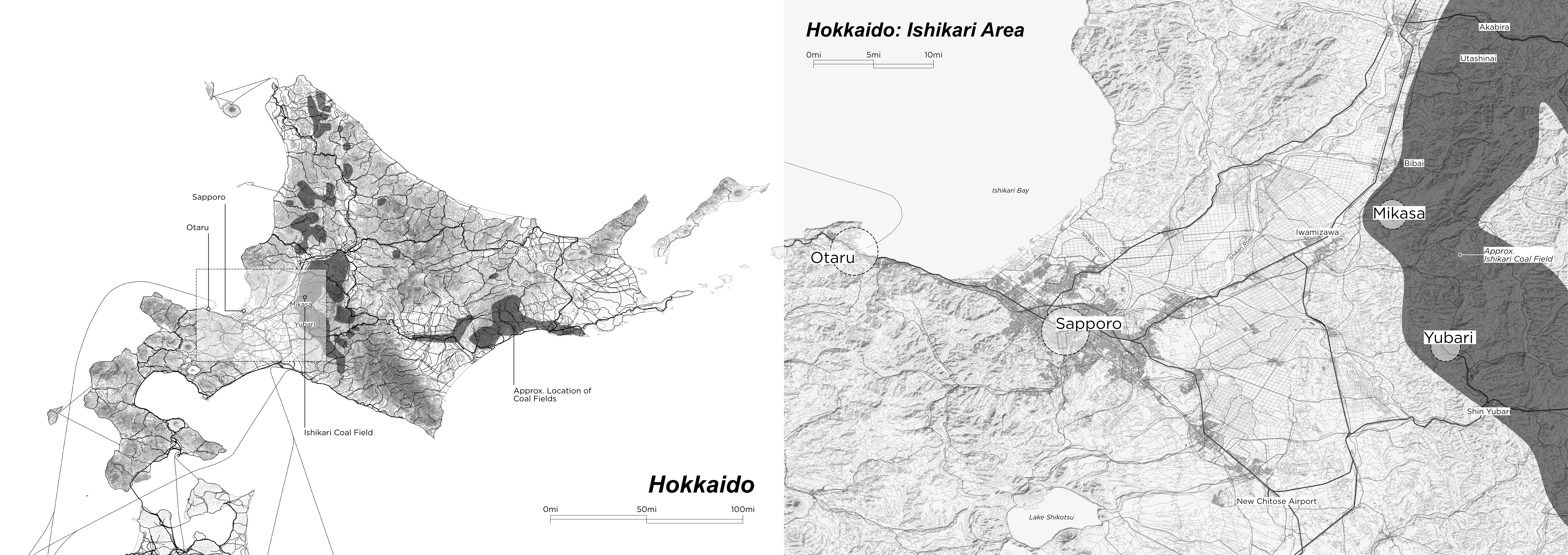
Map of Hokkaido [Left] and Map of the Ishikari Area showing Sapporo and surroundings [Right]. Image credit: Catalina Cabral-Framiñan
The Ishikari coal field in Hokkaido presents another landscape shaped by extraction, but on a scale far larger and far harsher than the islands of the Seto Inland Sea. The coal field stretches across the western portion of Hokkaido, in the mountains alongside the Ishikari River basin. The entire region embodies a different type of industrial ambition, one marked by the forces of rapid industrialization of the Meiji era that must also grapple with the contentious history of colonization of the island itself, which both enabled and justified Japanese development in the region.
The mining of coal in Hokkaido came just as the Kaitakushi (the Hokkaido Development Commission tasked with the administration and development of the northern island) was disbanded. Instead, development of the industry fell to different private entities that would thus drive the industrial revolution of Northern Japan. Once one of Japan’s most productive coal regions, Ishikari coal helped fuel the rapid industrialization of the country which would characterize the Meiji era. The nature of extractive economies would also come to be the region’s downfall. With the energy revolution in the mid-1900s and transition to other forms of energy, mines began to close, with the final one stopping production in 1990, only a hundred years after production began, leaving remnants of industry dotting the landscape by the dozens. As is the case with such extraction economies, the towns created to support the mines that once prospered began to decline. Yubari, one of the worst hit, was once home to 24 mines and a population of nearly 120,000. In 2007, the city was forced to declare bankruptcy, and as of 2024, the estimated population lies at 6,374. The city tried to diversify through multiple efforts, but ultimately failed in each.
One such effort was a vast Coal History Village theme park (an attempt to be part of an ’80s and ’90s boom in Japanese theme parks), which nonetheless failed and closed by 2006. Another effort to turn towards tourism was to focus on the region’s famous cantaloupes, opening themed shops and even commissioning a mascot, but that didn’t really work with a new expressway taking the city out of the standard roadside destination catalog. The railway line that once ran further into the mountain to support the main portion of the city also closed, with the nearest rail stop being Shin-Yubari station, an hour’s bus ride away.
Shin-Yubari station itself is already a small station by Japanese standards. Perhaps it was the day I went, where only a few lines were running due to storm-caused damage further down the line, resulting in the cancellation of most of the trains that week, but as I waited both before and after visiting, most of the trains I saw pass were cargo ones. People were scarce, with locals having a car as their main choice of transportation and tourists nowhere to be seen. I was the only one on the bus for the majority of the ride, with only another rider who got off soon after boarding. The area around Shin-Yubari station was already sparse, dominated by a nearby expressway and with only a few shops, houses, and a roadside station as signs of urban life. As the bus went on, houses lined the route, yet the farther from Shin-Yubari the bus went, the more forgotten the air felt. Standardized housing blocks lined the way further into the mountains, yet they all fell along a spectrum ranging from taken care of but evidently under-utilized to clearly abandoned. It was midday on a Monday, yet signs of life were sparse save for the occasional cars passing by. The closer to the coal mine area, the more signs of former industry could be seen until you reached the car park next to the Yubari Coal Mine Museum where the bus terminated.
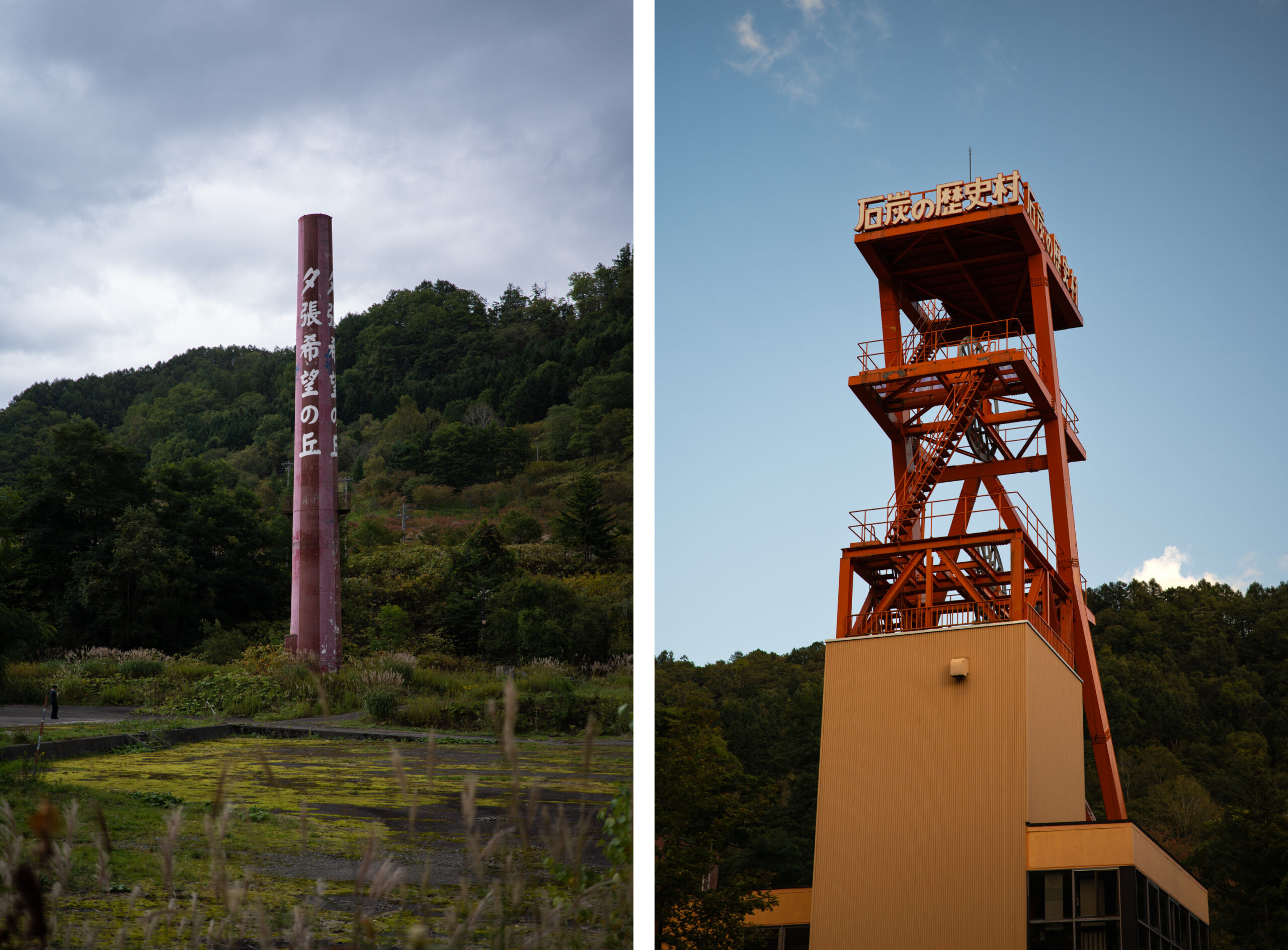
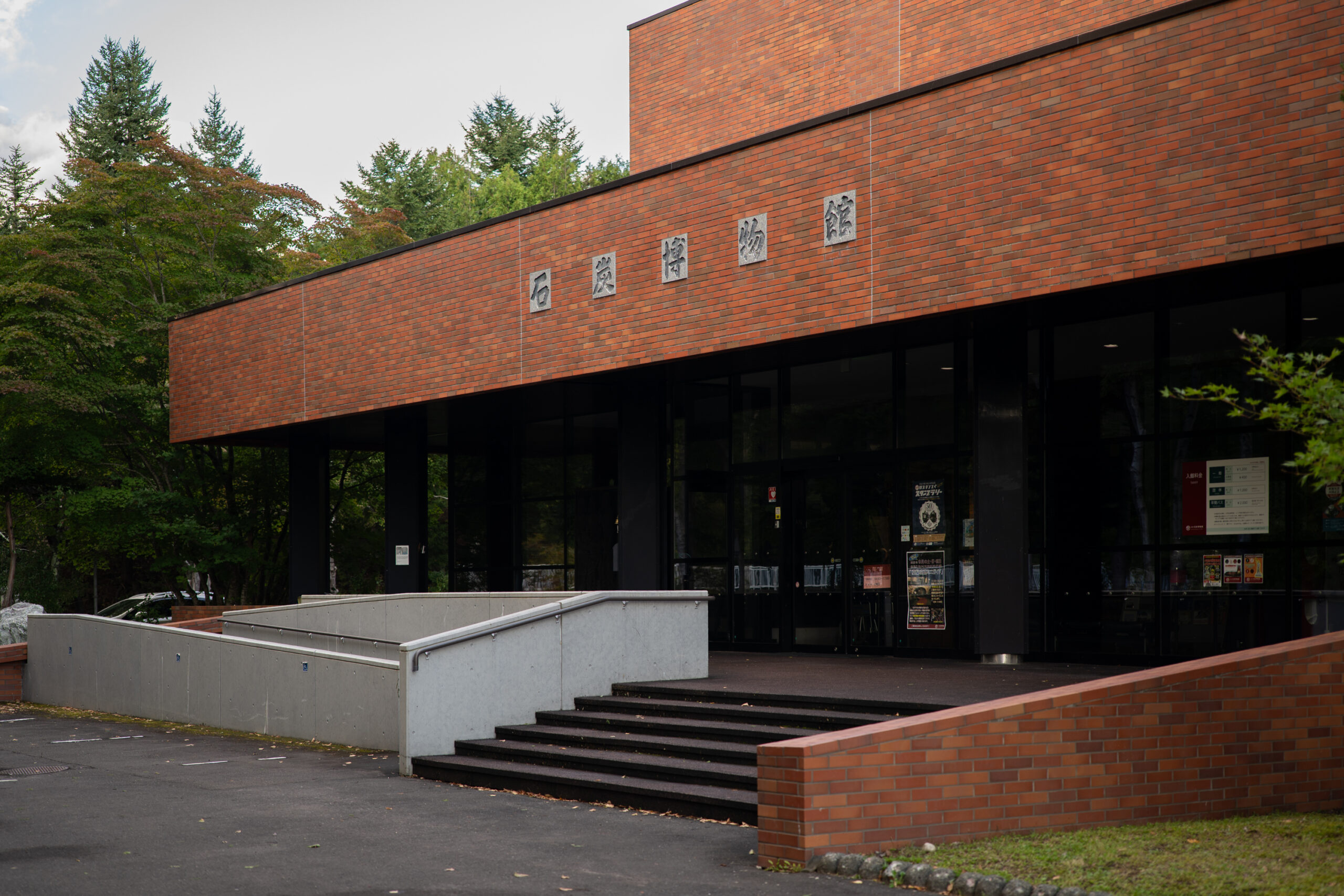
The Yubari Coal Mine Museum is the main museum focused on the coal industry in the area, and one of the few in the country. It originated as part of Yubari’s efforts to diversify away from coal mining towards coal-based tourism. It acts as a repository of mining artifacts, with two stories of the building dedicated to the history of the city and coal mining in the Ishikari coal field. Its main attraction, however, is the renovated mining shaft of the former Yubari mine (opened in 1900), which was prepared for a tour by the Emperor Hirohito and Empress Kojun in 1954. When I went, there was a decent number of visitors, all Japanese, who had all evidently come by car as a weekend day trip.
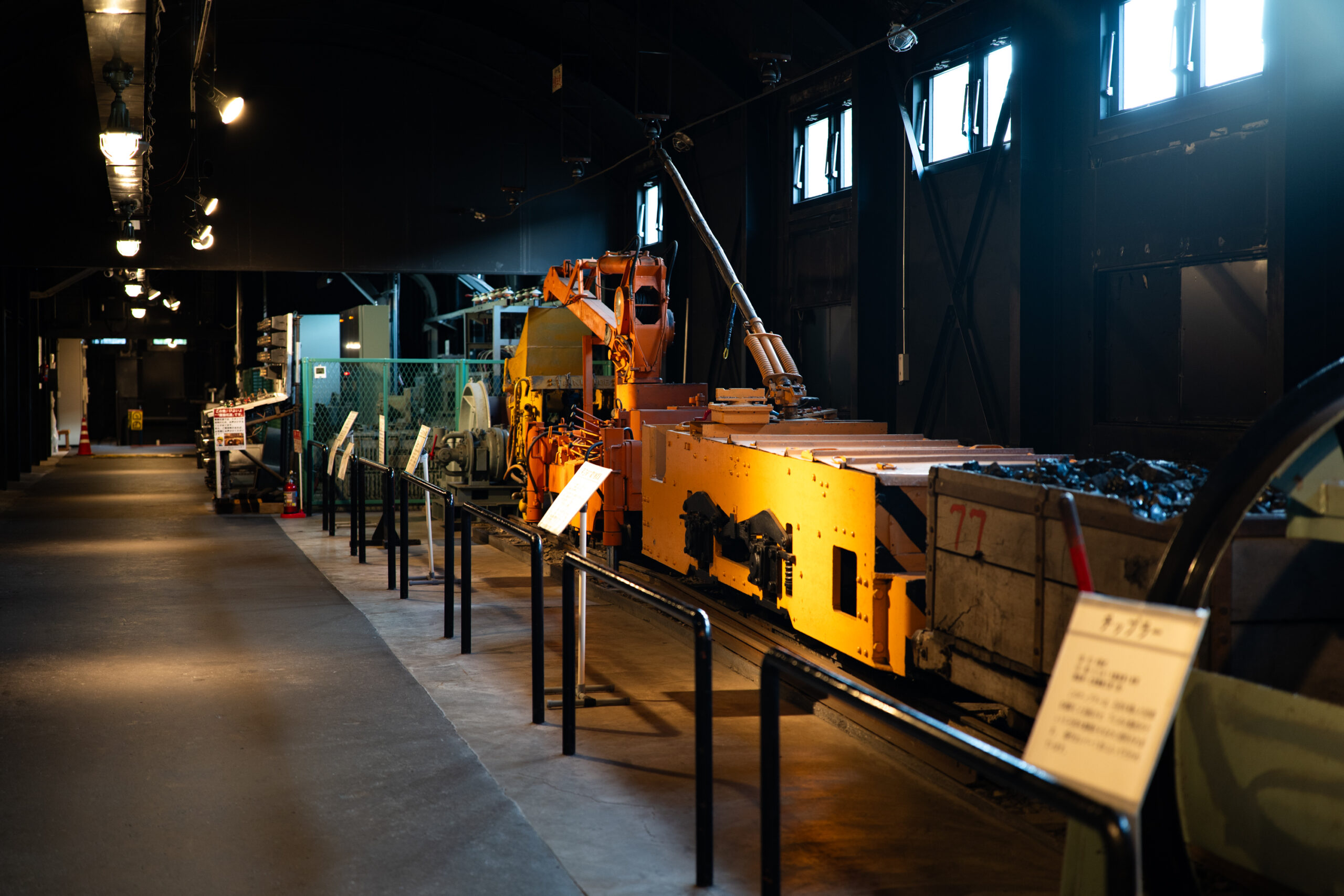
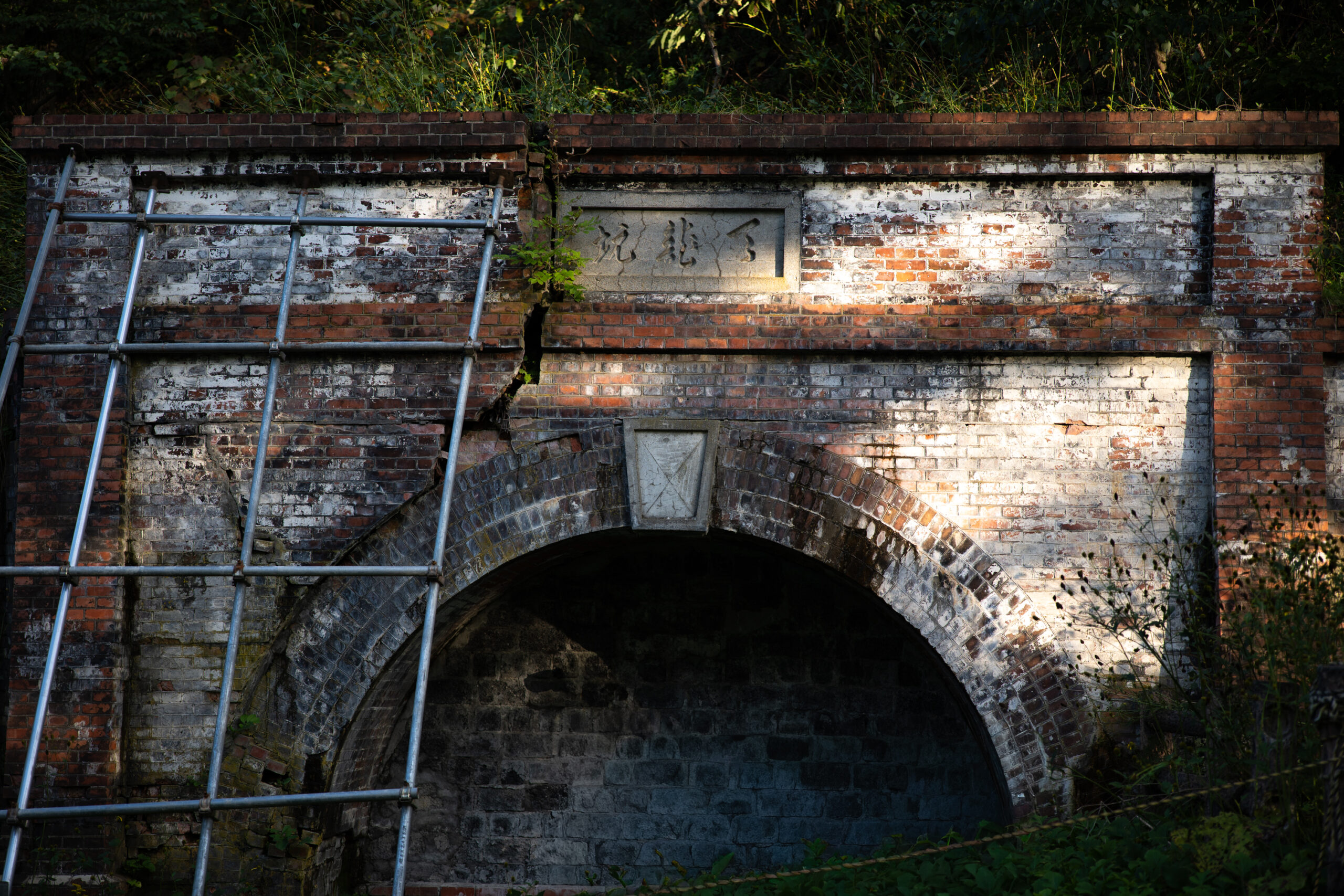
It was here that I was able to get the contact information of the director of the museum, Shigeaki Ishikawa, and was later able to interview him as part of my research. The following is a short excerpt from the longer interview, translated from the original Japanese by my good friend Xinrong “Cindy” Ye.
Catalina Cabral-Framiñan: How do you feel about preserving vs. adapting industrial structures? Would you rather see structures be maintained as they were to show how they were originally used or adapted towards other uses in order to be able to preserve the building but perhaps not the complete memory of it? Alternatively, is there an inherent beauty in the ruin of the structure in itself, and do you think that could be useful (an example being the Kitazawa Flotation Plant on Sado Island)?
Shigeaki Ishikawa: Unlike small cultural properties, the preservation of industrial structures involves risks that threaten people’s safety, such as collapse due to aging. In particular, for most coal mining facilities that have been closed for more than half a century, even maintaining their current condition is extremely difficult, and in many cases, restoring them to their original operational state is considered highly challenging.
That said, we believe that especially valuable facilities such as cultural properties must be subject to appropriate preservation measures. However, for structures where conservation measures are difficult, so-called “watchful preservation” (minimal intervention conservation) can be one possible approach. In addition, when multiple structures of the same type exist, it may be necessary to make selective choices, such as preserving a representative example.
When renovation of structures is possible, we believe that assigning them new roles and promoting initiatives for regional sustainability (including economic activities, if feasible) is an effective approach. However, in coal-producing areas facing population decline, there are concerns that even the operation and management of renovated facilities may become difficult in the short term. In particular, in Hokkaido, heavy snow and cold weather pose a major obstacle to year-round use.
Cabral-Framiñan: Do you think that Yubari’s decline was inevitable the moment it grew around a single industry and didn’t diversify, or were there also urban planning choices that were made that accelerated it?
Ishikawa: As for the changes in the Yubari region, I believe they were not the result of autonomous local transformation, but rather changes unique to a region that was inevitably dependent on national policy and global energy circumstances—namely, the decline of the coal industry and the resulting population decrease.
I also visited the coal town of Mikasa, which was also a victim of the boom-and-bust cycle of the coal industry. It was easier to reach compared to Yubari, the same hour train followed by an hour bus ride, yet the region seemed more populated in general than Yubari. The train stopped at Iwamizawa, which is a larger station, and the bus left from a large bus terminal that served the greater region. The route to Mikasa was also more transited, in a large part by motorcycle enthusiasts taking advantage of the beautiful day.
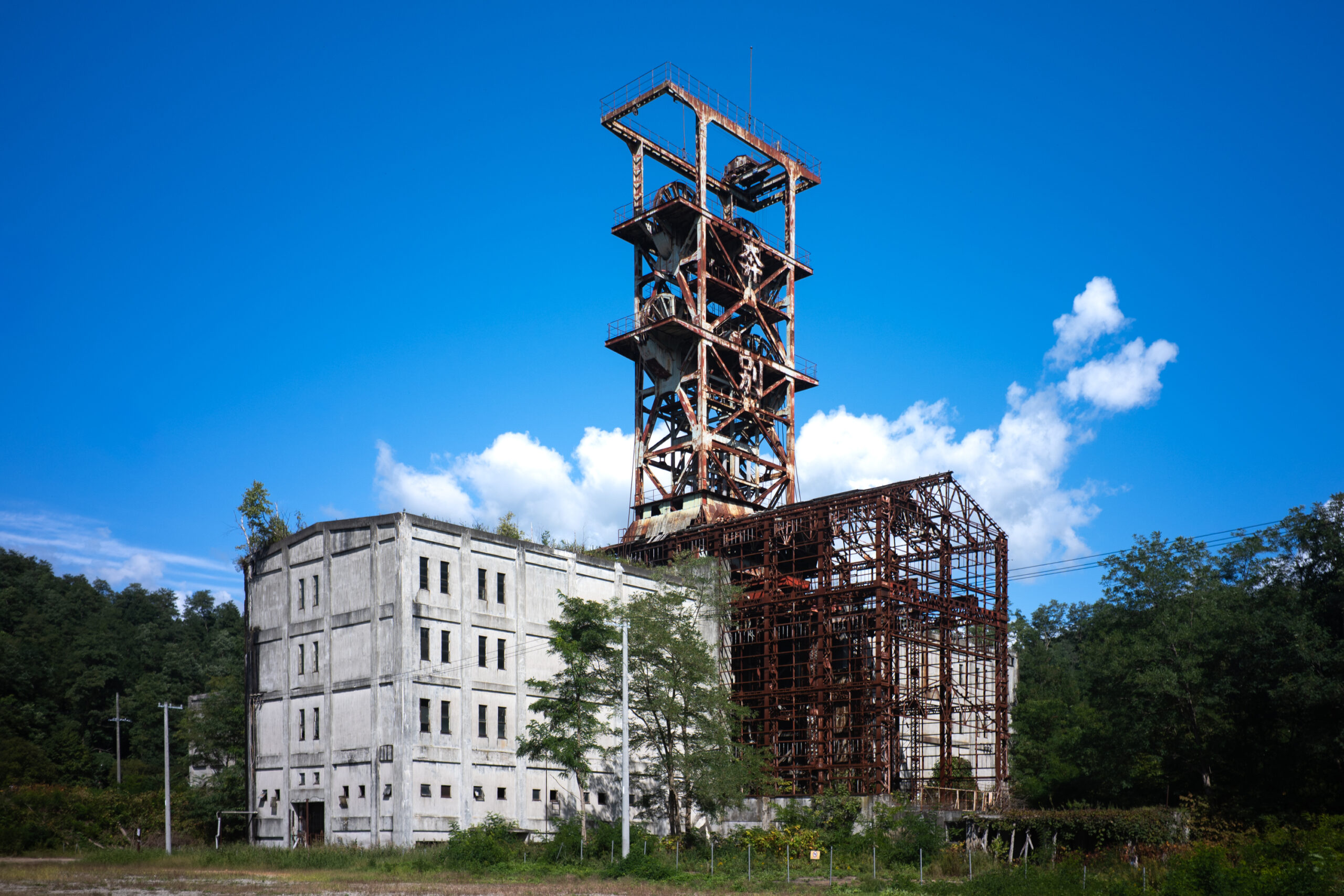
Sumitomo Ponbetsu Coal Mine in Mikasa. Image credit: Catalina Cabral-Framiñan
My reasons for going to Mikasa were two-fold: The Sumitomo Ponbetsu Coal Mine is there, one of the most famous abandoned sites in Japan, which are typically called haikyo. While I was there, several people stopped by to take pictures before continuing along on their road trip. Mikasa is also home to a museum and a geo-park with several more industrial ruins, though when I went, the geo-park was closed off due to multiple bear sightings. The museum did have an area dedicated to coal mining history, but the main attraction was the massive collection of ammonites and marine dinosaur fossils that had been excavated in the area. Rather than its mining history, the fossils were the main attraction.
Across the region, the remnants of coal extraction form a constellation of abandoned industrial structures tied together by towns in decline. Yubari and Mikasa are only two points within the much larger area of mines and show only two sides of the story present in the communities across the coal field. Some museums, memorials, geo-parks, and notable haikyo show isolated efforts to preserve communities, but they exist alongside areas where nature is steadily reclaiming the abandoned structures. It is a landscape of incomplete erasure, where industrial heritage has not been condensed into a cohesive narrative throughout the region, and which lacks the large-scale self-promotion of the Setouchi Art Islands or the Sado Island Gold Mines. The Ishikari coal field thus shows how extractive economies can both make and destroy regions.
Castle in the Sky: Sado Island’s Gold Mines
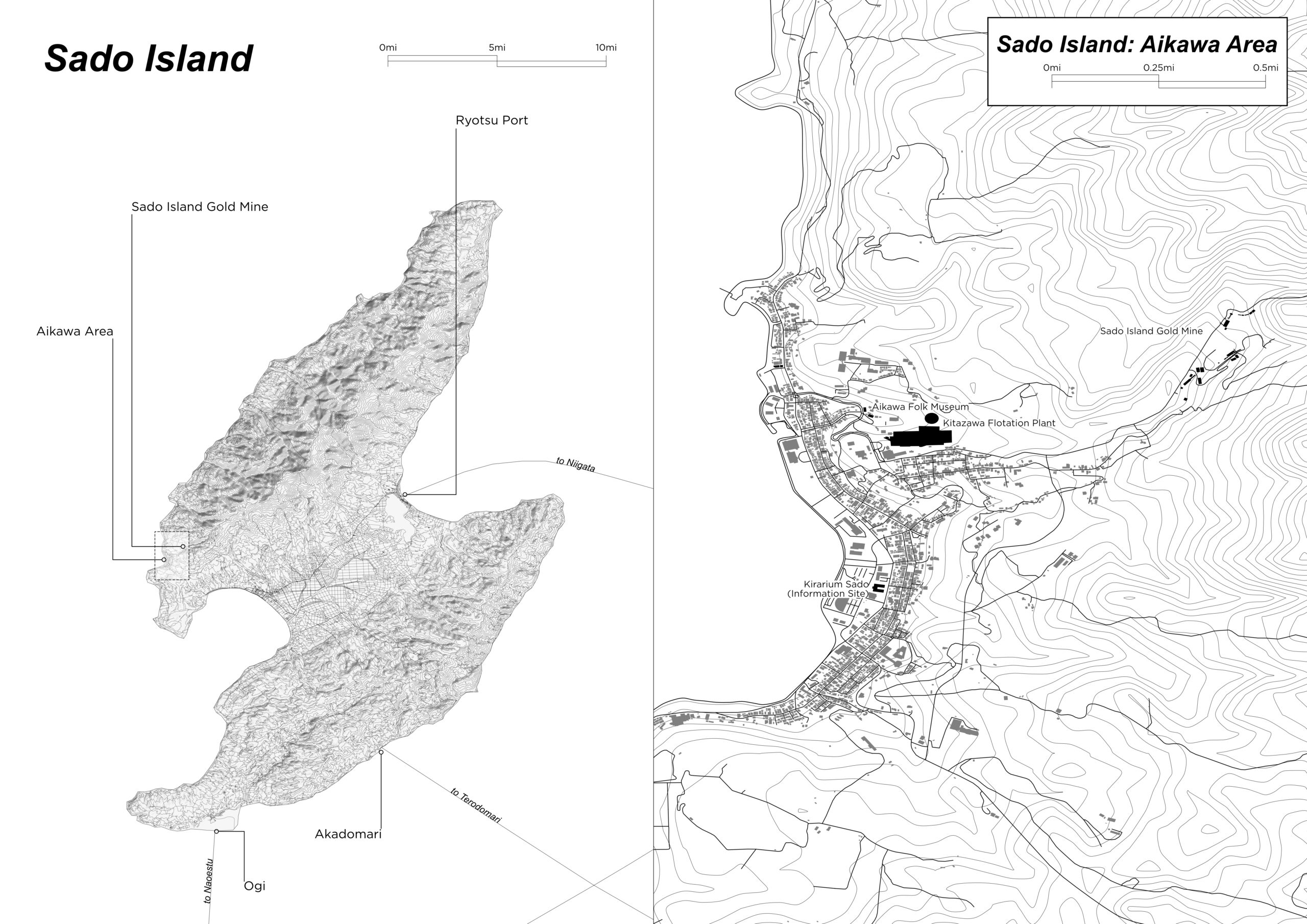
Map of Sado Island [Left] and close-up of the Aikawa Area [Right]. Image credit: Catalina Cabral- Framiñan
Sado Island’s gold mines present another landscape shaped by extraction, this time by gold. Its lifespan, however, far exceeds that of Ishikari, stretching back at least around four centuries to the early Edo period. Here, the gold mines are one of, if not the, main attraction of the rather massive island of Sado, recently named a UNESCO World Heritage Site in 2024, and currently promoted in train stations in every city I visited (even local subway stations in Tokyo and Nagoya had signs advertising the mines). The terrain is physically marked by the gold mining, most famously with the V-shaped cleft of Doyu-no-Warito, which serves as the most emblematic view of the island.
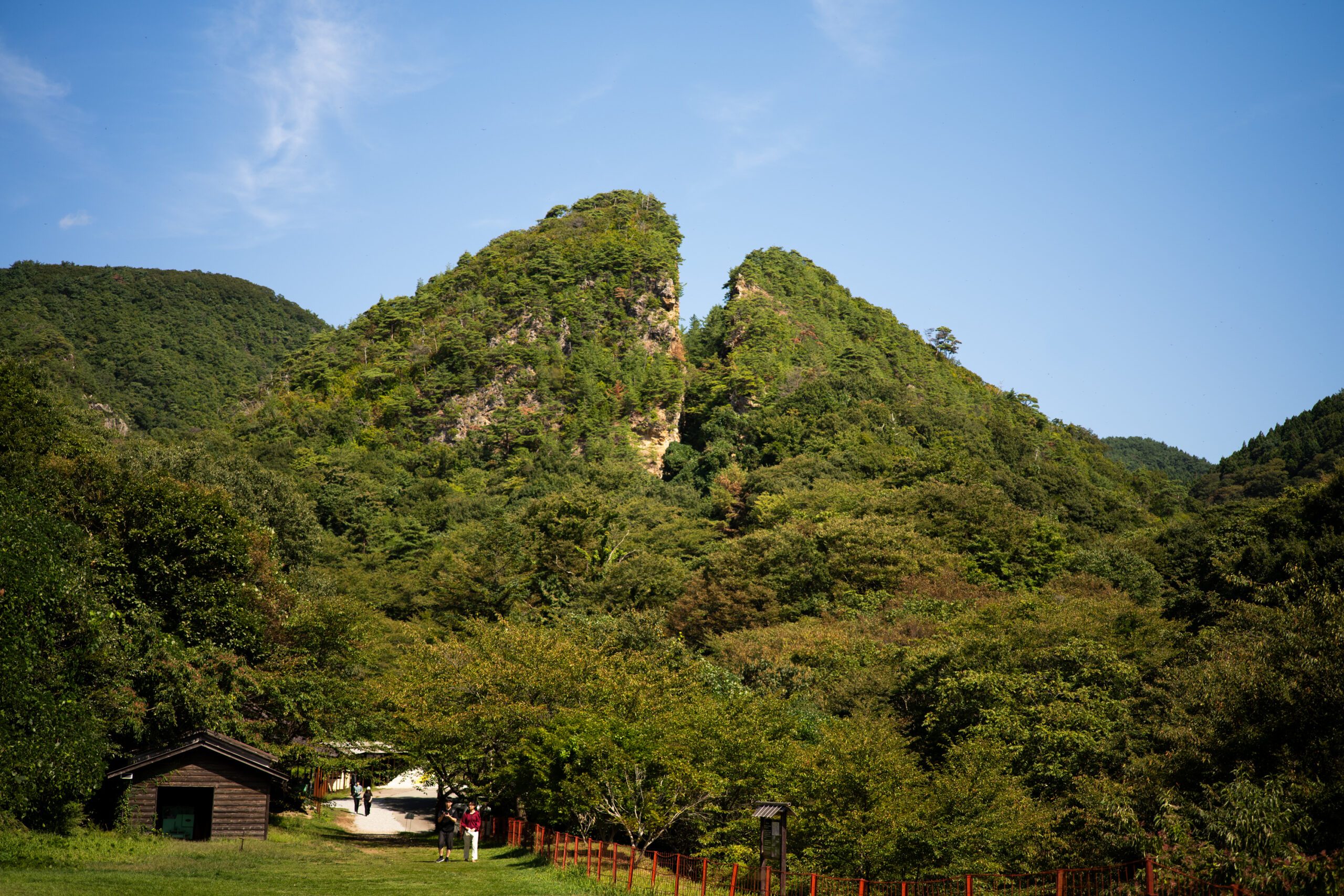
Doyu-no-Warito and its famous cleft created by gold mining in the early Edo period. Image credit: Catalina Cabral-Framiñan
The island is most accessible by a two-hour ferry or a 45-minute jet-foil ferry from Niigata, and the mines are an additional 45-minute bus ride from the ferry terminal in Ryotsu port to the Aikawa area on the northwestern side of the island. The ferry and jet-foils are filled to the brim with tourists and day-trippers. Most visit the mines during their stay, though some are obviously locals from Niigata who traveled to the island for its fishing or to visit friends and family.
While known for its surface deposits of gold and silver since the Heian period, extraction of gold in Sado began in the 1600s during the Edo period when those mining silver discovered the deeper gold veins. In 1601, full-scale mining began under the Tokugawa Shogunate in what became the Aikawa Gold and Silver Mine. Gold was minted into “Koban” (a type of oval coin) on the island in the largest gold mine in the country during its operation and was distributed throughout the country as coinage, even making its way to foreign ports in Europe. Mining would continue for centuries, though transferred to imperial holdings in the Meiji restoration and then released to Mitsubishi Goshi Kaisha (now Mitsubishi Materials, the same company which operates in Naoshima) in the 1890s. Production briefly continued to increase following the invasion of Manchuria and World War II, during which the mines began to conscript Korean workers from the Japanese occupied Korean Peninsula to fill in the shortage of Japanese workers, leading to a controversial history which continues to be discussed today (South Korea was against the naming of the mines as a UNESCO world heritage site due to lack of representation of the history of these conscripted workers in the exhibits). Production declined following World War II, and the mines eventually closed in 1989.
Apart from the modestly sized exhibit with dioramas showing the history of the mines on the site, the main attraction in the mining area is the tunnels themselves, around 300 meters of the original 400 kilometers, which have been converted into a walkthrough with wax-figure miners, some machinery, and a new artificial reality walk geared toward children.
However, what first drew me to the island is what perhaps draws a large part of my demographic and a good amount of families to Sado: The Kitazawa Flotation Plant. On paper, it’s an odd attraction, the ruins of the flotation plant built in 1937 during peak production and investment in World War II to extract gold and silver using methods originally created for copper extraction. Most of the massive facility was dismantled following the closure of the mine, leaving only its concrete carcass to be covered by ivy and other plants. However, the structure is well known for its obvious resemblance to the floating kingdom of Laputa in Studio Ghibli’s Castle in the Sky, something most evidenced by the amount of Ghibli figures hiding amongst the tableware in the cafe facing the site, the Castle in the Sky soundtrack playing on the speakers, and the amount of families with young children both excited to see the site and also slightly dejected due to the lack of friendly giant robots.
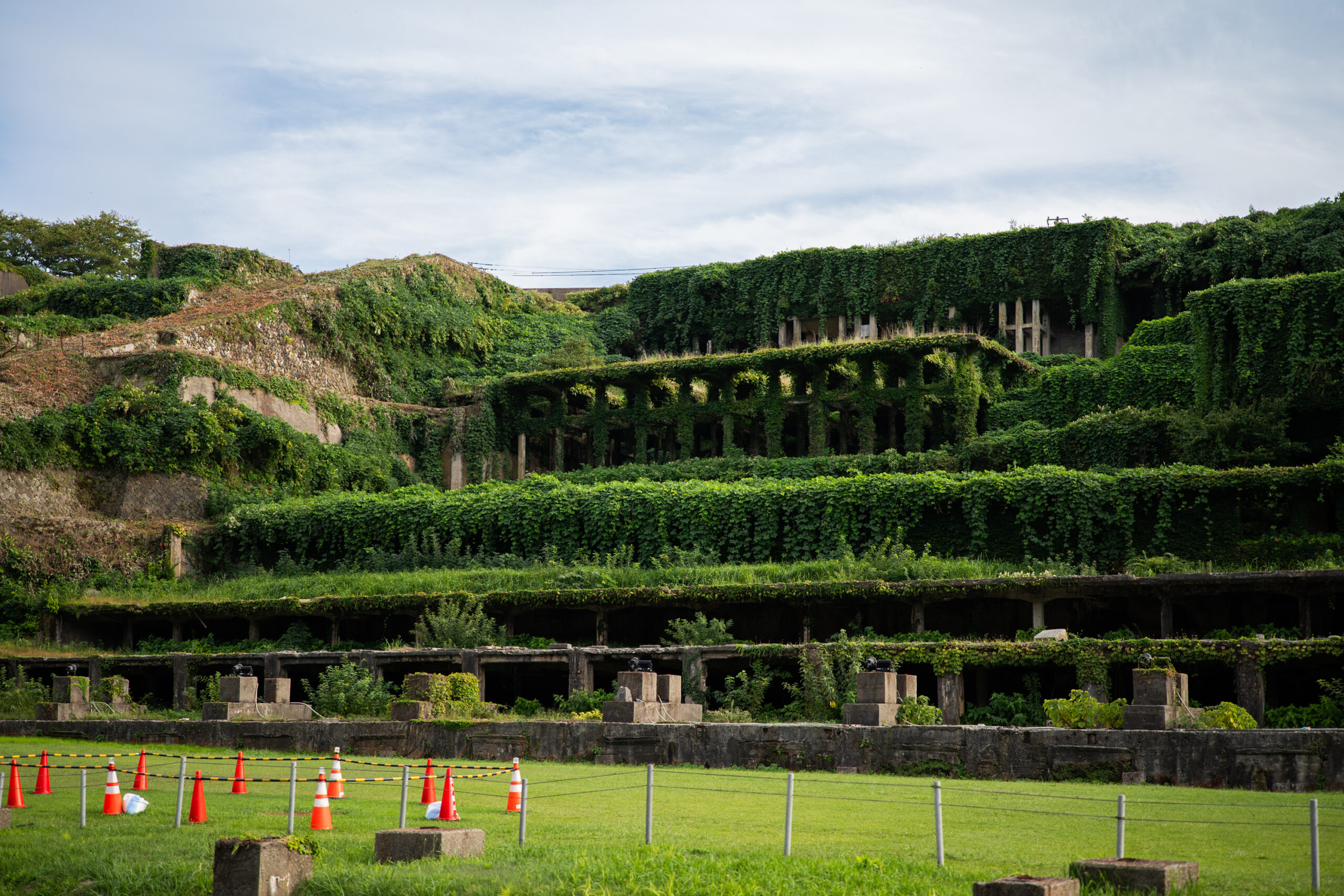
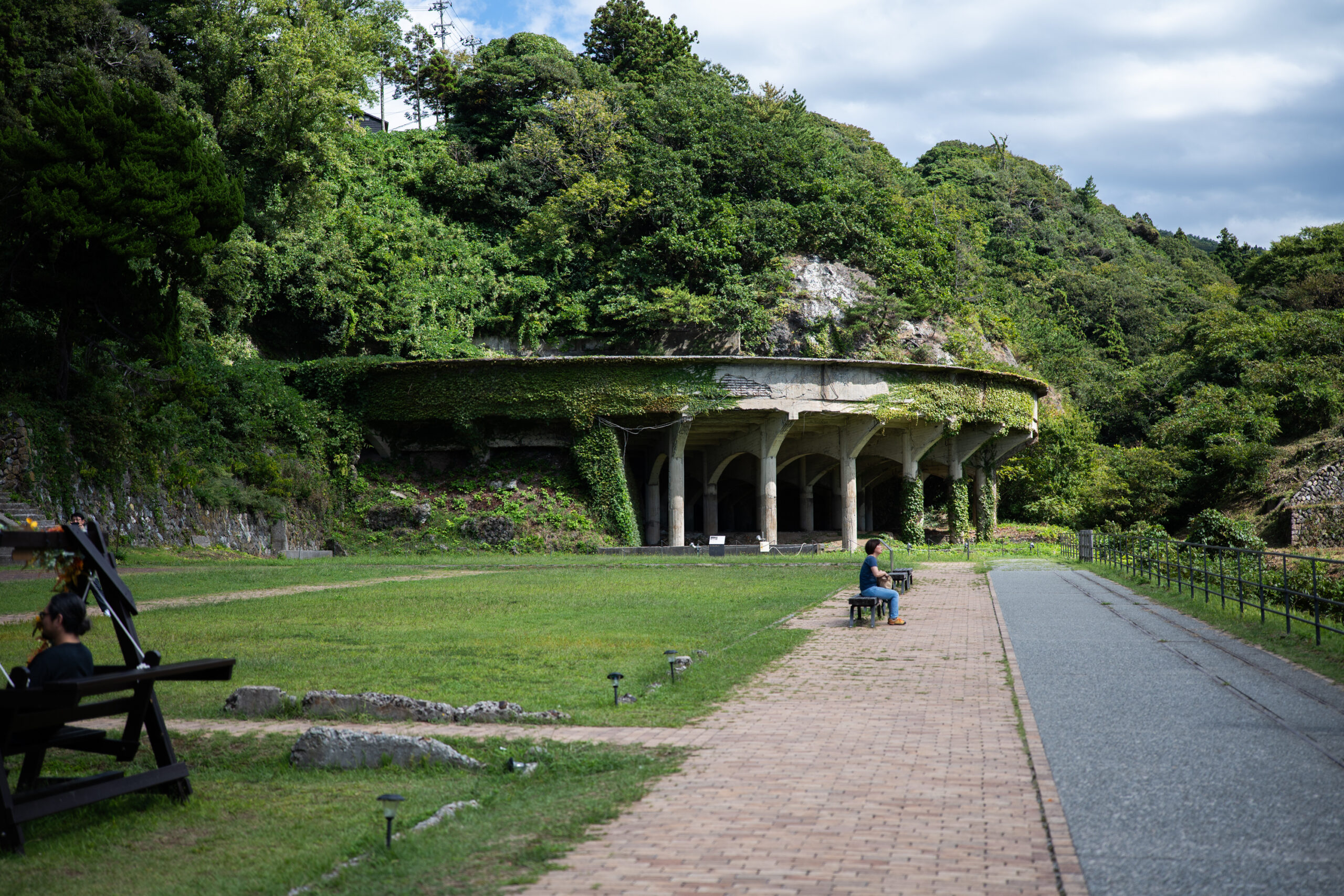
The decommissioned mines and ruins of the flotation plant show that preservation of the mining heritage and the inherent beauty of ruins themselves can be enough to attract a large amount of tourists to the area, enough to power the economy of the island. The novelty of the site, however, is still apparent, as there has been a peak in tourism due to its recent UNESCO status. It is a novelty which Mr. Ishikawa noted during my interview with him: “Just as visitor numbers at the World Heritage Site of Iwami Ginzan dropped by half within a few years, attention should also be paid to how long the popularity of the Sado Gold Mine can be sustained, as well as to the extent of the company’s efforts—together with the local community of Sado City—in maintaining the facility through its ability to attract visitors, disseminate information, and provide financial resources.”
In Transition
Across these three landscapes, the afterlives of the communities once built around industry reveal separate efforts to regenerate them. Some are top-down; the billionaire-foundation-backed development of Naoshima, Teshima, and Inujima into the now famous “art islands.” Some are more grassroots in a way, as communities try and struggle to reinvent themselves in order to survive, like in Ishikari’s former coal towns. Some work to preserve their heritage as-is with help from international backing and diversifying tourist activities, like in Sado Island.
Studying, visiting, and engaging these three sites from a research point of view has helped me gain a deeper understanding of how extractive landscapes influence the communities that are built by them, as well as gain a deeper view of rural Japan that I wasn’t able to get from living in Tokyo during my study abroad program and internship in years past. The relationship between industry and community is a topic I originally worked on for my undergraduate research thesis, albeit unable to visit the case study sites I had chosen. This opportunity finally allowed me to bridge the gap between research and field study, gaining new contacts that I otherwise would’ve been unable to get and grounding my understanding in first-hand experience.
Explore
Hiroshi Sugimoto lecture
Sugimoto, a renowned photographer, explains his turn toward architecture.
Inhotim: Contemporary Ruralities
Amanda Coen writes about the role of cultural institutions in rural development by looking at the Inhotim art center in Brumadinho, Brazil.
Andrew Freear and Rusty Smith, Rural Studio: The Challenges of Sustainable Rural Living
The architects and educators speak about their design and teaching work in rural Alabama.