
February 23, 2026
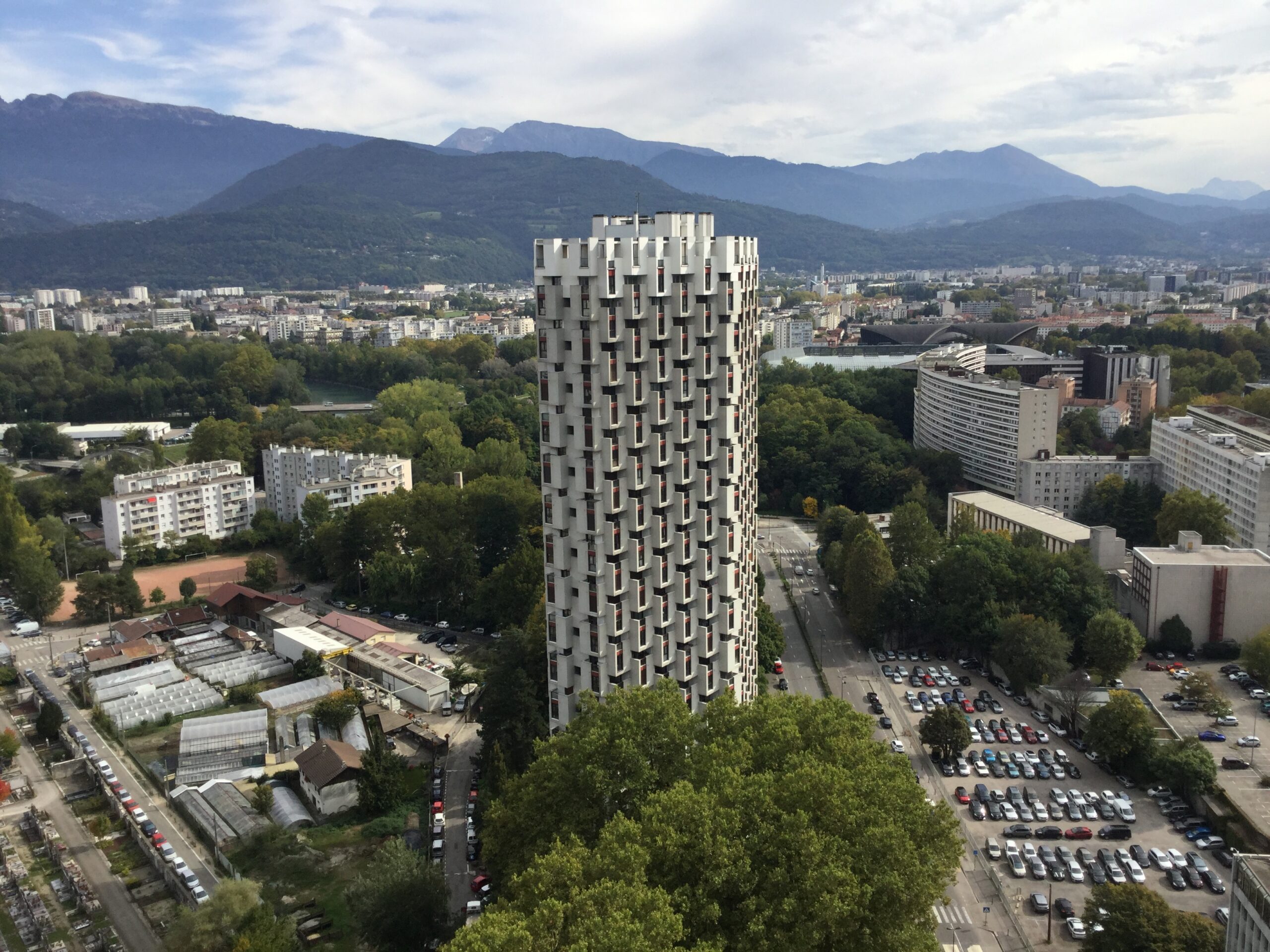
Les Trois Tours, designed by Roger Anger. Image credit: Priyanka Shah
The Deborah J. Norden Fund, a program of The Architectural League of New York, was established in 1995 in memory of architect and arts administrator Deborah Norden. Each year, the competition awards up to $5,000 in travel grants to students and recent graduates in the fields of architecture, architectural history, and urban studies.
Priyanka Shah received a 2017 award.
The best-kept secret about Paris is how much it rains there. I had imagined a stay with long walks from the center where I was staying to Roger Anger’s buildings, most of which are located towards the outer limits of Paris proper. Having only spent a few days in the city on previous trips, this time over the course of a month where I lived cheaply and ate well, I soon realized that my fantasy of walking across Paris and sitting plein air nearby with a sketch-book was not likely to be.
Anyhow, adopting a persona with Moleskine and pen was more a reflexive projection of what an Architect on his (almost always his) Grand Tour did rather than the type of recording or analysis that Roger Anger’s buildings called for. Unlike the galactic imagery of his masterplan for the experimental township of Auroville in southern India, Anger’s Paris buildings are iconic in their fabric, their skin, rather than the silhouettes they cut against the sky.
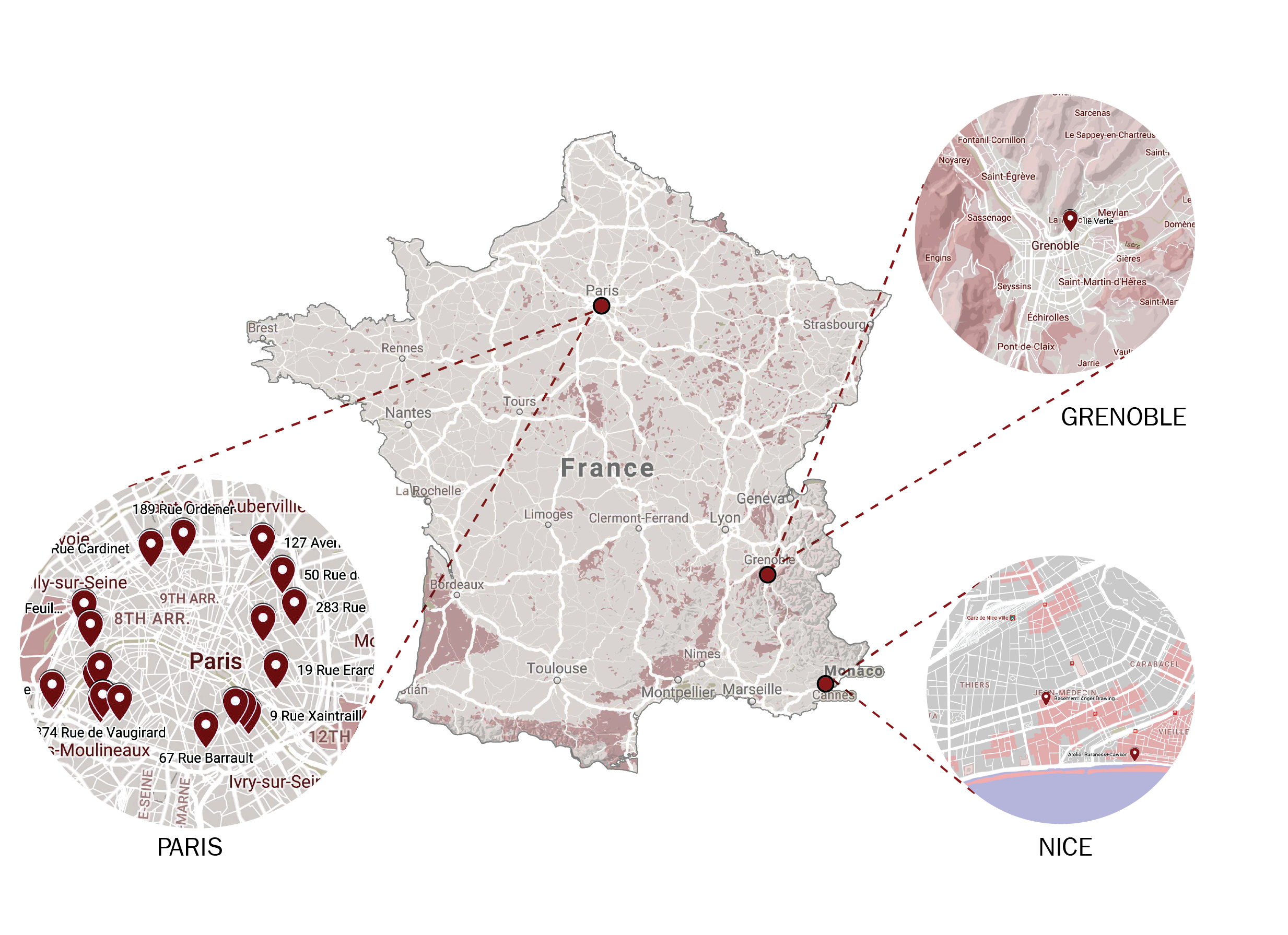
Places Visited: Map of Paris marking the locations of Roger Anger’s buildings. Grenoble where Anger’s most iconic project is located. Nice, where Anger’s archival drawings are stored. Image credit: Priyanka Shah
A quick glance at the map shows that Anger’s buildings are located away from the historic core but within the Peripherique, the ring road encircling the zone of what is known as Paris proper. Working primarily with developers of upscale apartments, Anger’s buildings are not in the Banlieues located beyond the city limits, but as modern buildings, they also did not infiltrate the historic core.
Roger Anger (1923-2008) was one of the most prolific architects in Paris during the 1950s and 1960s, yet his work remains relatively unknown among contemporary architects. Subsequently joined by Pierre Puccinelli and Mario Heymann, between the early 50s and early 60s. Anger’s practice was arguably one of the busiest studios in the city. At its peak, it comprised almost a hundred architects and assistants, and together they designed about as many buildings in Paris alone, not all of which were realized.
The second half of Anger’s career was spent mainly as chief architect of Auroville, an ambitious experimental city in Southern India. While his work on the masterplan of Auroville is well known, I encountered Anger’s buildings from the first half of his career only a few years ago, in the only book devoted to his work, Anupama Kundoo’s Roger Anger: Research on Beauty. I was immediately struck by the virtuosity of the geometrical variations on the facades of his residential buildings in France. Anger and his practice had achieved in the pre-computational era a depth and complexity of 3-dimensional articulation that is rarely seen in housing design even today.
While attention to a building’s envelope is, of course, de rigueur to architectural design, Anger and his partners were also working at a moment in history when modernist ideals had eschewed decorative expression in favor of “honest” facades that refrained from looking decorative. Anger’s entire oeuvre cuts across this professed purity of modernist architecture – upon seeing his buildings, it became apparent that Anger and his collaborators used the functional elements of housing design, loggias, planter beds at kitchen windows, balcony parapets, and most significantly, the orientation and shaping of interior spaces to craft intricate facade geometries. These are not superficial appliques, but building elevations that are integrally tied to the utilitarian elements of its architecture. It is form follows function done more imaginatively. Such an articulation of building skins is especially canny in the urban fabric of Paris. In a city of strictly controlled frontages, Anger et al’s projects offer a modern urban baroque interpretation of the ornate repetition of the facades of Hausmann’s Paris.
My purpose for this trip was to observe Anger’s buildings as part of the cityscape in Paris and to attempt to access the inside of the buildings to understand how the plan is affected by the façade geometries and vice versa.
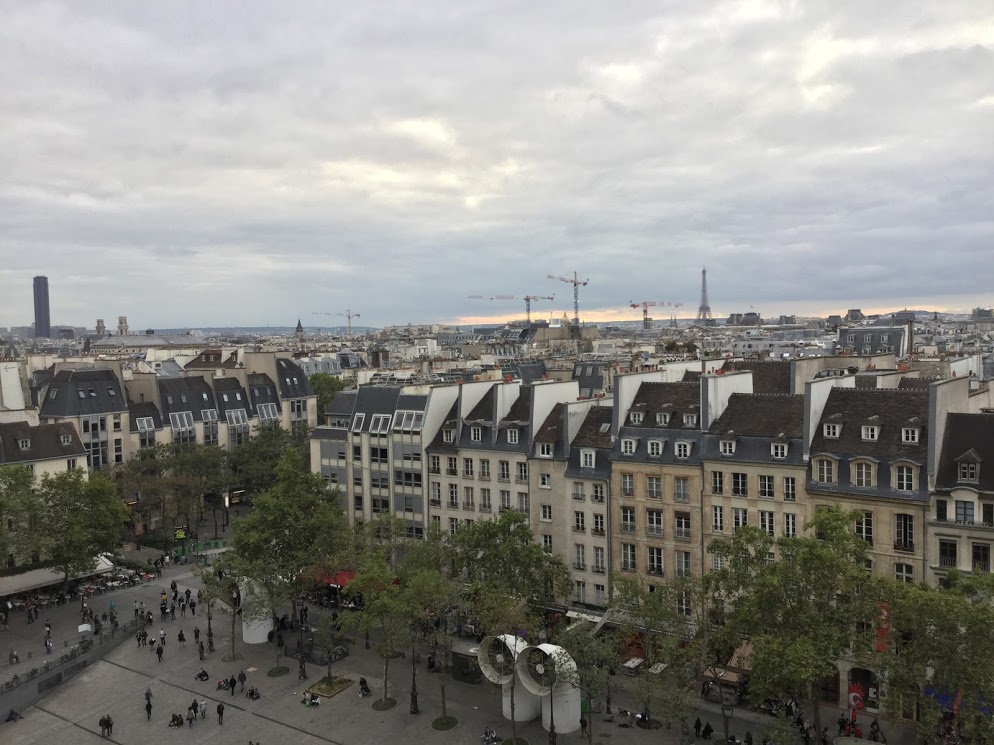
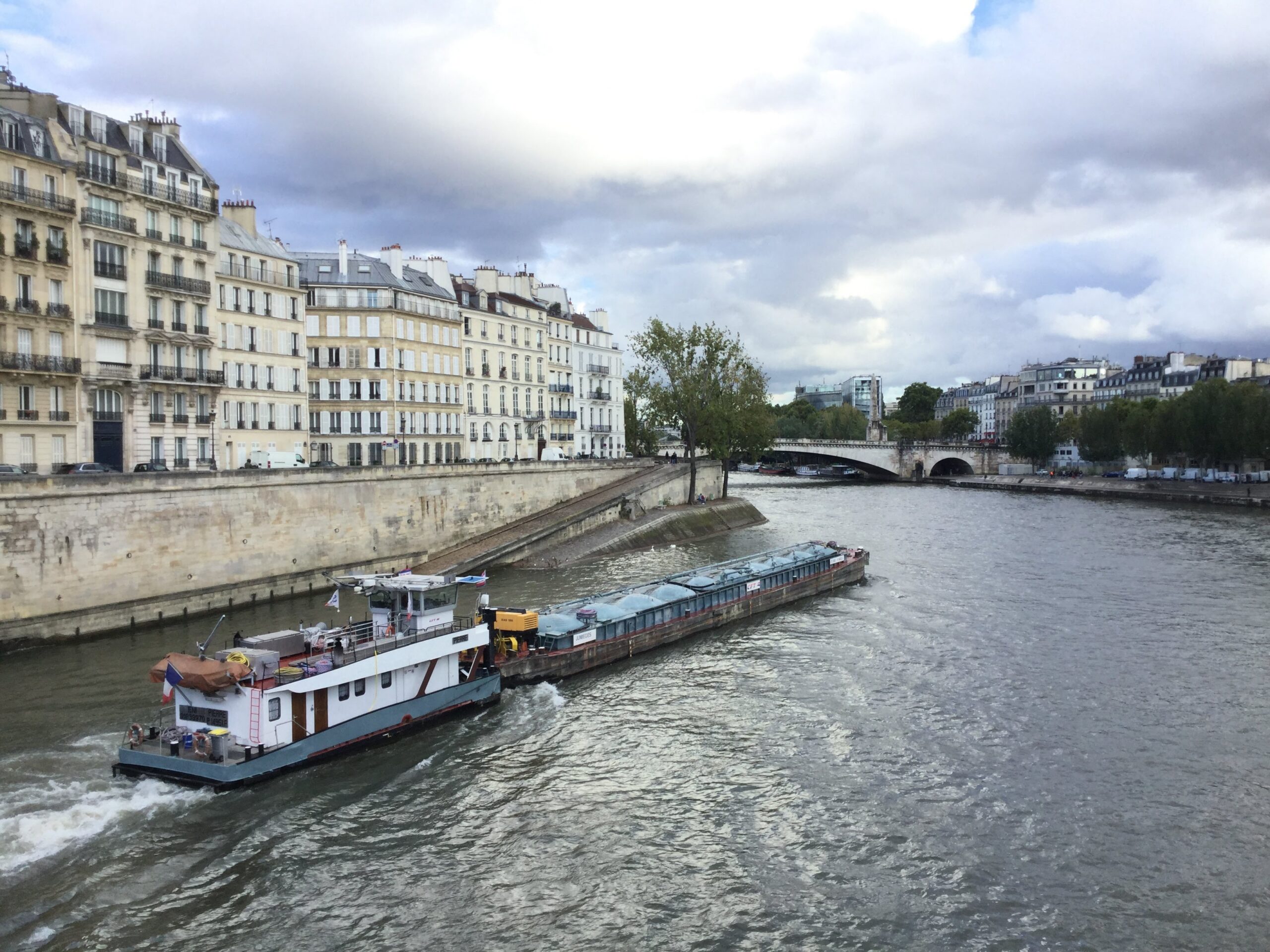
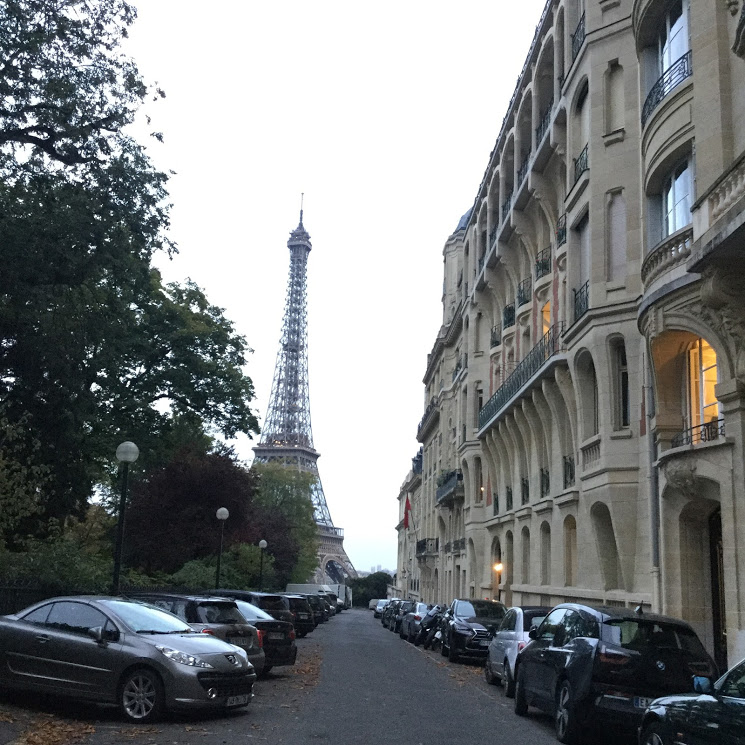
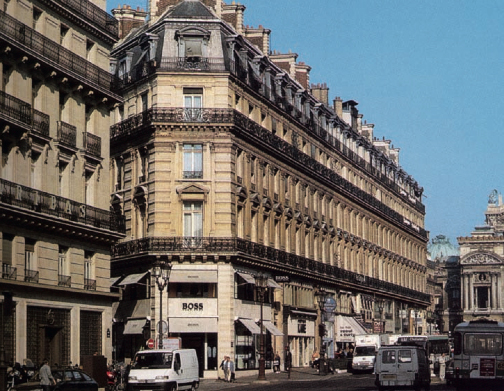
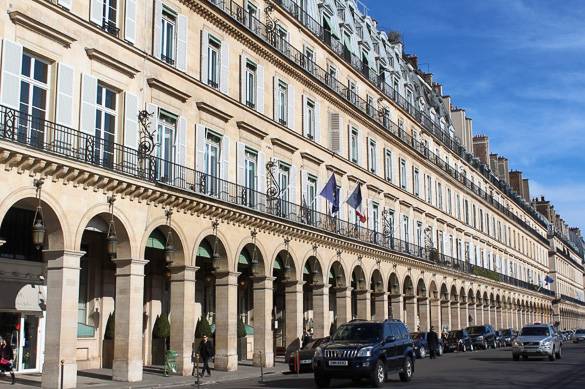
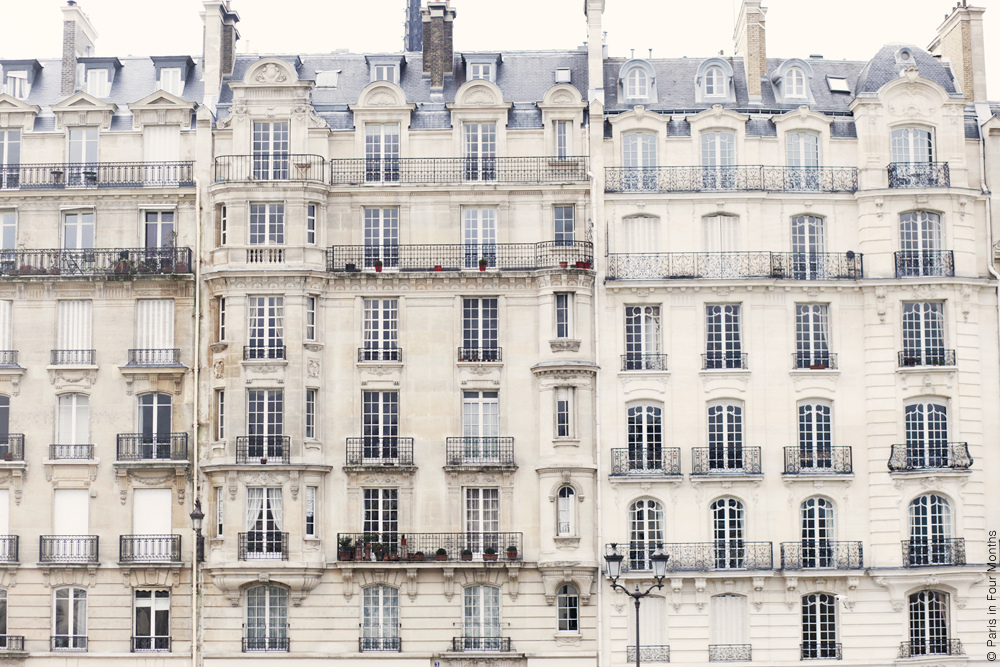
Paris, city of facades. Image credit: Priyanka Shah
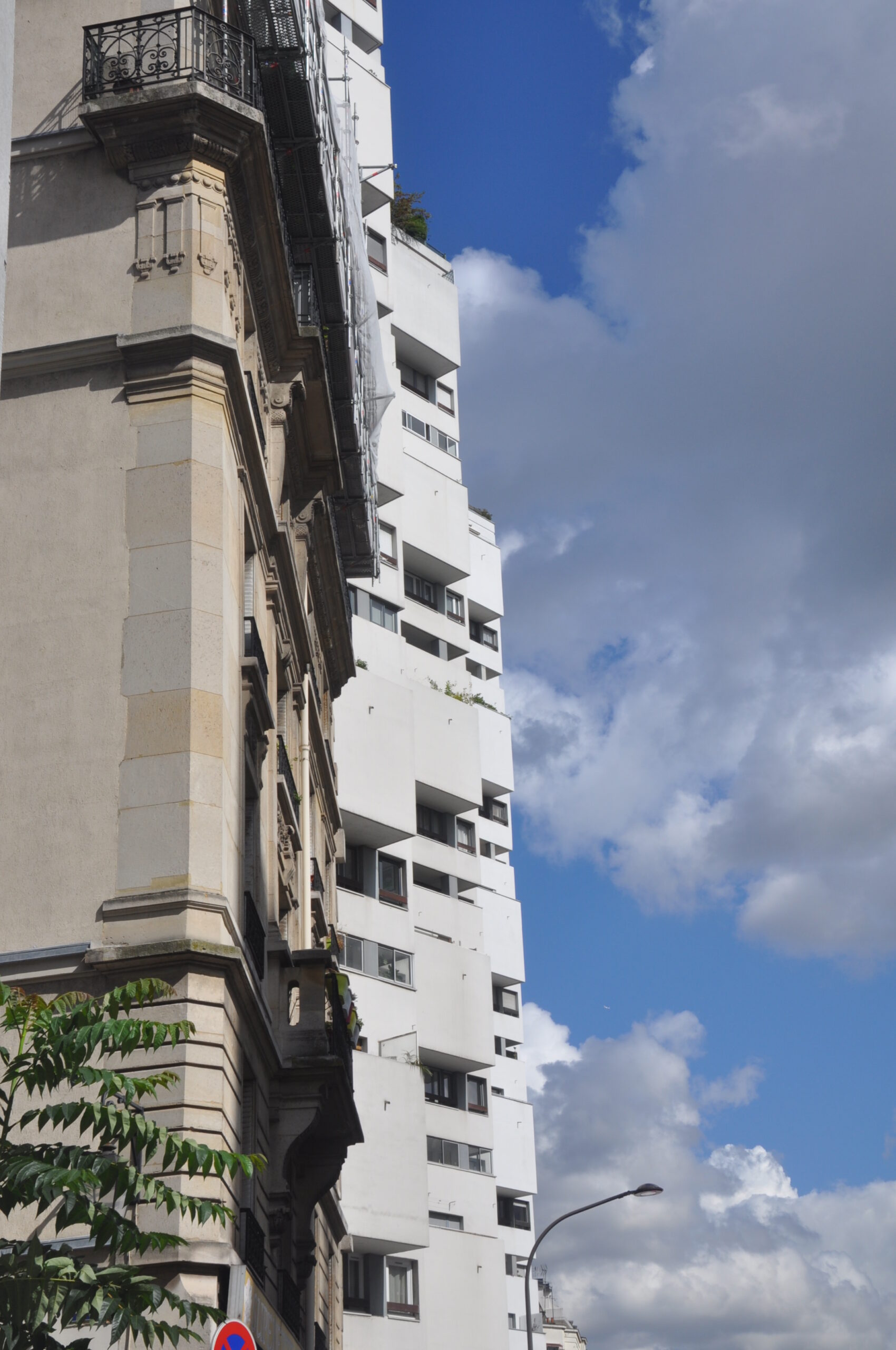
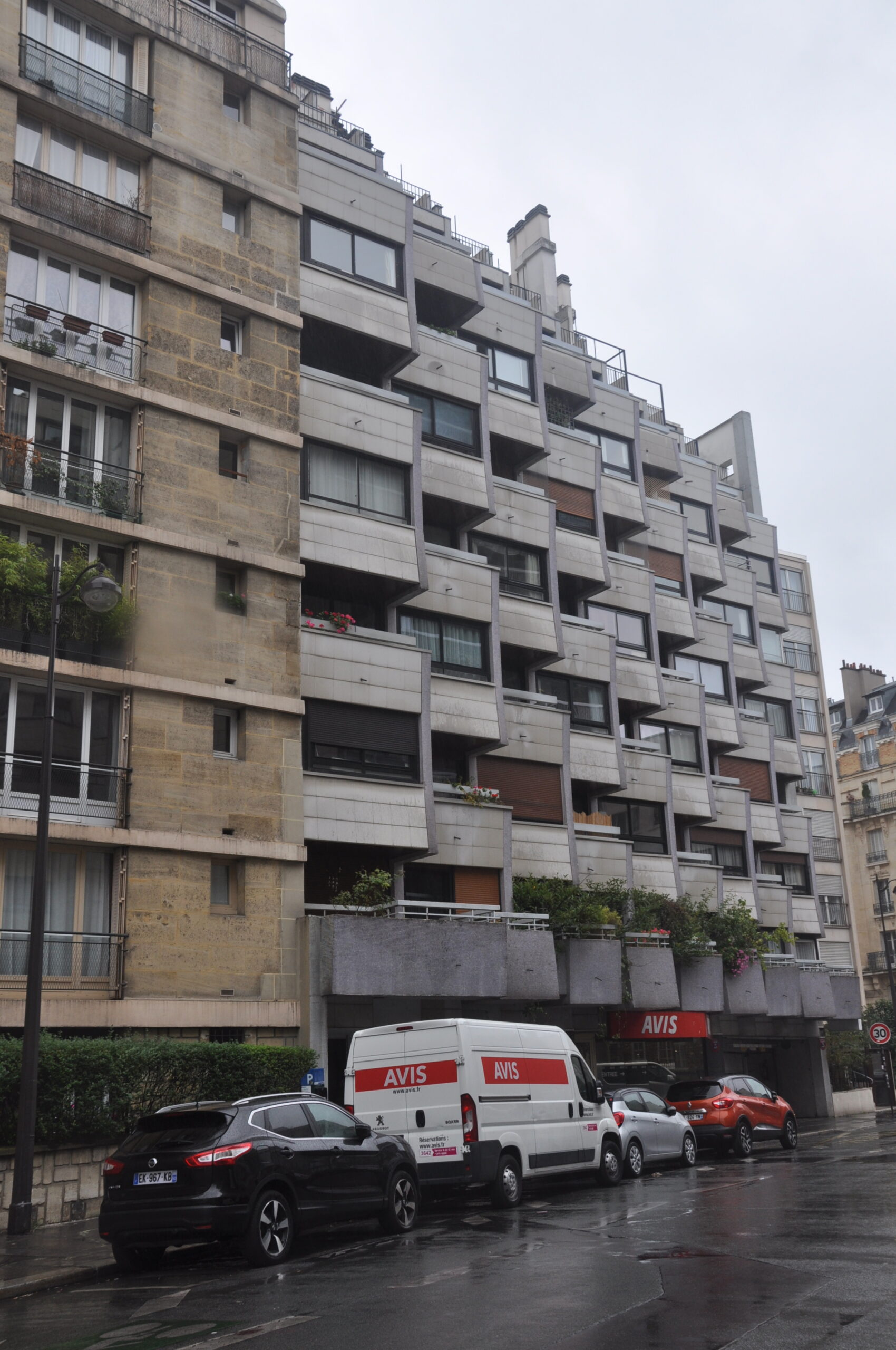
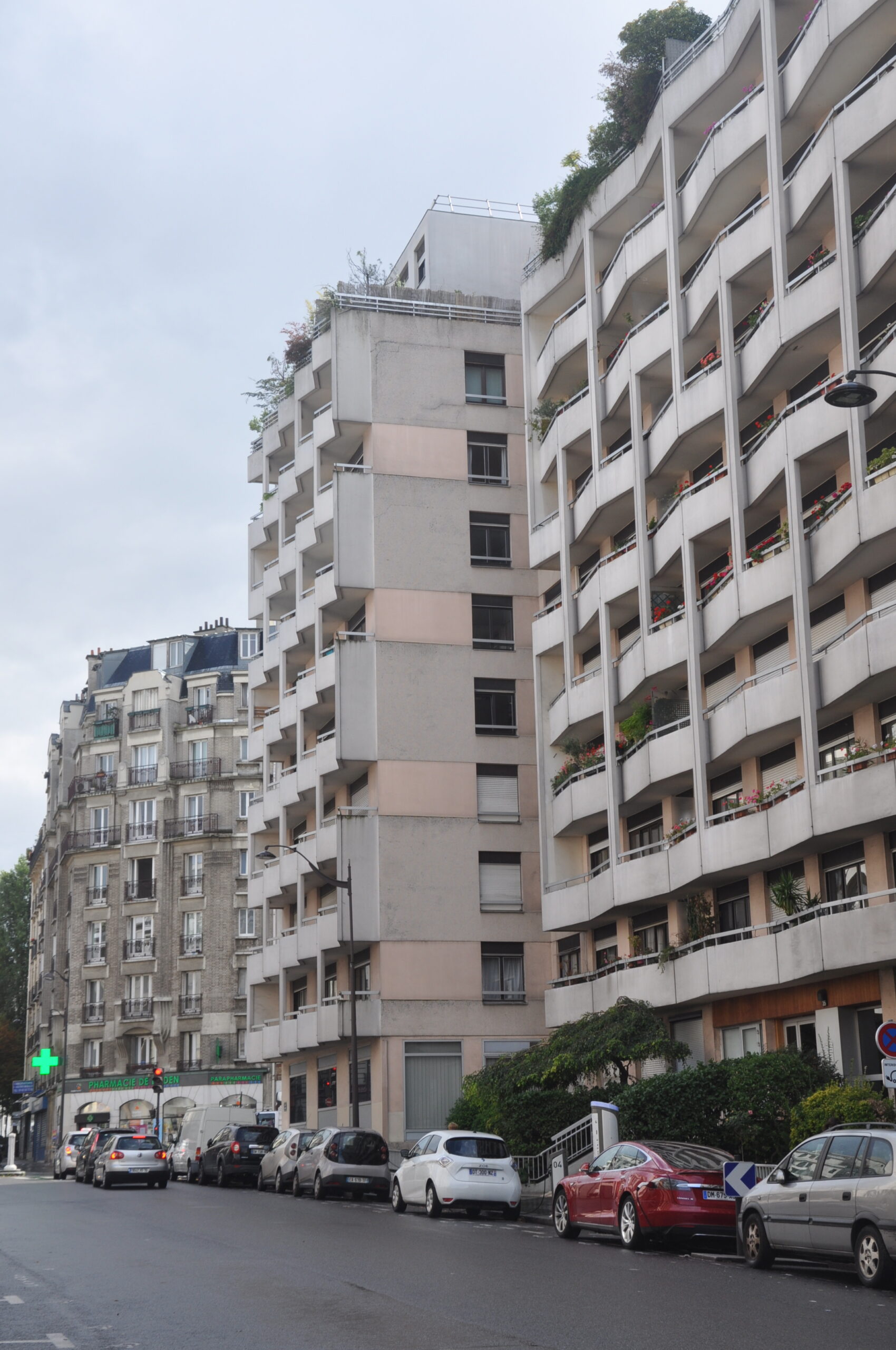
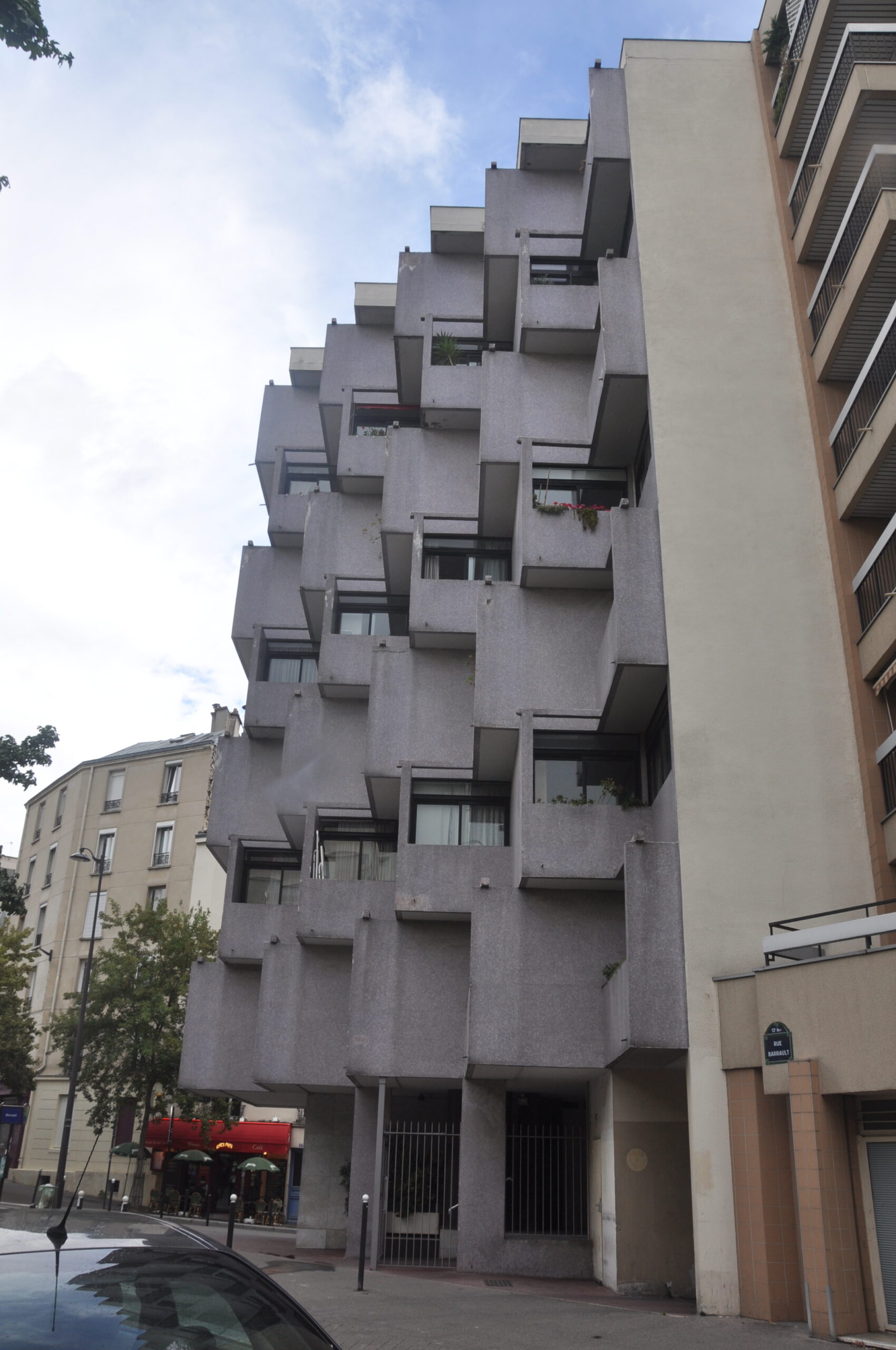
Halfway through my trip, I was fortunate to get access to Anger’s archival drawings. In the buildings I visited in Paris and Grenoble and the archival materials I found, I discovered a range of facade operations from thin surface folds or appliqué independent from interior spaces to the manipulation of loggias and the push-pull of volumes that affected the layout of the apartments within. When the buildings are seen collectively as a body of work, it becomes clear that Anger and his collaborators considered facade expression a key element of their design ethos. Even in buildings with presumably smaller budgets or site constraints, the facade elements, such as balcony parapets, are expressed with subtle angular folds, giving a distinctive look through economical design moves. The loggia is a key feature in the manipulation of these facades, generally staggered between odd and even floors, forming a checkerboard pattern on the building’s elevation.
The following matrix of typologies shows the categories of facade operations and the range of spatial depth influencing them:

Image credit: Priyanka Shah
As consistency and repetition are the driving requirements of multifamily housing, the floor plates are identical on all floors in the first and third typology and vary on alternating floors in the second one. The unit plans, therefore, are identical on alternating floors in all types. With the planning constraints in place, Anger and his team then create the facade play by shifting the loggia in a checkerboard pattern such that from floor to floor it swaps between bedrooms or biases to one or another side of a living space. Still, if this is all they were doing, we would see a simple checked pattern, but the overlay of interlocking parapets, awnings, and planter-beds on a basic checkerboard background creates complex tessellations that are boggling at first sight. The animation in the next section demonstrates the layer of the facade described here.
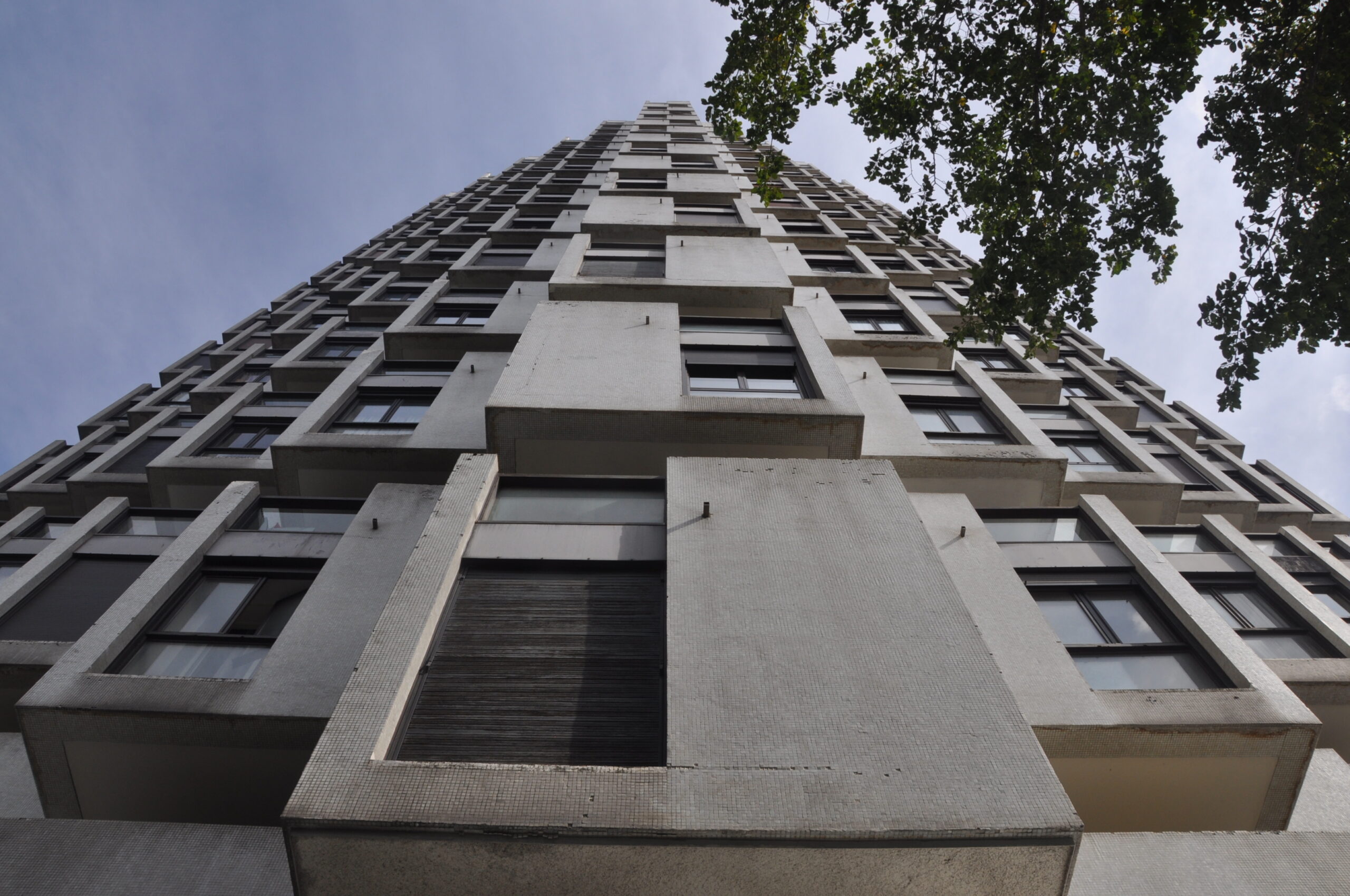
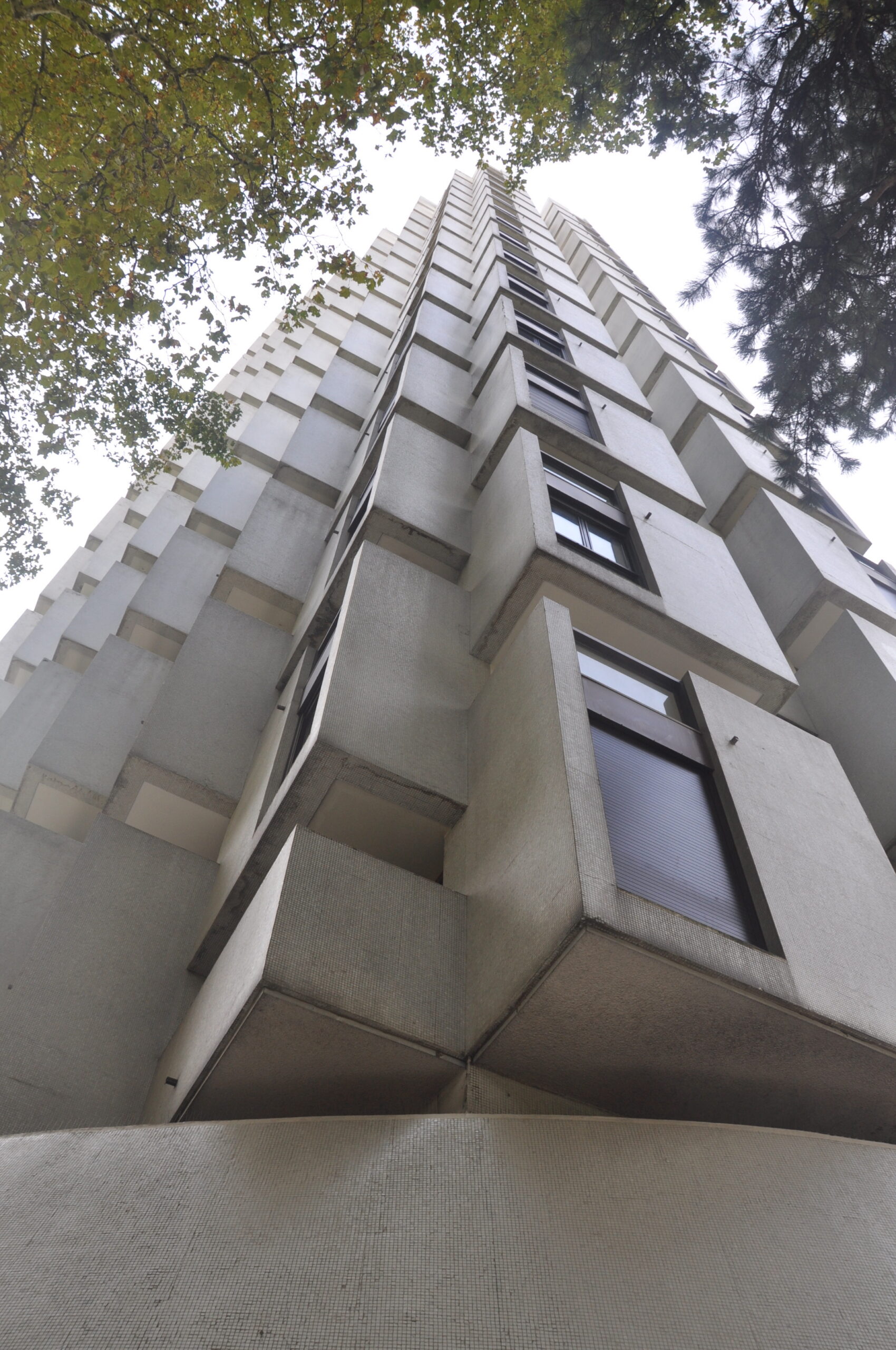
The crowning achievement of Anger’s French career sits not in Paris but in the town of Grenoble, close to the Italian border, where Anger, Pucinelli, and their collaborators built apartment towers. While the Paris buildings were inserted in a dense urban fabric, the Grenoble project, embodying the prevailing urban planning trend of the time, placed towers in a park. Named for mountain ranges and peaks in the surrounding Dauphine and Graian Alps, a trio of identical buildings, Vercors, Belledonne, and Mont Blanc, rise to 98 feet and are not only taller than any apartment building in Paris today or 1968 when they were completed, but these towers were the tallest buildings in Europe. Unencumbered by adjacencies and site constraints, the Trois Tours (the three towers) are the purest expression of Anger’s residential oeuvre. Based on a rhomboid plan and anchored by a centrally placed elevator core, the towers rise as monumental filigree against a backdrop of the Alpine landscape.
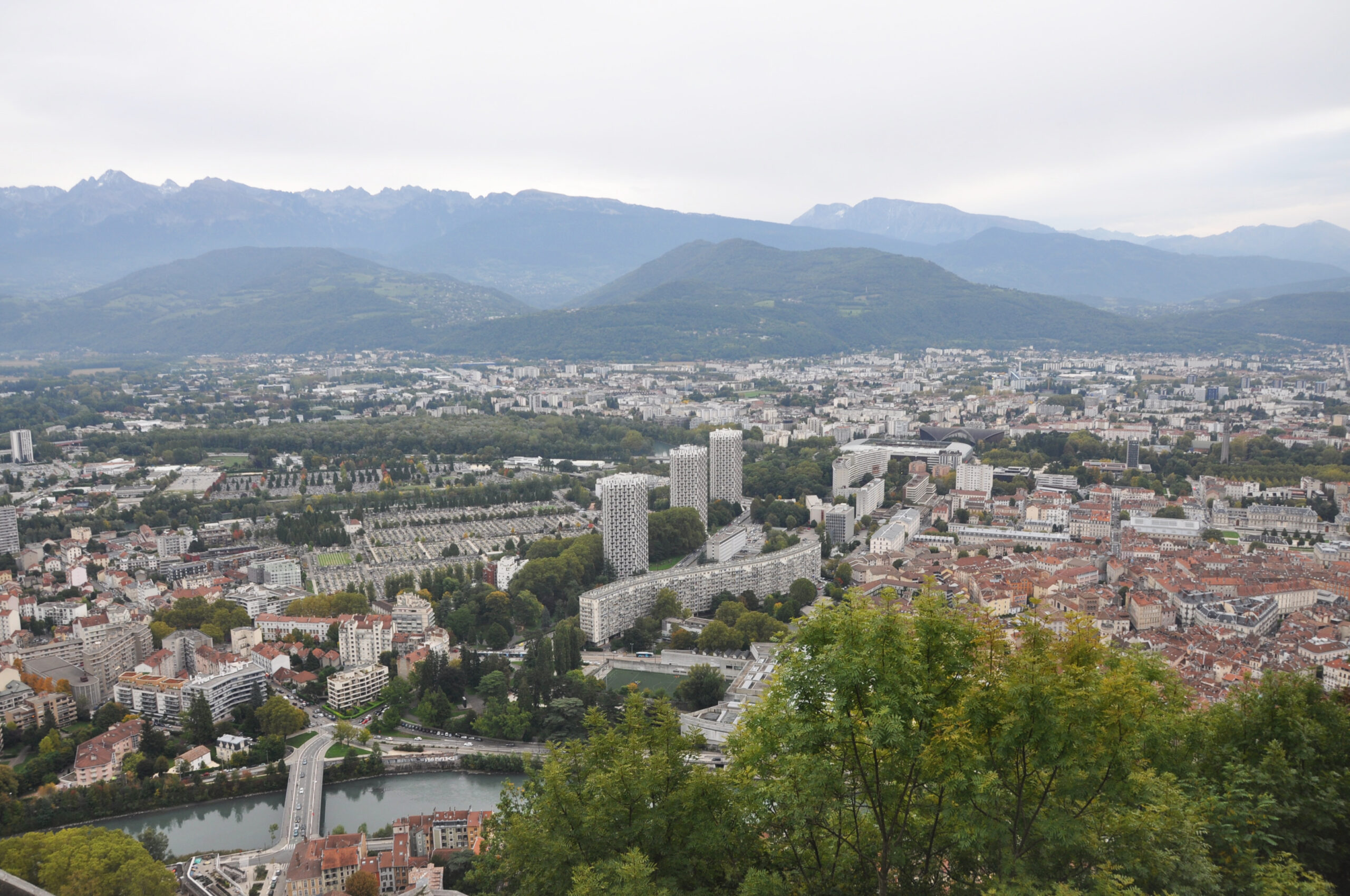
Les Trois Tours from the Fort de la Bastille in Grenoble. Image credit: Priyanka Shah
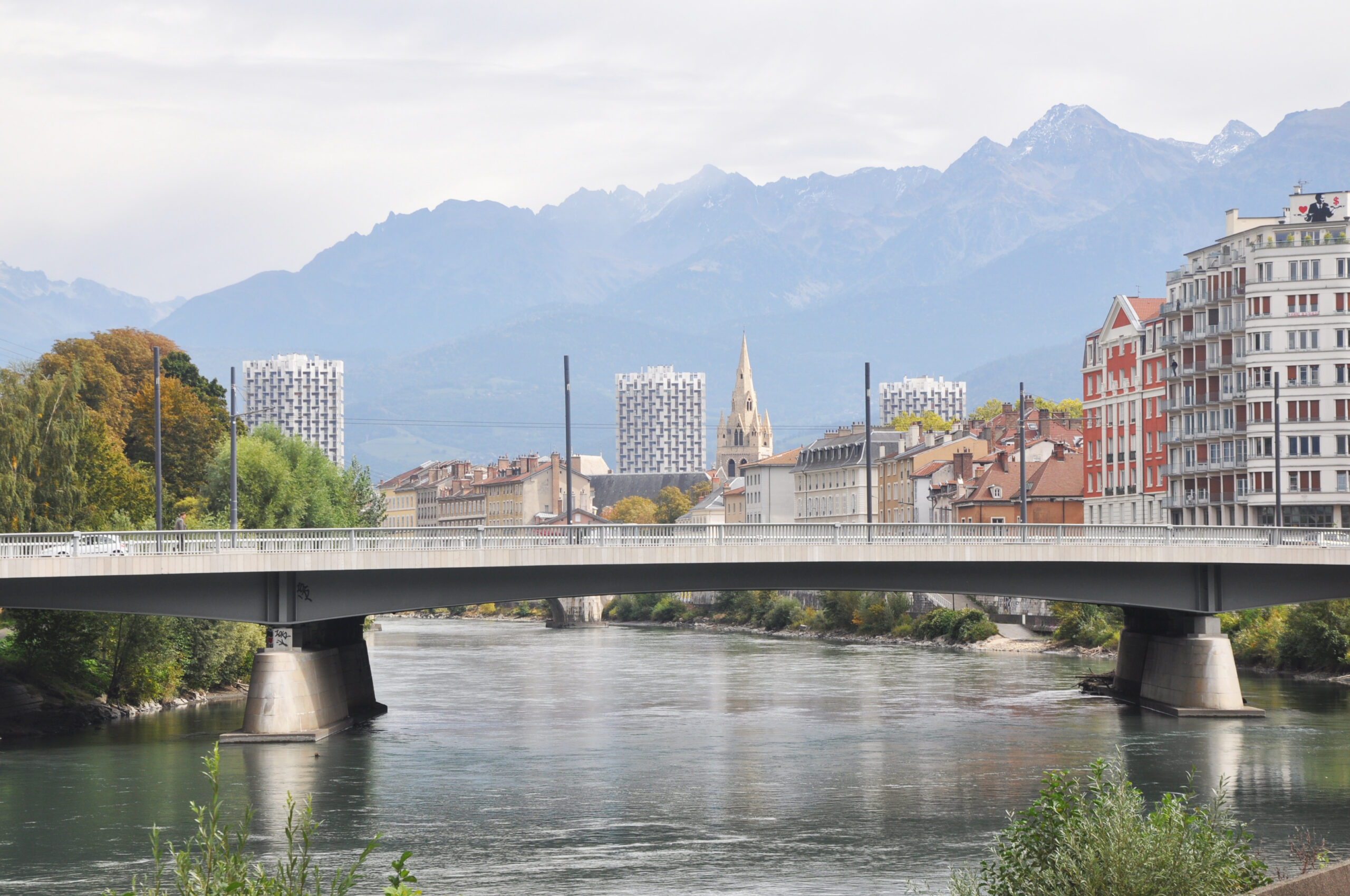
Les Trois Tours from across the river Isère, against the Western Alps In Grenoble. Image credit: Priyanka Shah
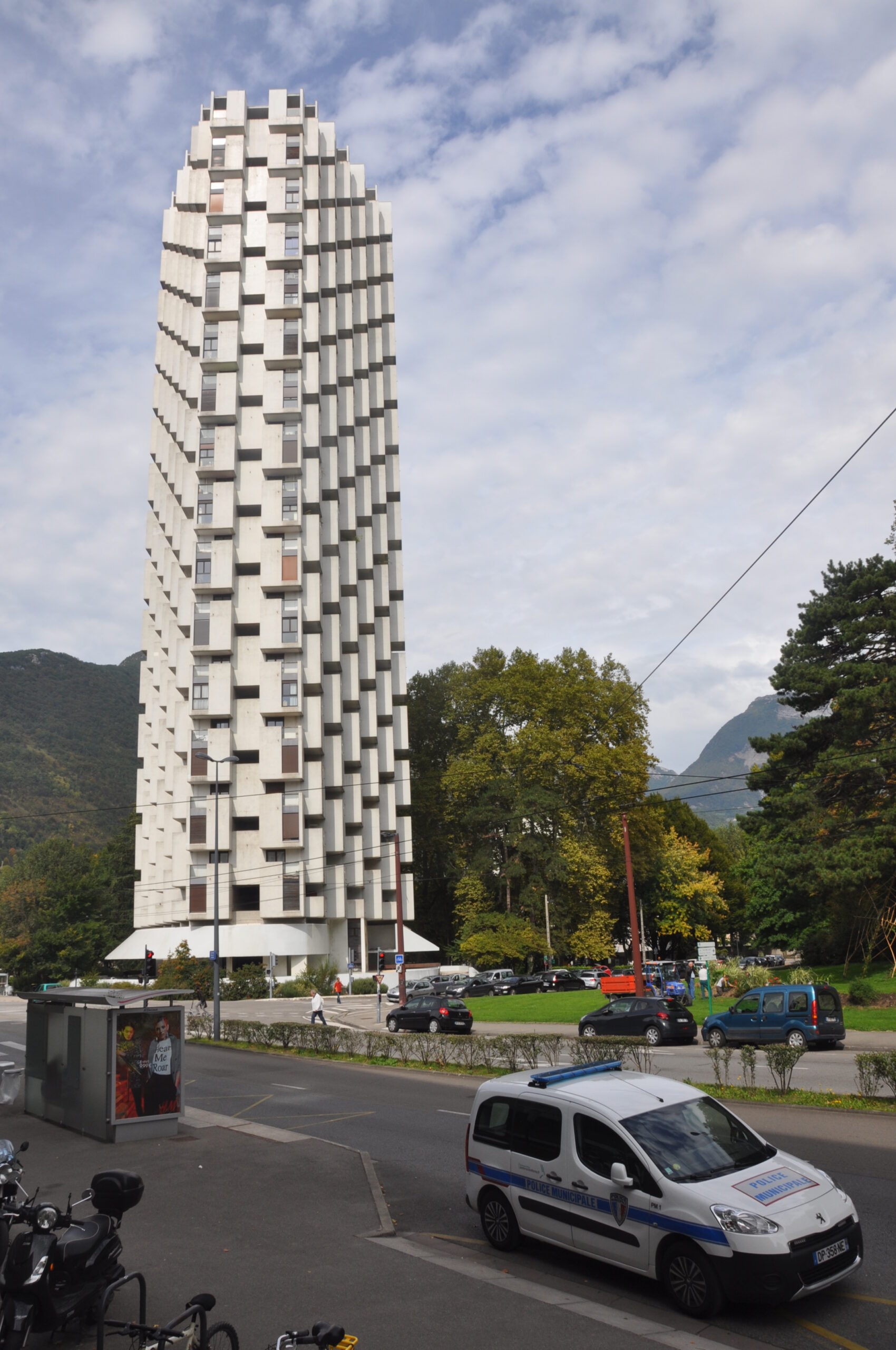
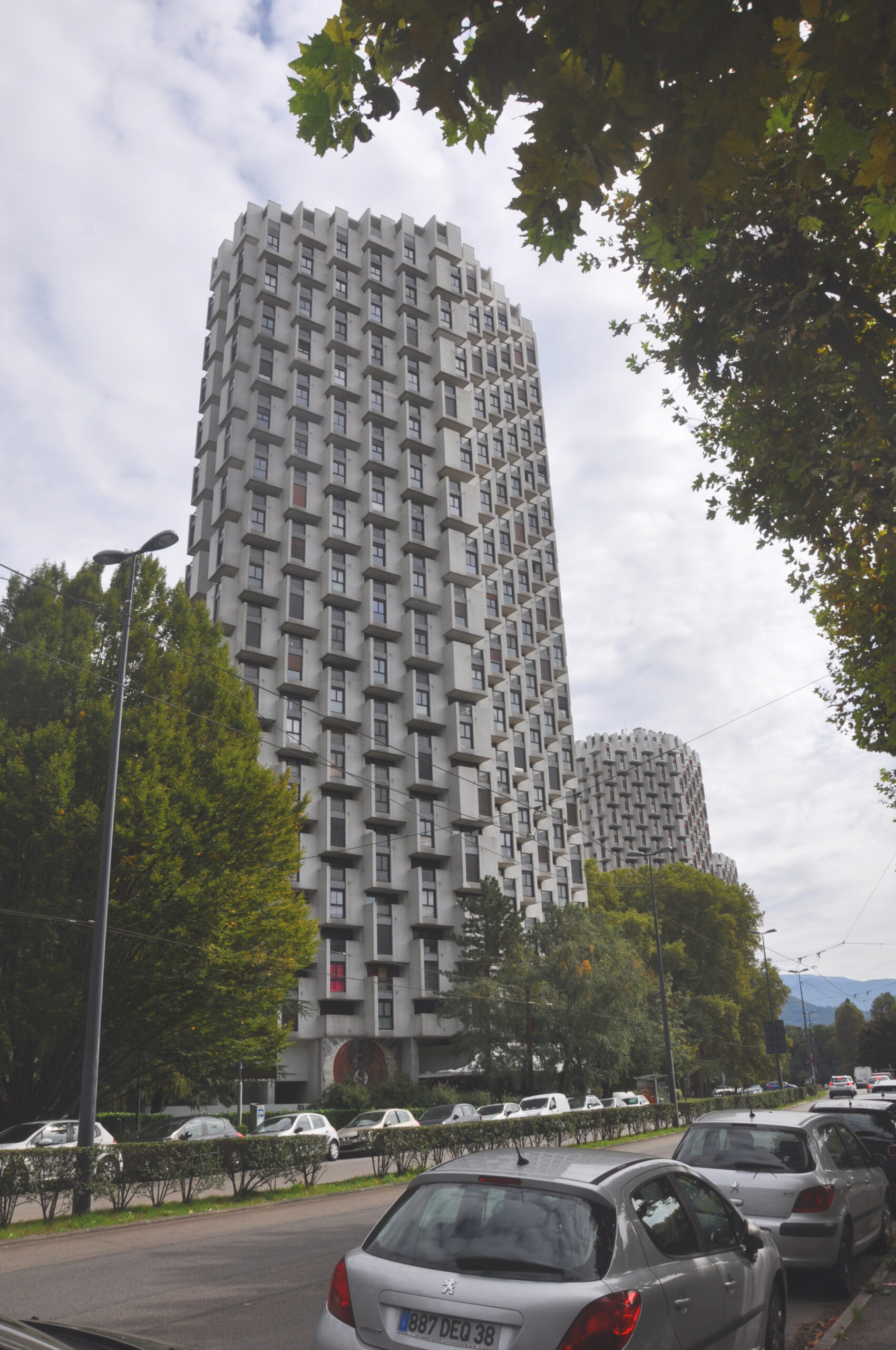
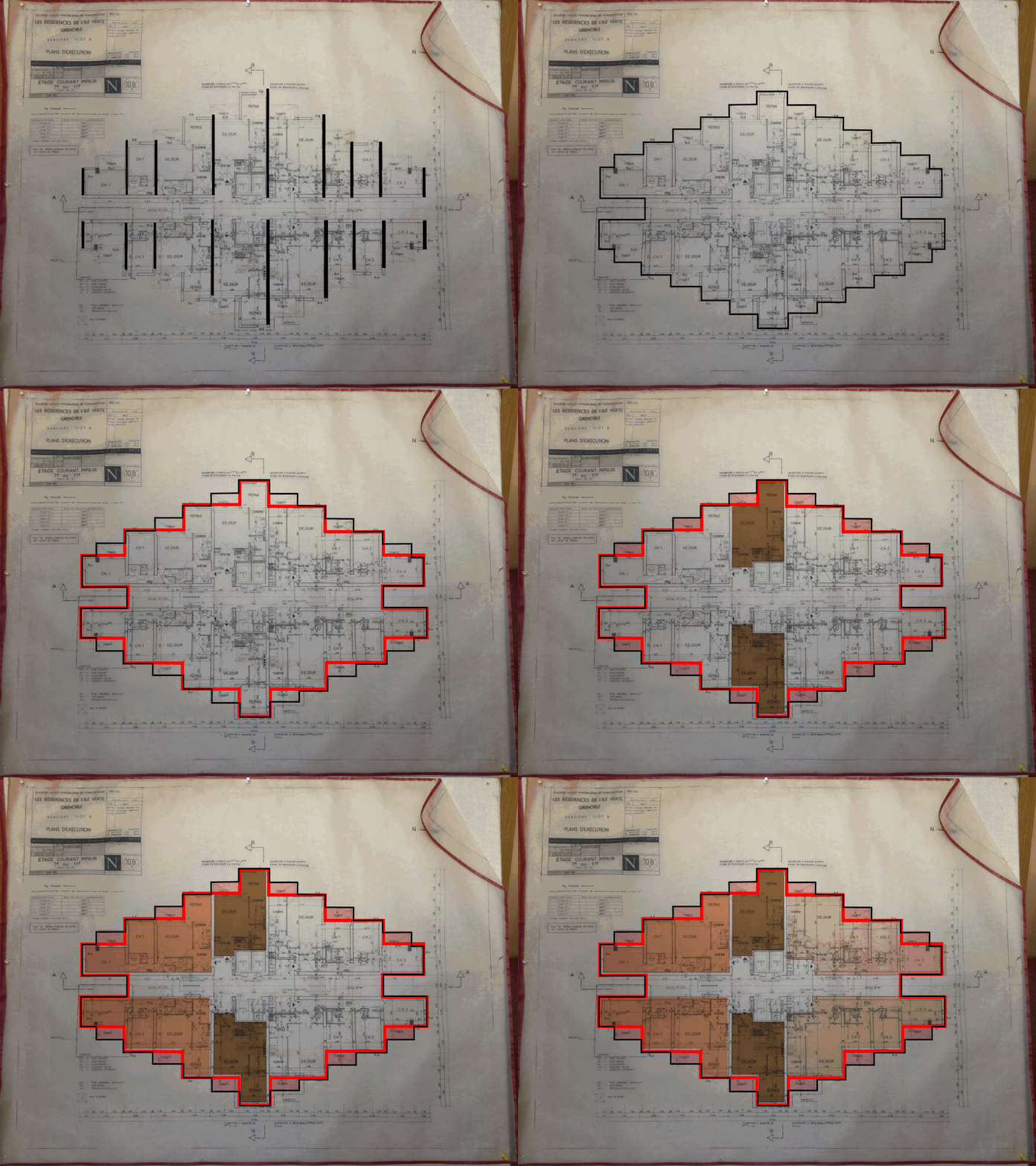
Les Trois Tours articulation of facade, loggia, and interior spaces. Image credit: Roger Anger Archives. Animation by Priyanka Shah
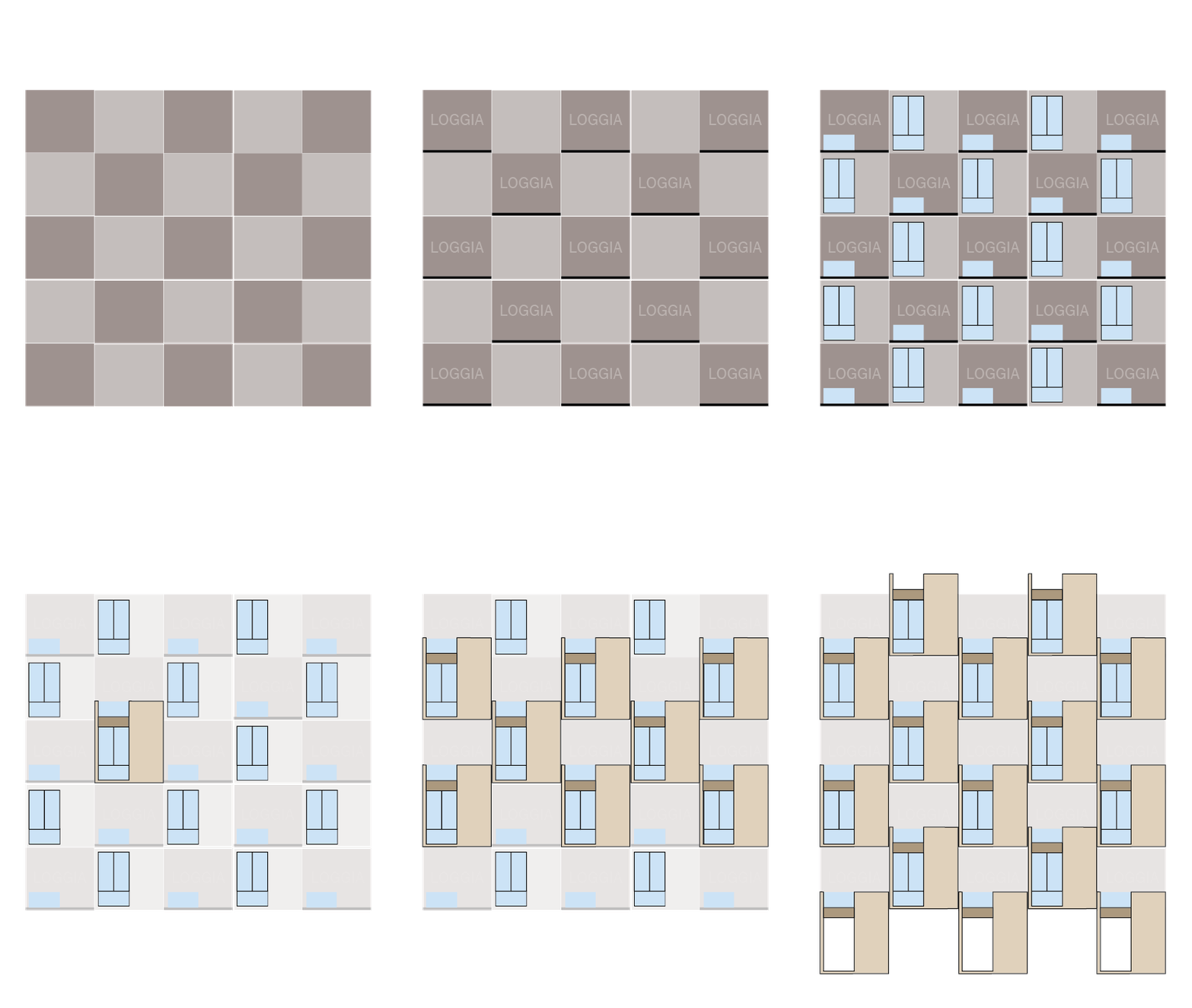
Les Trois Tours facade, layering of elements. Image credit: Priyanka Shah
The Lobbies
Where from a distance Anger’s facade geometries catch the eye, upon approaching and entering the buildings, the lobbies are a surprise, almost wholly in contrast to the hyper-geometric skins. Variously sculpted, curvaceous, and with lively patterns and elements, the lobbies have a whimsy that is a foil to the strict orthogonal elements of the facades.
On many of the most expressive lobbies, Anger and his team, particularly Pierre Pucinelli, collaborated with L’Œuf centre d’études, a multidisciplinary French design collective that was founded in 1963 and active until the early 1990s. It comprised architects, sculptors, designers, graphic designers, and mosaicists who crafted the lobbies, particularly at the Trois Tours in Grenoble, and 35 Avenue Paul Doumer as projects unto themselves. We see intricate mosaics, custom sculptures, and organic forms that treat the building’s entry space and its interface with the street as a moment for public art.
When I first saw images of Anger’s work before his move to India, I was surprised by how much of a departure his subsequent aesthetic in Auroville was from his work in France. In the lobbies, however, we can see the link between this earlier phase and his designs in India. The meticulous crafting, the shapely and playful forms heavily influenced by the L’Oeuf collective, contained in the lobby spaces in France space seem to have later found their milieu in the Auroville experiment at a monumental scale.
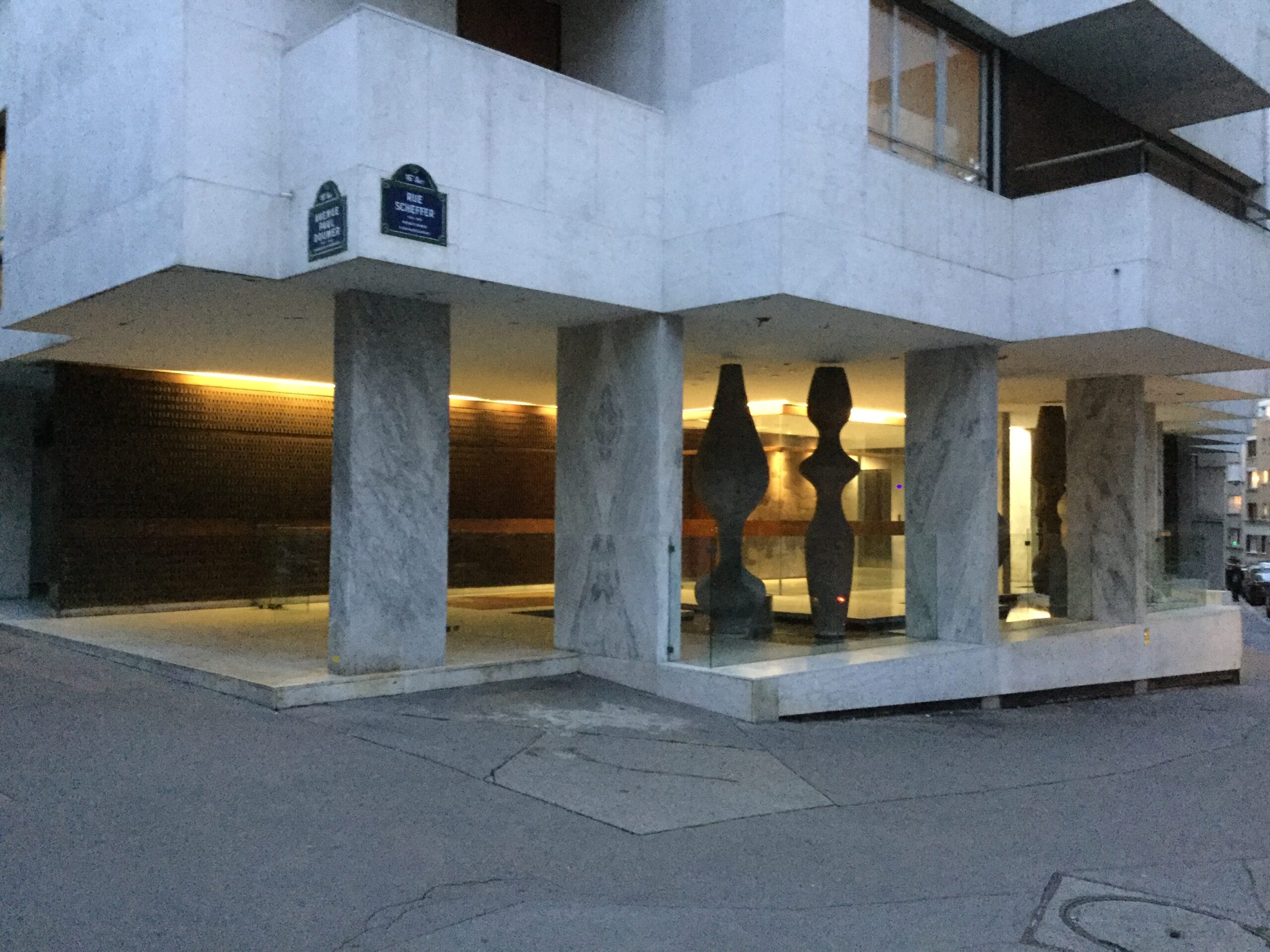
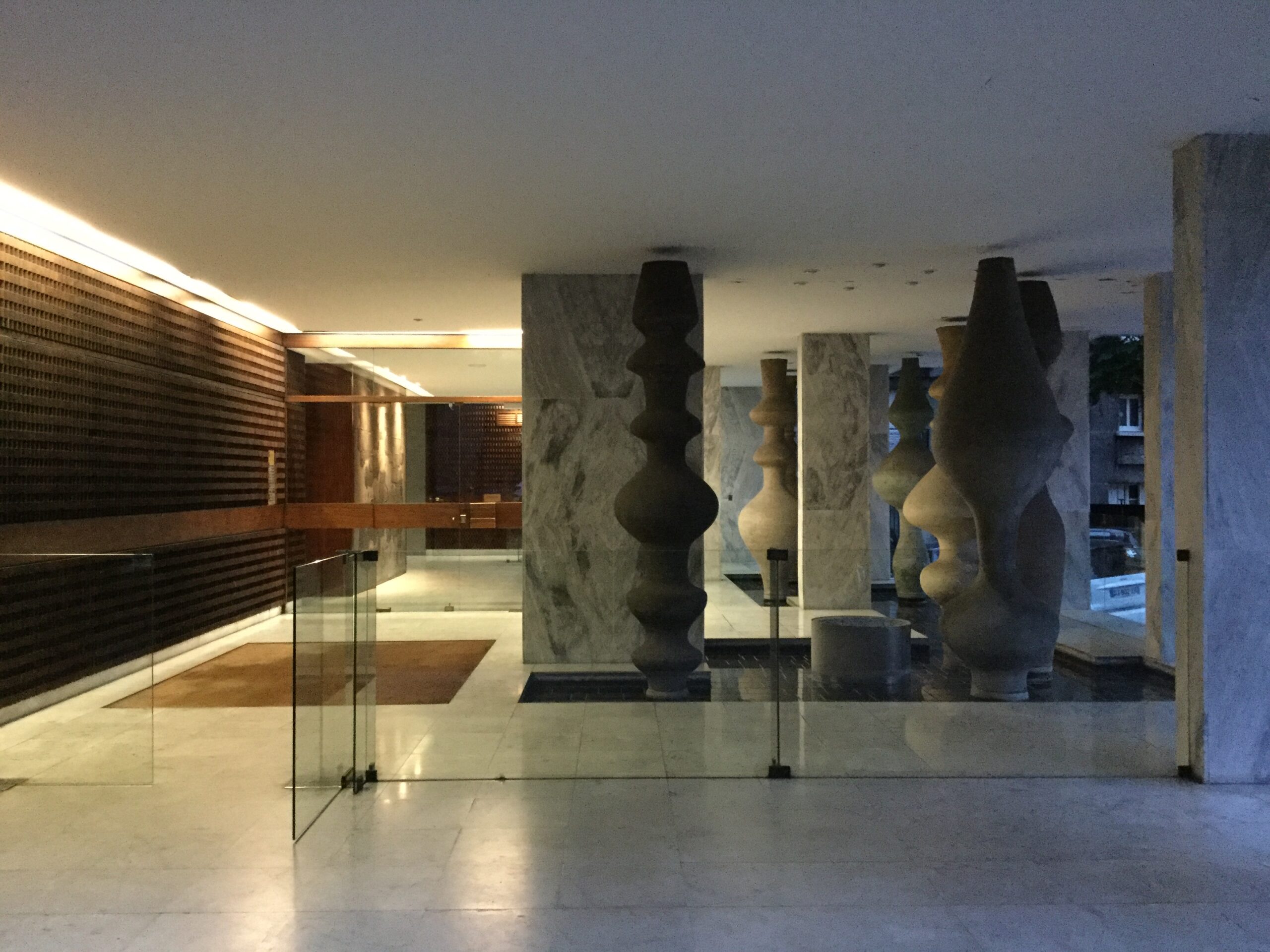
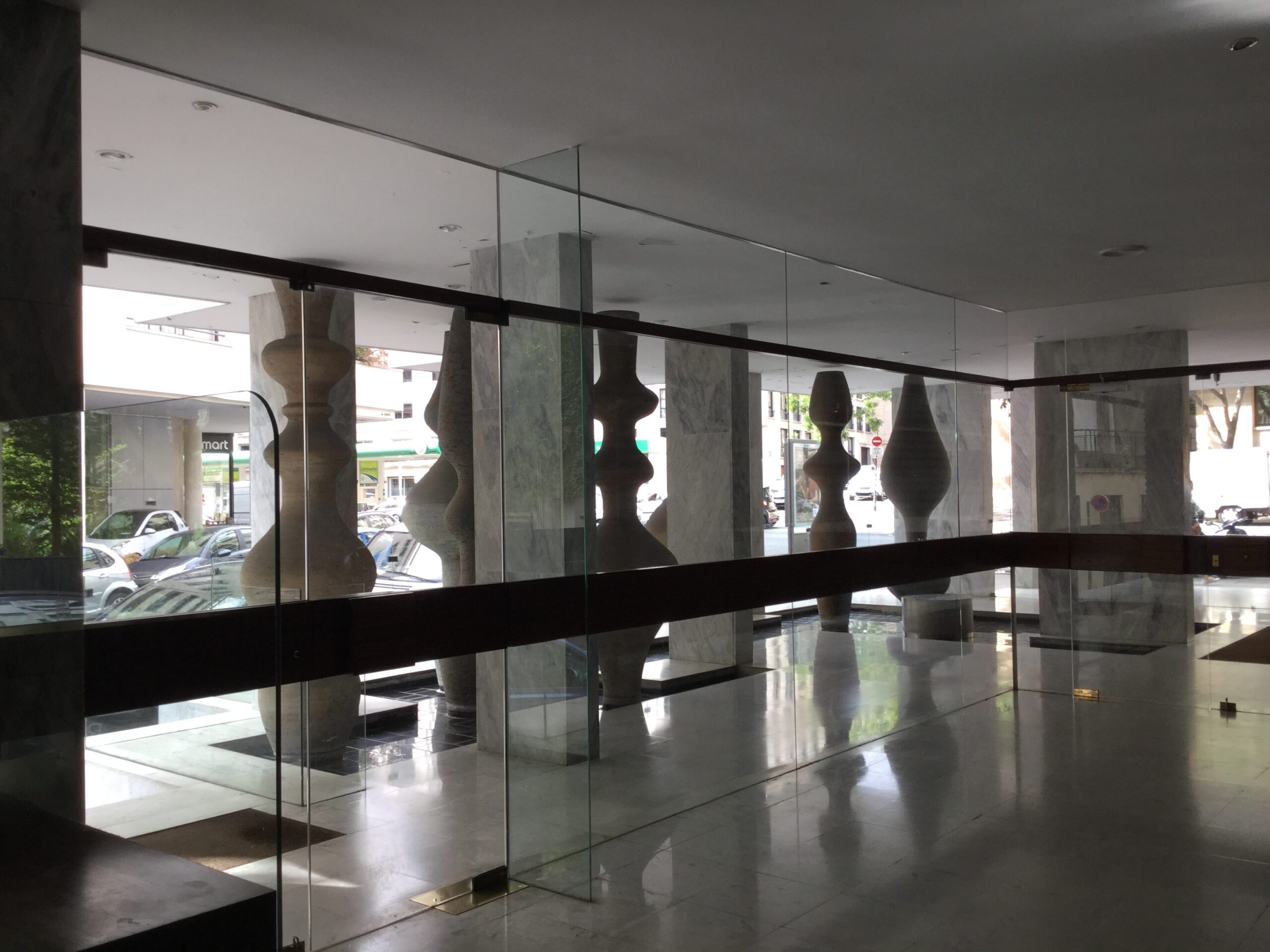
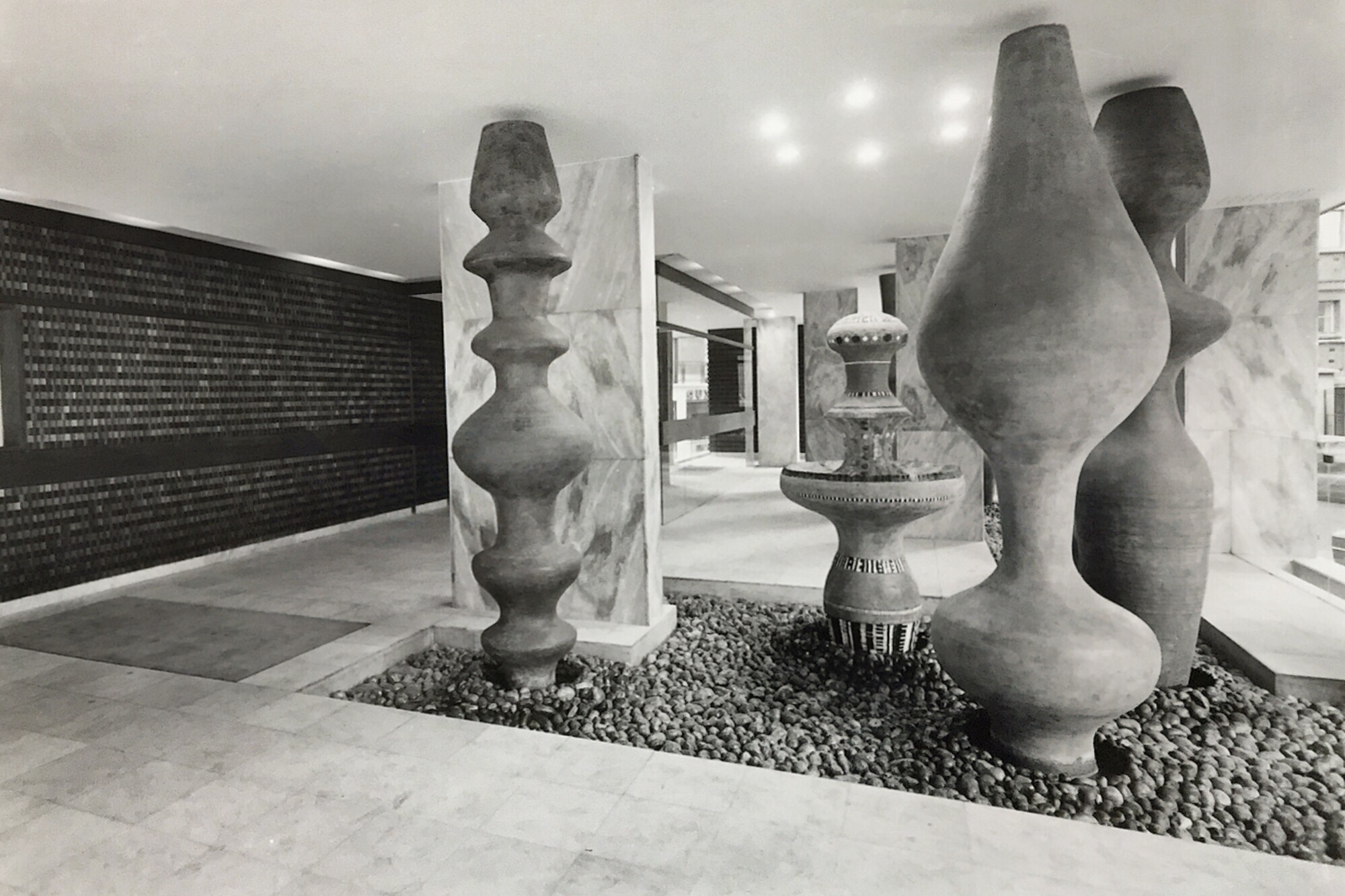
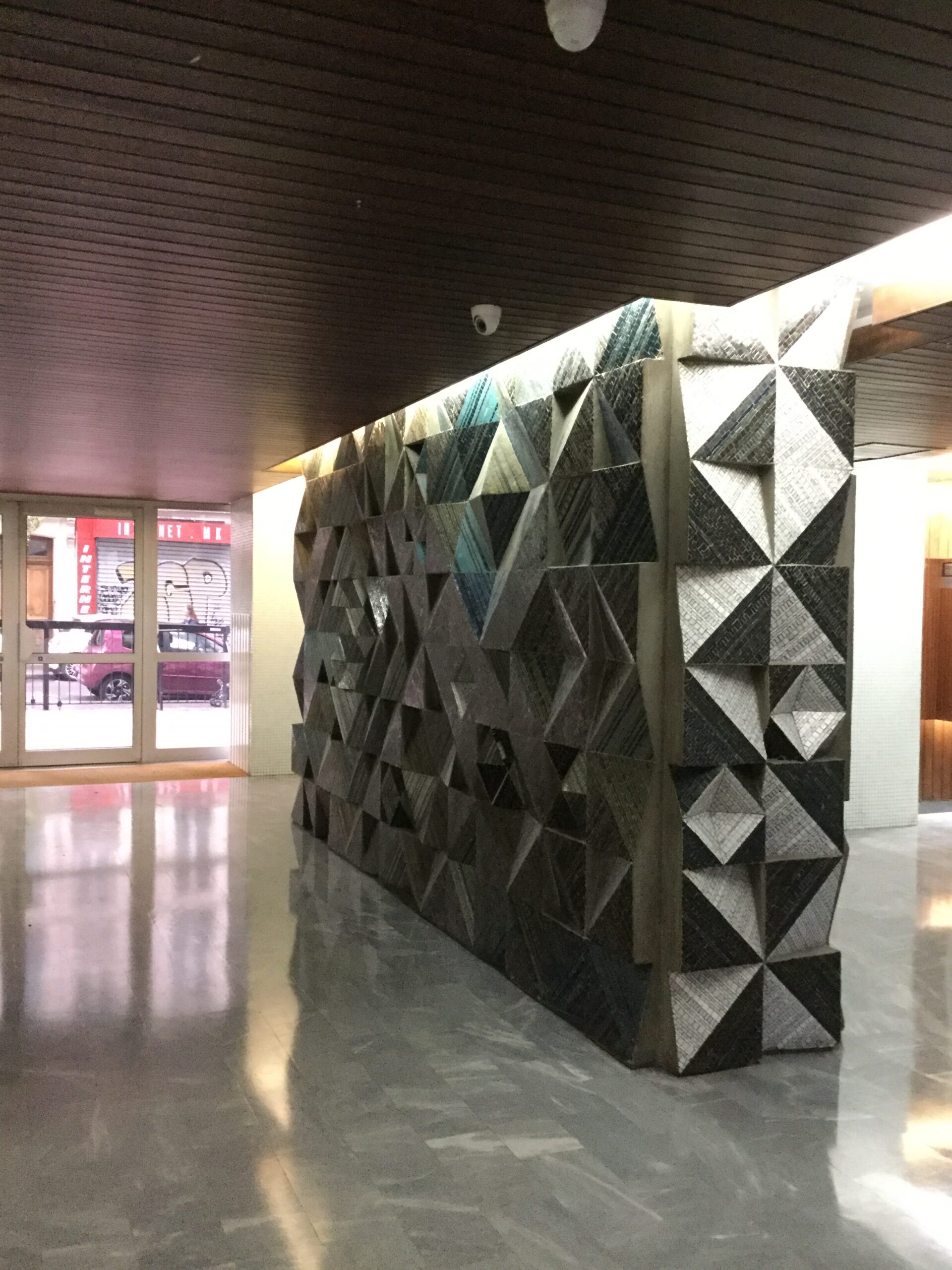
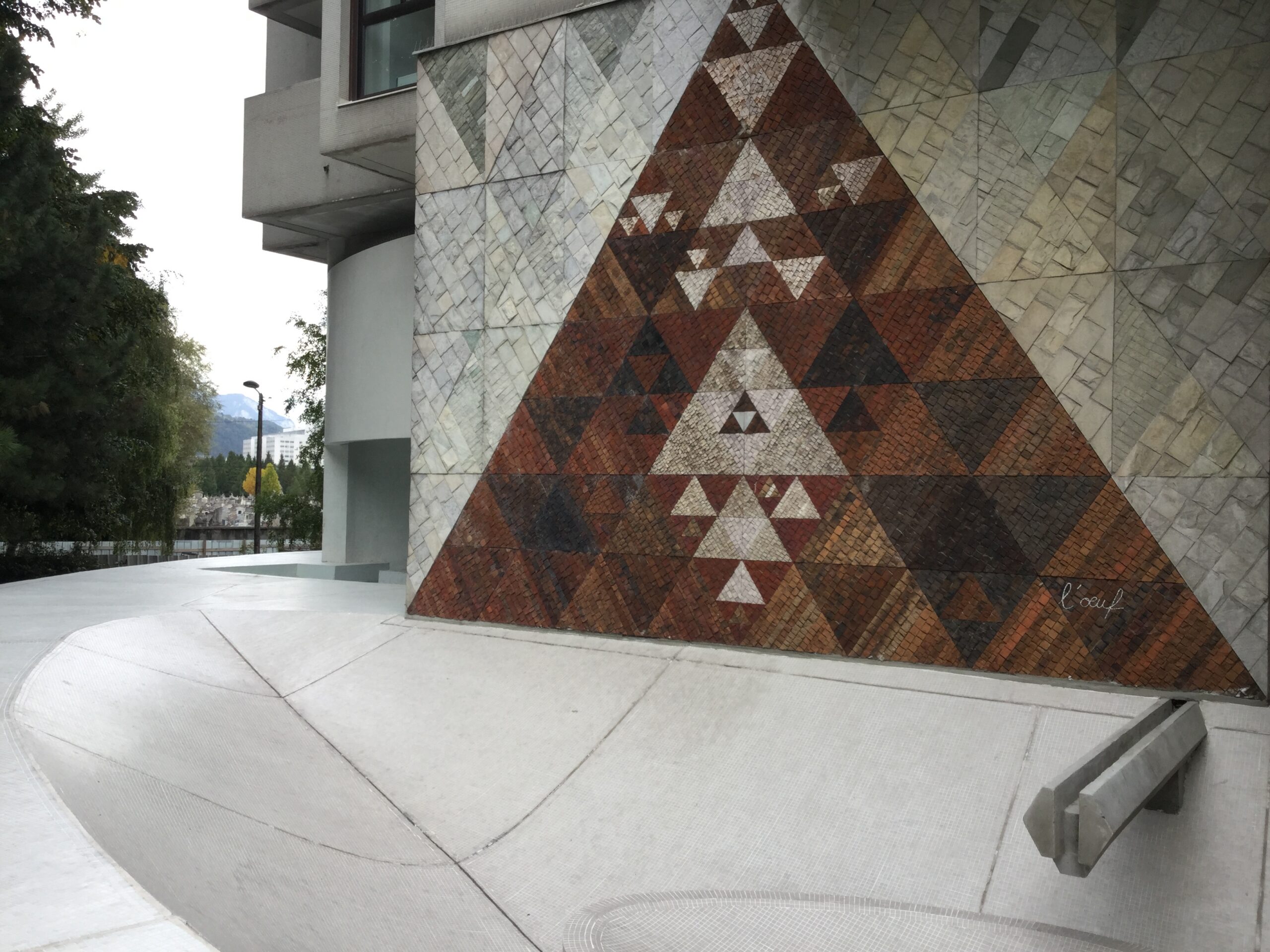
Left: Mosaics in the lobbies at 35 Rue Saint Ambrose; Right: Mosaics at Le Trois Tours, Grenoble. Image credit: Priyanka Shah
The Archives
Halfway through my trip in France, I received permission to access Anger’s archival drawings, which were stored in a basement in the glamorous city of Nice in France’s southern Côte d’Azur. A few days later, carrying an old-fashioned verbal recommendation from an acquaintance in Paris to an architect in Nice, I arrived by train and took a bus to a quotidian part of town, where an acquaintance of Anger handed me the keys to a small dark room in the “cellar” of an apartment building. Before he left, he turned back once, shook my hand, and said bon courage.
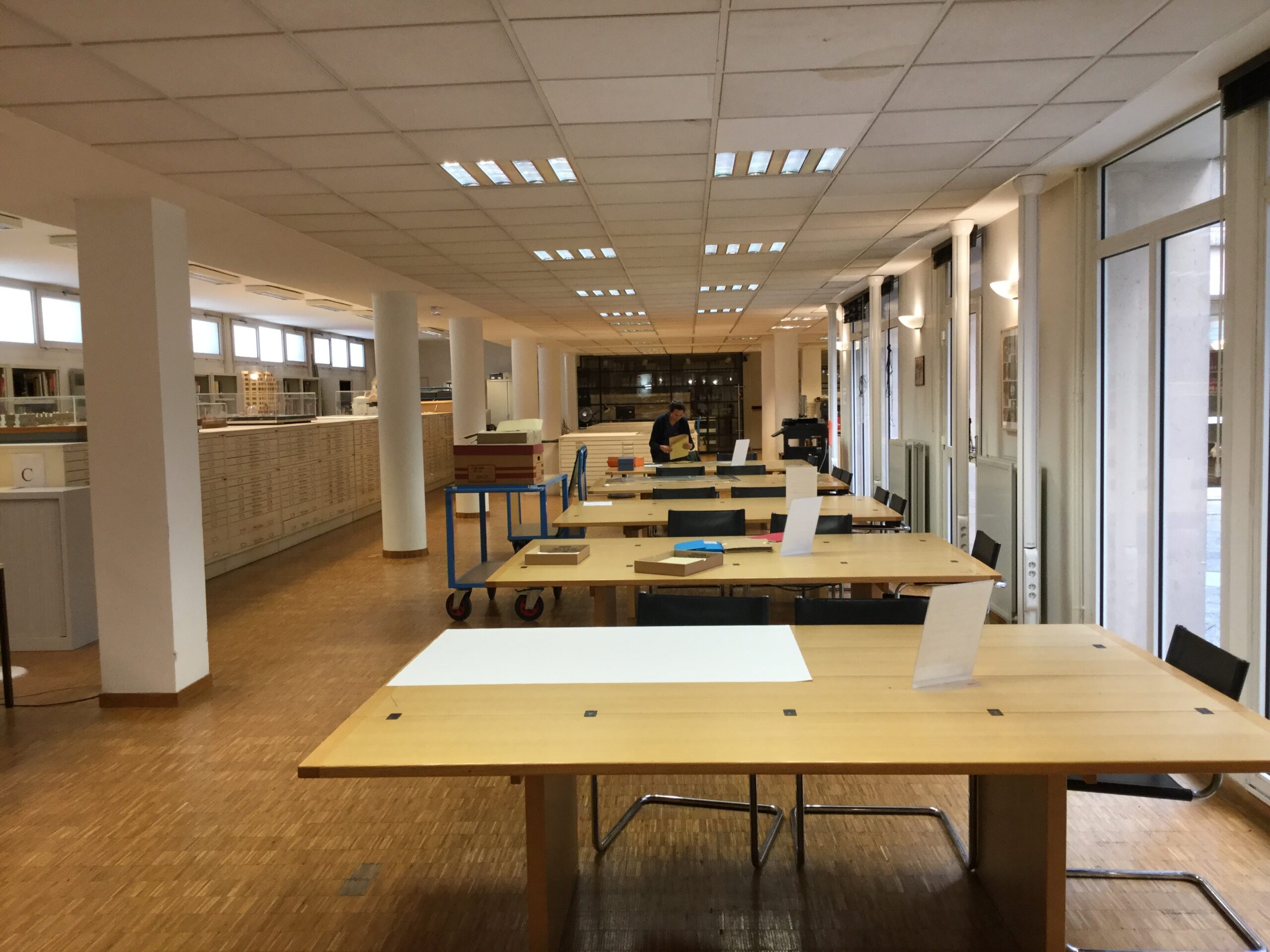
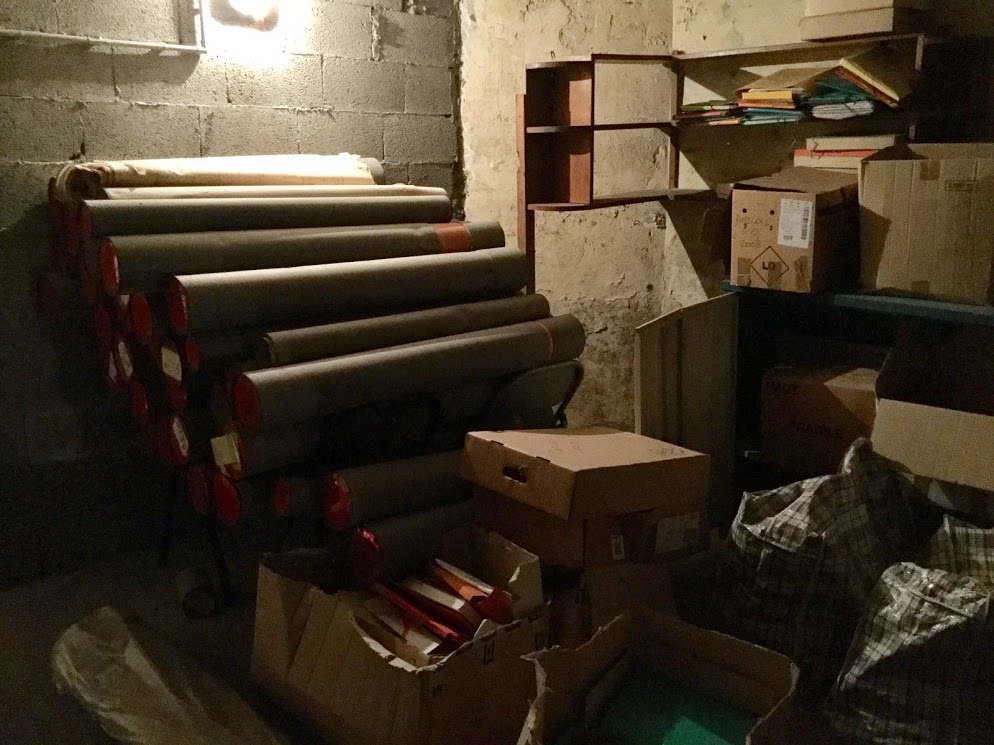
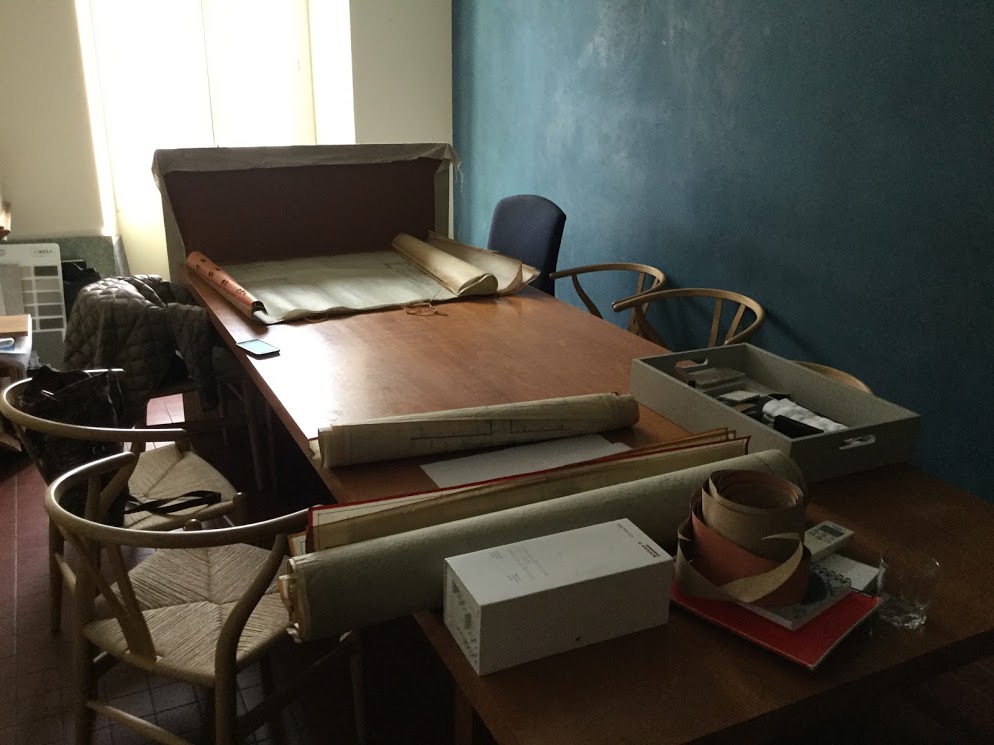
The windowless room had one bulb on a timer, which had to be pushed every few minutes to stall total darkness. Working in a slow-motion dance of hitting the light switch and demounting cardboard drawing tubes from a stack almost as tall as me, I quickly realized I was faced with a task beyond the scope of my visit to Nice. Having seen the projects in Paris, I chose five drawing sets to get a more detailed understanding of their design. I showed up at the doorstep of the sea-facing architecture studio, separated from the Mediterranean by a promenade, carrying five tubes of 50-year-old drawings. My black jeans were not black anymore after a couple of hours in the basement. I introduced myself to the friend of my friend in Paris, apologizing for my appearance, which he brushed off, saying he was more concerned about the drawings.
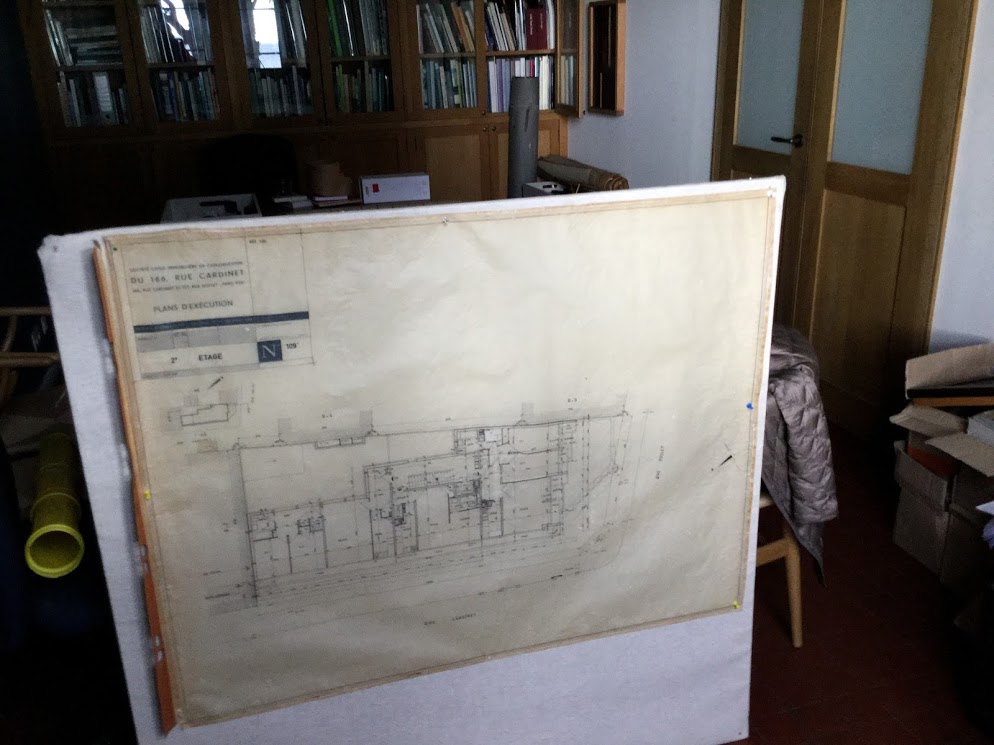
For the next two days, the small practice of perhaps 10 employees handed over their meeting room to me and set up an easel where I mounted the ink on Mylar drawings and photographed them. Each day, I was promptly evicted from the office for an hour at lunch and for the day at 6:00 p.m. This glimpse of French work culture was both a shock and a delight to my New York sensibilities.
I found a couple of drawings and building photographs at Les Archives d’architectures du XXe siècle in Paris and in a publication at the RIBA library in London, which contained plans, but the floor by delineation that I saw in the drawing sets from Anger’s repository in Nice were key to deconstructing the facade typologies and geometries that are depicted earlier.
The sparse findings at various archives, which are in stark contrast to Anger’s sizeable collection in Nice, speak to a gap in the historical record of modern architecture. Buildings stand as long as society, landowners, and the laws of gravity permit. Anger’s archive deserves a home at an institution that will preserve it for posterity.
Explore
Farshid Moussavi: Style Matters
Farshid Moussavi presents six projects that illustrate the subversion of architectural conventions.
In conversation: Guy Nordenson and Thomas Phifer
The designers reflect on their history of collaboration.
Álvaro Siza Vieira lecture
Portuguese architect Siza discusses his Iberê Camargo Museum, which is located in Porto Alegre, Brazil.