Sign and Line
The Red Line, by competition winners Eric Arneson and Nahal Sohbati of Topophyla and Gabriel Castro-Andrade, is a site access strategy that uses bold and simple components to enhance safety and orderliness on construction sites.
March 3, 2026
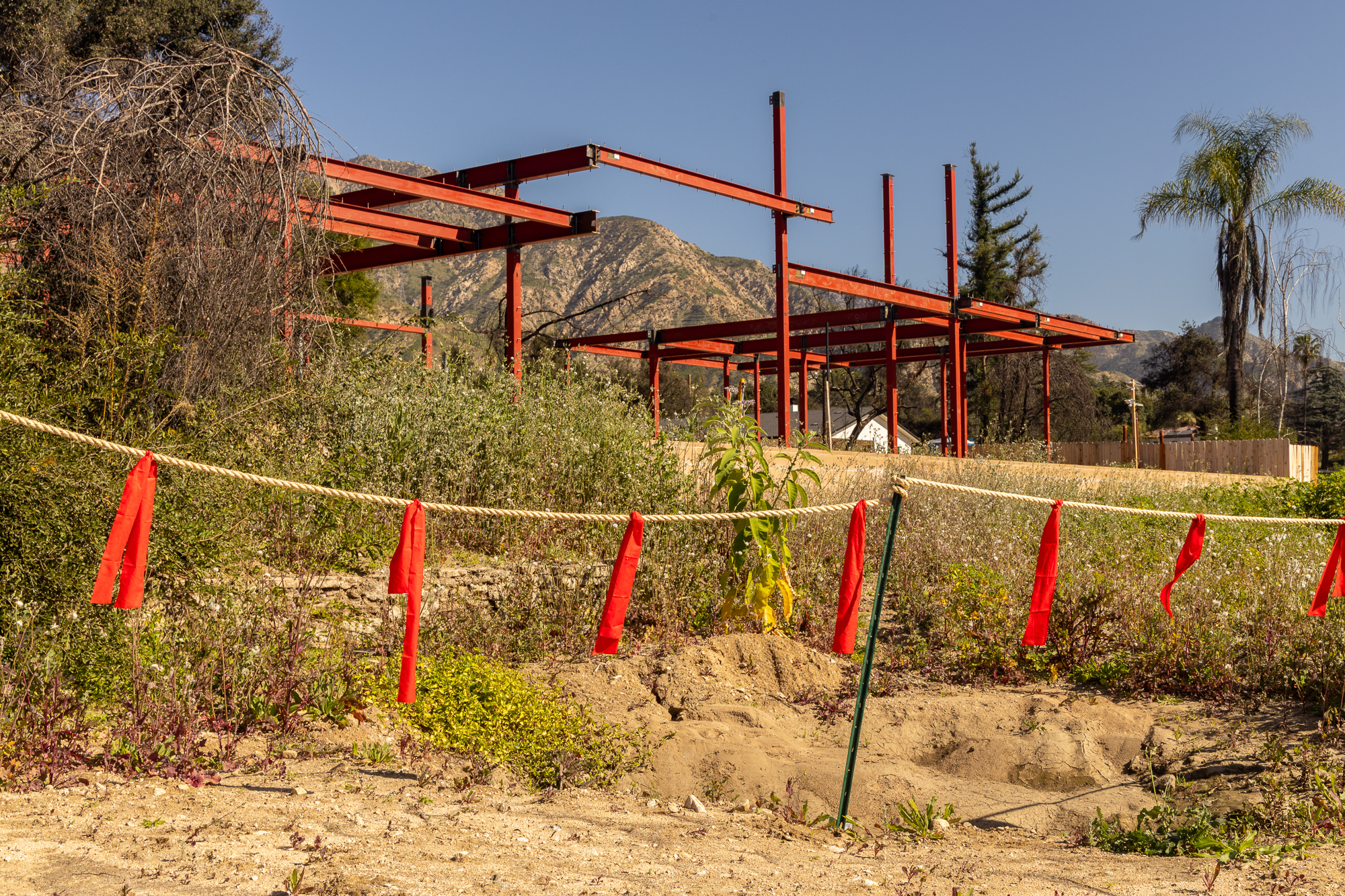
Topophyla, Gabriel Castro-Andrade | The Red Line. Image credit: Topophyla
The proliferation and intensification of federal immigration enforcement actions are affecting landscape and construction sites all across the country. In response, Construction Workers United, an initiative of the Worker’s Justice Project, and The Architectural League of New York launched the Sign and Line Request for Proposals in the fall of 2025, seeking designs that clearly articulate the regulations governing jobsite access (Sign) and the boundaries between public and private spaces (Line), therefore encouraging maximally compliant, safe, and orderly workplaces.
The Red Line, the proposal by winners Eric Arneson and Nahal Sohbati of Topophyla and Gabriel Castro-Andrade, is a site access strategy that uses clear boundaries, scalable protocols, and specific points of contact to manage entry into active jobsites. Inspired by global traditions of cloth as a signifier of protection, solidarity, and unity, the system specifies commonly available materials to establish a continuous perimeter line marked with red fabric, designated contact zones, standardized signage, and a single point of authority.
The Red Line shifts responsibility for access away from individual workers and helps management establish the boundaries of private construction sites. It directs potential conflict away from entry points and provides rules and procedures to strengthen the safety and orderliness of jobsites.
Download to Learn More and Use The Red Line on Your Jobsite
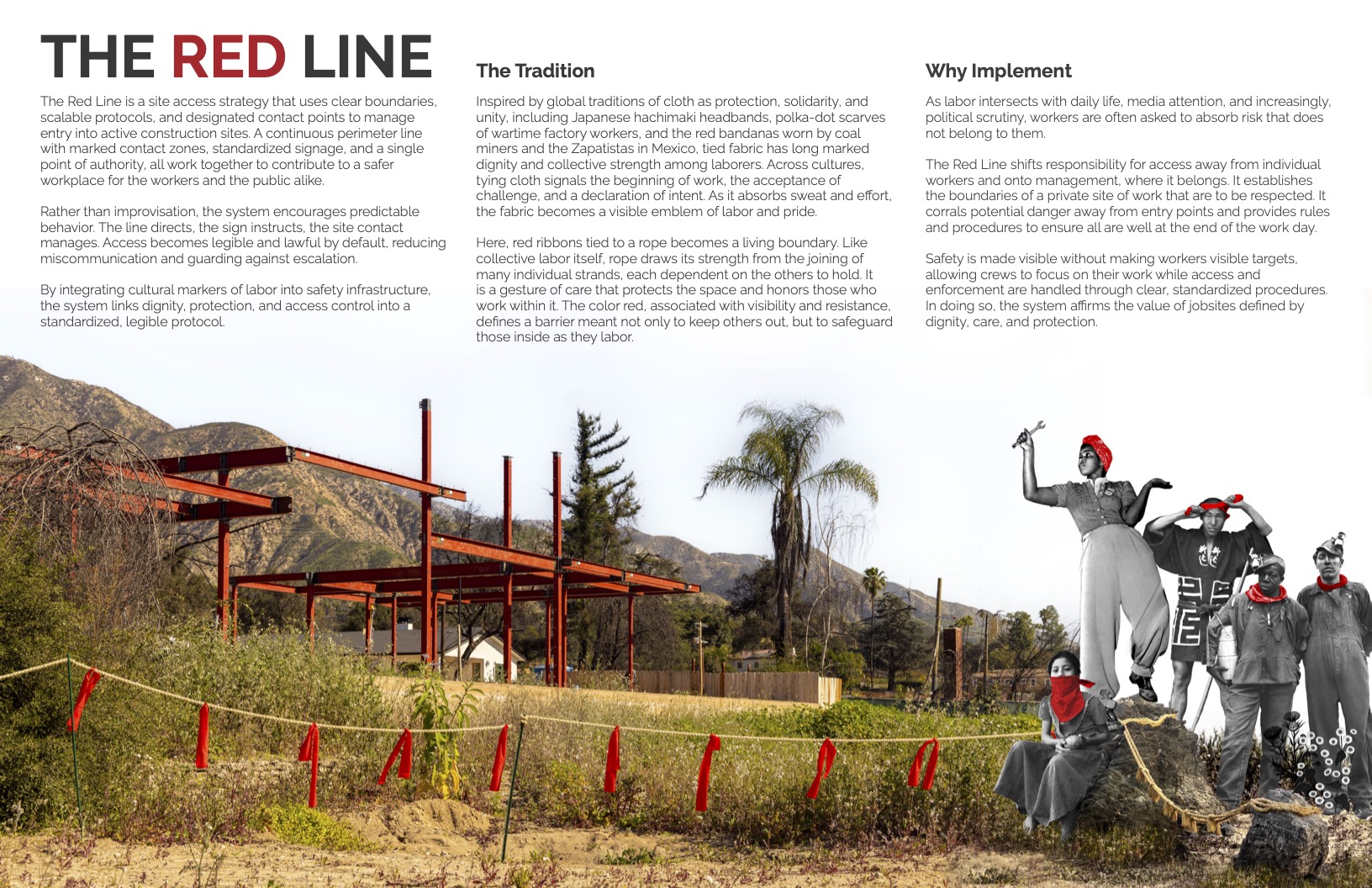
A limited number of The Red Line kits will soon be available from the League. Please email programs@archleague.org for more information.
About the Winners
Topophyla is an analysis-driven, process-oriented landscape architecture practice serving Santa Barbara, Los Angeles, and the Bay Area, co-founded by Eric Arneson and Nahal Sohbati. Topophyla approaches each project through a holistic, site-specific lens, using careful analysis to shape landscapes that are ecologically responsive, contextually grounded, and experientially rich. Eric Arneson is a California-licensed landscape architect who incorporates advanced documentation tools, including aerial mapping and drone-based workflow, in the design and construction coordination process. Nahal Sohbati is a landscape designer whose work engages ecological systems, graphic exploration, and community based practice as a tool for social and environmental advocacy.
Gabriel Castro-Andrade is a designer and researcher examining how construction labor, safety systems, and material boundaries shape architectural form and civic life. His graduate research on detailing—tracking choreography, injury, and craft knowledge—as a shared language between designers and builders contributed to his recent work on The Red Line. Currently an exhibition designer at the Museum of Fine Arts, Boston, Castro-Andrade previously worked at Wilmotte & Associés in Paris, TEN Arquitectos in Mexico City, and as a cement mason in Newark, New Jersey.
About the Jury
The Sign and Line jury included Eduardo Castañeda and Armary Perez of Construction Workers United, an initiative of the Worker’s Justice Project; Jacob R. Moore of The Architectural League of New York, Michael Bierut of Pentagram, Andy Klemmer of Paratus Group, Elsa Ponce of Studio Elsa Ponce, and Lloyd Westerman of Westerman Construction.
About the Request for Proposals
At the Draw the Line webinar, recorded on October 1, 2025, representatives from Construction Workers United, an initiative of the Worker’s Justice Project, and the League shared brief updates about how federal immigration enforcement actions are affecting landscape and construction sites all across the country, and presented a request for design proposals focused on information sharing and enhanced protection of workers on jobsites.
Support
Sign and Line is made possible by the members and supporters of The Architectural League of New York. Additional support is provided by the New York State Council on the Arts with the support of the Office of the Governor and the New York State Legislature.
The Sign and Line RFP was co-organized with Construction Workers United, an initiative of the Worker’s Justice Project.
Construction Workers United (CWU) organizes and advocates for day laborers and low-wage immigrant workers in New York City’s construction industry. In their own words, “CWU is preparing the next generation of builders in NYC by delivering effective, culturally-competent health and safety training under Local Law 196, raising the wage floor for day laborers through negotiations with employers, operating a hiring hall for day laborers, preventing wage theft, and connecting the dots between workforce development and worker protections.”
Founded in 2010, the Worker’s Justice Project (WJP) is a New York City worker center that educates, organizes, and fights for better work conditions and social justice in the workplace. With a base of more than 12,000 members, WJP organizes low-wage, immigrant workers who are fighting to raise workplace standards in the construction, house cleaning, and app-based delivery industries.