
A Slightly Unruly Practice
Anda and Jenny French of Boston-based French 2D discuss their approach to materializing the subversive potential of domesticity.
The Architectural League’s biennial Emerging Voices award spotlights North American individuals and firms with distinct design voices that have the potential to influence the disciplines of architecture, landscape architecture, and urban design. This year, the League posed a series of questions to the eight practices that received a 2026 award, prompting each firm or individual to reflect on their working theories and methods, the opportunities and challenges of contemporary practice, and what’s next.
French 2D is a 2026 Emerging Voice.
At Boston-based design firm French 2D, Anda French and Jenny French challenge familiar domestic ideas through radical organizations and typologies. In this interview, the partners and sisters discuss their approach to materializing these “mischievous” inquiries across projects that range from a 30-unit co-housing development to installations that invite new conditions of gathering.
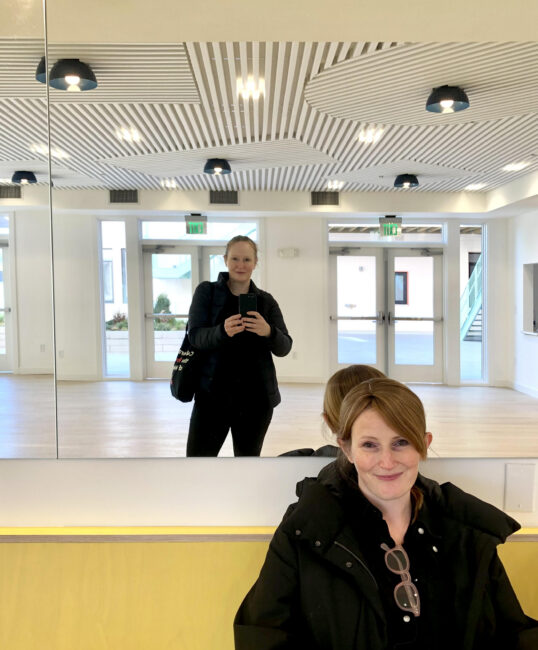
Image courtesy French 2D
***
As an emerging firm, where do you locate your practice, environmentally, socially, and within the design field?
We locate our work between the pragmatic and the mischievous. We are interested in architecture’s capacity to recalibrate habit, whether around energy use, proximity, or collective forms of dwelling. Much of our work begins with comfort, understood not as indulgence but as a thermal and social condition: temperate spaces, accommodating structures, and environments that invite forms of mutuality that are increasingly rare.
What is the main challenge for your practice in today’s economic, environmental, and political climate?
The challenge is how a deliberately small practice participates in large-scale systems that have grown increasingly risk-averse.
Much of our work is coalition-building before it is building. We cultivate relationships with institutions, neighbors, collaborators, and clients around questions that may take years to become material. That slower ecology of trust is often where consequential work begins.
At the same time, our political and environmental conditions reward familiarity and efficiency precisely when unfamiliar models of living are urgently needed. Our task is to remain nimble, persuasive, and slightly unruly within structures that favor caution.
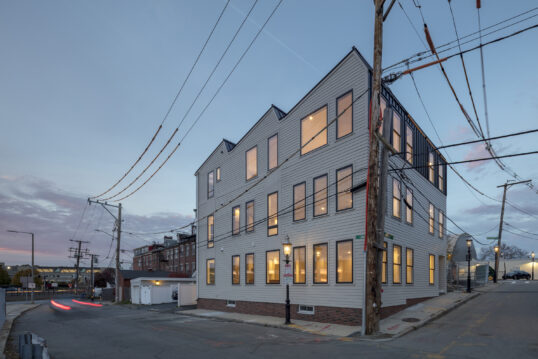
French 2D | Outlier Lofts, Boston, MA, 2018. Image credit: John Horner
When deciding whether to take on a project or collaboration, what questions do you ask yourselves? What do you ask clients or collaborators?
We are often looking for a way into normative problems through stranger questions.
Those questions might be social, material, or formal: how proximity shapes domestic life, how shared infrastructure changes relationships, or how a material choice can shift the character of inhabitation.
With clients, we ask about priorities. Where should attention gather? Where should resources be concentrated? What is worth insisting on? Ideally, these conversations help to underpin the entire process that follows.
How would you define research in your practice?
For us, research and practice are inseparable. Often a line of research opens questions that later become projects. Just as often, a project reveals questions we continue pursuing independently through fabrication, writing, drawing, or teaching.
Research is how we sustain inquiry across scales and mediums. Practice is one way that inquiry becomes material.
Cover: French 2D | Bay State Cohousing, Malden, MA, 2023. Image credit: Naho Kubota. Video editor: Darlena Chiem
Do you teach? What is the interplay between your teaching and practice?
We both teach and hold appointments as Professors of/in, Practice. We see the conversations and the processes that we put in place to help our students and to write our studio briefs as forms of both research and disciplinary engagement that are directly related to the work of our office.
Writing a studio brief, framing a question for students, or building a pedagogical structure is a way of testing ideas in public. The academy gives certain questions room to breathe longer than practice often allows. Practice, in turn, grounds speculation in consequence, budgets, clients, and the stubborn realities of making things.
Do you prefer to work in a certain scale or typology, or do your projects range in scope? Is there a project type you would like to design for but have not yet?
Even though one can categorize much of our work within a set of typologies of multifamily housing or civic installations, we would say that we are focused on a set of entangled qualities, all having to do with domesticity. In our work domesticity is concerned less with the private interior and instead with arrangements and affordances for inhabitation by individuals and collectives, across scale and scope.
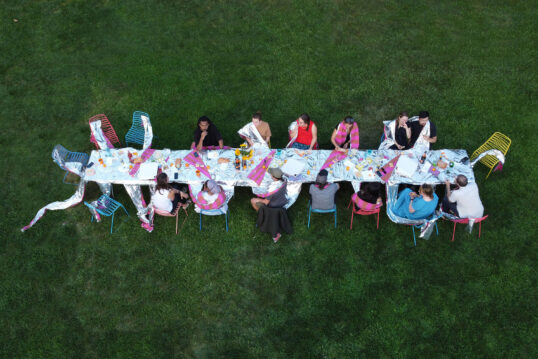
French 2D | Dinner Cozy installation, 2022–ongoing. Image credit: French 2D
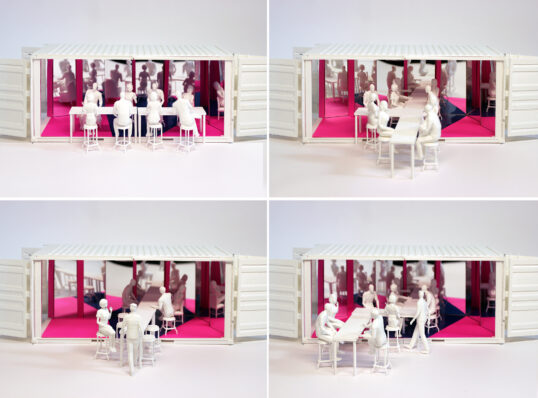
French 2D | Place/Setting installation at the Boston City Hall Plaza, rendering, 2017. Image credit: French 2D
When do you consider a project complete?
Rarely at construction completion.
Buildings continue to reveal themselves through occupation, weathering, adaptation, representation, and re-reading. We often return to projects through drawing, photography, conversation, or post-occupancy reflection and discover latent dimensions that were not visible at handover.
Architecture has an afterlife. It accumulates meanings, habits, and unexpected uses. In that sense, completion is less an endpoint than a transfer, when a project begins living a life beyond our authorship. The challenge then is how to capture that afterlife meaningfully enough to influence future work, and this is where our practice of continuous processing lives.
How did you meet your partner?
We met in the hospital when Jenny was born. It took us about five years from that initial meeting to realize we probably wanted to collaborate.
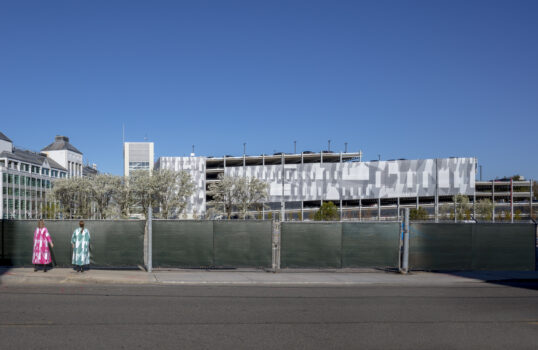
French 2D | Kengall Square Garage Screens, Cambridge, MA, 2019. Image credit: John Horner
What’s one piece of advice you would give a young architect who wants to start their own firm?
Think about how you want to spend your days, and let that question be one of the most important ones as you plan your future firm. If you’re not sure, then working for a weird mix of different offices can show you what kinds of lives you can lead in this profession and what kind of practice you have to invent and sculpt in order to live that life.
Can you name a person, book, film, or other source of inspiration?
We always have to give a shout out to Allan Wexler.
He has a way of making familiar objects feel newly visible, awkward, profound.
What do you need to do your best work?
Ongoing conversations with friends and collaborators, some autonomy, time to think. We subscribe to Twyla Tharpe’s advice that creative people need to be in motion in order to think. We’re often out and about as we discuss things rather than sitting at a desk, trying to come up with ideas: so, field trips.