
Care and Consequence
Mahsa Malek and Alex Yueyan Li of 11 x 17 break down the process of inserting a white box gallery into a vacant Denver pizza shop.
July 28, 2025

11 x 17 | Minuscules construction process, Denver, CO, 2025. Image courtesy 11 x 17
Mahsa Malek and Alex Yueyan Li of 11 x 17 are 2025 League Prize winners.
11 x 17 is a research-driven design practice founded by Mahsa Malek and Alex Yueyan Li with offices in Denver and Toronto. The firm’s projects include exhibitions, furniture, interiors, books, and buildings, united by a critical examination of materiality. For their League Prize installation, Malek and Yueyan Li worked with a developer to insert a white box gallery into an abandoned pizza shop in Denver.
League Programs and Membership Director Anne Rieselbach spoke with the two architects about the “plot twists” underlying the design and construction of the minimal gallery space and what’s next for their practice.
*
Anne Rieselbach: Plotting Resourcefulness, your entry to the League Prize competition, describes 11 x 17’s design process as beginning with an exploration of the smallest, seemingly inconsequential details, outlining examples of material qualities, programmatic processes, and building techniques that generate form. Could you briefly explain how this approach shapes your work and, in particular, your League Prize installation?
Mahsa Malek: The theme got us thinking about how we work, both as a practice and about our projects. We always want to start with understanding pre-configured plots, whether for a space, a site, a wall, or a material that we’re interested in working with, and then try to find restrictions. For example, we were working with a preexisting space that seemed immalleable. We were interested in finding ways to insert our proposal as a plot twist into these conditions.
Alex Yueyan Li: Mahsa and I want to build with a level of care and consequence. There’s a lot of discussion about how destructive architecture is; any construction comes with a burden. There is truth to that. But for us, dealing with plot is about trying to understand all the layers of policy protocols that came before us. Reading through the building code is not something that we teach, but that doesn’t mean it doesn’t matter. It can be boring and logistical, but fundamentally, having grasp on codes can not only feed into the design process but offer us a seat at the table.
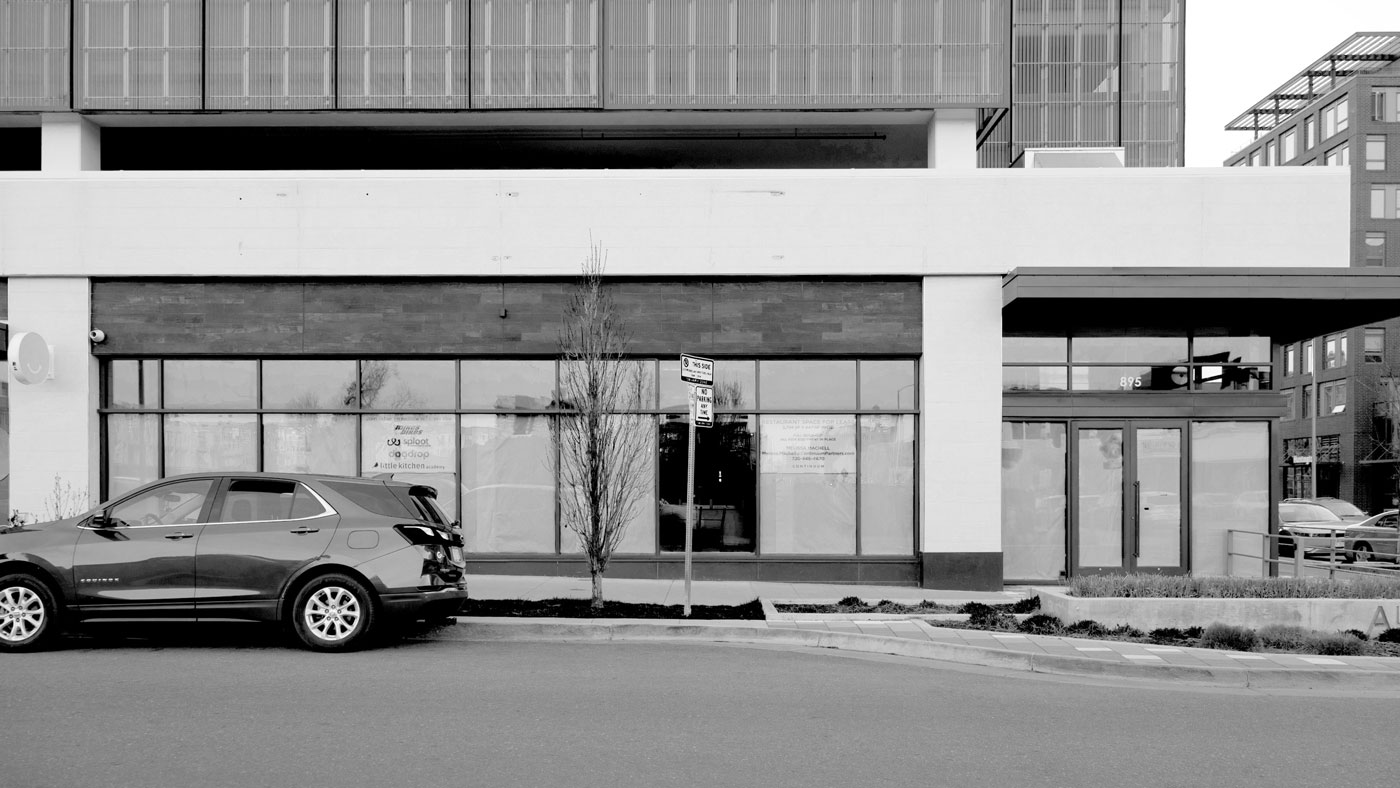
Vacant pizza shop in Denver, CO, 2025. Image courtesy 11 x 17
Rieselbach: Minuscules transforms a former pizza shop into a temporary gallery space. What’s the story underlining this particular plot of land?
Yueyan Li: We did a lot of research about the site. The plot is roughly a 20-minute drive from downtown Denver. It used to be the hospital of University of Colorado, until they moved to a new location. When the campus moved, there was a desire to redesign and reuse the existing buildings, which were beautiful and brutal. There were multiple studies about renovating and converting the research lab building for residential use. Unfortunately, that didn’t go through. One construction photo depicts the fragment of that building as they were building everything around it while trying to figure out what to do about this heritage piece. Unfortunately, they had to demolish it in the end.
Malek: We are new to Denver, and we thought of [the League Prize] as a way to reach a broader network in the city. Through [University of Colorado], we got connected with curators at the Denver Art Museum, some local galleries, and quite a few developers. We looked at a lot of galleries, but none of them felt right to us. So, we went back to our interest in vacant spaces, something that we’ve been working on for the past three years in various capacities.
We found two sites we liked. One was a bit hazardous—it was a building that was falling apart, but very gracefully, so you could see everything being peeled away. We thought it [would be] a little dangerous to take people there. The other option was this pizza shop, which had a really interesting presence on the street. We developed our design to be viewable 24/7. In the morning, you see the bright interior. At night, all of that is lit up, and it activates the space. It already had a community around it and a park was opening across the street. The space came with a lot of challenges, which we talked about in our League Prize lecture. We eventually decided to take it on.
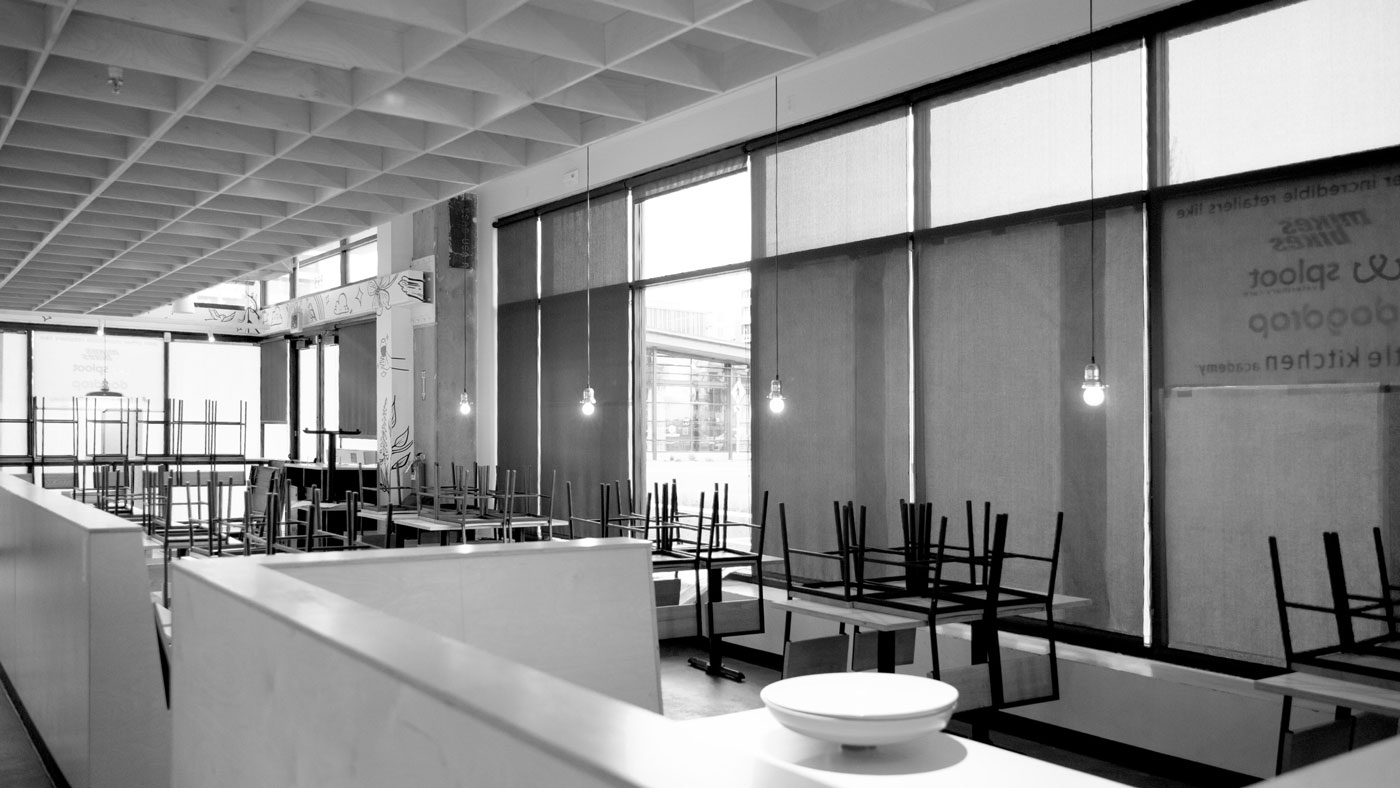
Vacant pizza shop in Denver, CO, 2025. Image courtesy 11 x 17
Rieselbach: In response to the theme “Plot,” your competition portfolio included an extended series of exchanges with contractors and suppliers running as a narrative alongside drawings and images of your work. Why did you do that?
Malek: Part of it has to do with the way we practice. Alex and I both taught at Syracuse University, but now we’re teaching in two different cities. A lot of our practice happens through conversation: on Zoom, on text, on Slack. We feel like this also happens whenever you’re building something. You’re the mastermind, but you’re also having a lot of small conversations with different people. A lot of them are unexpected, like “plot twists.” We thought that bringing in some of those experiences [added] a level of realism: you’re not the only one in conversation and building this thing, you’re in contact with all of the material participants, whether they’re suppliers, contractors, or fabricators.

11 x 17 | Minuscules construction process, Denver, CO, 2025. Image courtesy 11 x 17
Yueyan Li: One way to explain this is through the idea of authorship. As a small, very young practice, we don’t get to draw a plan without thinking about the implications, whether that’s cost or labor. So, writing emails or coordinating and talking is a more direct way of drawing the full plan than the plan-making itself. We feel there’s a level of authenticity to the process when we include those conversations. We would love to think of ourselves as collaborative. In that sense, we are open to change, we are willing to listen, but with an always focused mind that guides those conversations.
Rieselbach: What would the text chain be for this project? And with whom?
Malek: I think the initial conversations that led to finding the site would be the more interesting part of the narrative.
Yueyan Li: There’s a lot of unexpected things that we didn’t consider at first. We started from scratch. In a way, it’s very different from our typical projects; there’s a level of agency in finding the site that we wanted to work with. What we didn’t realize is that once you propose transforming a pizza shop into a seasonal art gallery, you have to think about how you program this space. The developer [Continuum Partners] was very keen on us trying to figure out what happens within the space, which, in a way, is not our expertise. There was a lot of learning, trying to figure out where the funding comes from to have [an attendant] there every Saturday and who we should talk to in order to have events there. There’s a hardware problem, which we are very good at, but there’s also a software programming side which exposes the importance of an institution and how it can cultivate a space over time.
Rieselbach: Could you expand on your design strategy of “minimal contact,” the phrase you use to reference the new, temporary elements inserted above, through, and around the existing structure, lighting, and millwork? What elements are the most important to reveal and, conversely, to mask?
Malek: When we first saw the site, the space was filled with a lot of furniture and it was hard to understand what was movable, what wasn’t. There was an existing millwork ceiling grid. It was beautifully done, but not necessarily something we wanted to focus on. Trying to find a way to make that go away without using drywall was quite a challenge. We started to look at exhibition designs from different galleries and museums we’ve visited. Being typical architects, we’re always looking at details. Through our research, we came up with a very light frame strategy for floating the ceiling. Because the rest is laying on the ground, it was easier to build a frame around it. The ceiling weight and area was a big challenge, specifically because it had a preexisting grid. We had to find a way to clamp things so that our grid is not necessarily aligned with it.

11 x 17 | Minuscules construction process, Denver, CO, 2025. Image courtesy 11 x 17
Yueyan Li: We looked at a lot of references before we started, thinking: What do we do about this space? We don’t particularly love it, we also don’t hate it. One exhibition that we were very drawn to is Lucio Pozzi’s 1977 MoMA PS1 installation 4 Windows, where the room was reclad with four arch-formed window frames. This deepens the window threshold, which then starts to contrast with the existing room. The way in which the work is photographed is not really about what he proposed in the room, but rather about how the two things start to talk to each other. I think that essentially formed the early idea of how we could inscribe a white box art gallery into the pizza shop, designing a box-shaped form with tiny cracks. And of course, to achieve that form, the challenge becomes the ceiling panel that Mahsa described.
Rieselbach: What was the public response to the installation, and were there any surprises?
Yueyan Li: We get a lot of responses about what visitors do in the show. Some of them just stand at the door because they don’t know what to do about a commercial space turning into an art gallery. I think the general impression is, if one were to go into a store, there must be something to purchase. There’s a sort of gray zone where the idea of the public is not easily conveyed. There are other visitors who are just amazed that the pizza shop is still there. They’re wondering, what are we doing in this space now? What’s the future of this space? A lot of people are still hoping to have another new lunch spot in the neighborhood.
Malek: I also think we’ve gotten people curious; they are reaching out. It would have been interesting to tap into the building’s cameras and see what happens at night when we’re not there, but we’re not going to do that. Just getting people’s curiosity and attention is interesting for us.

11 x 17 | Minuscules opening night, Denver, CO, 2025. Image courtesy 11 x 17
Rieselbach: There are plans to display the work of other artists. Are you working with them to design the installations? Does seeing it through their curatorial eyes change your own experience of the gallery?
Yueyan Li: We talked a lot about this. We agreed that we want to be hands off, simply because we have other projects to work on. We are curious how other people use or curate the space. One [upcoming exhibit] is by a band called Devo. They are traveling around the country, and they bring a photographic collection with them. The developer was able to reach out to them, and they’re planning to display a photographic collection in the space [when they come to Denver]. We are also in conversation with the curators who initially helped us locate the space.
Malek: It will be interesting to see how photography gets exhibited, because we designed the gallery to display drawings on the walls that we created around the benches, but the big table is also a major aspect of the design. I think the relationship to photographs will be different.
Rieselbach: How does this project relate to your ongoing research on working remnants as a way of reclaiming and reworking existing structures?
Yueyan Li: We’re currently working on [an] installation for the Chicago Architecture Biennial. We were just trying to figure out the logistics this morning! [The installation] will work with an existing structure in a slightly different way. It’s more surgical in terms of getting into the bones of the foundation [and] trying to understand where the cracks come from within the building. We will be displaying two foundations. One is looking at the technology of house lifts as a way to sneak in additional volume underneath what exists on the ground level, whereas the other way is more about digging under. That [intervention] utilizes underpinning technology to add a volume, while at the same time stabilizing what was already there.

11 x 17 | Minuscules finished gallery, Denver, CO, 2025. Image credit: James Florio, courtesy 11 x 17
Interview has been edited and condensed.