
Architecture, Planning, and International Law: Building Postcarbon Futures
For Climate Week NYC, built environment and climate policy experts spotlight works of climate justice around the world and draw a roadmap for the future of our cities, landscapes, and communities.
September 23, 2026
6:30 p.m.
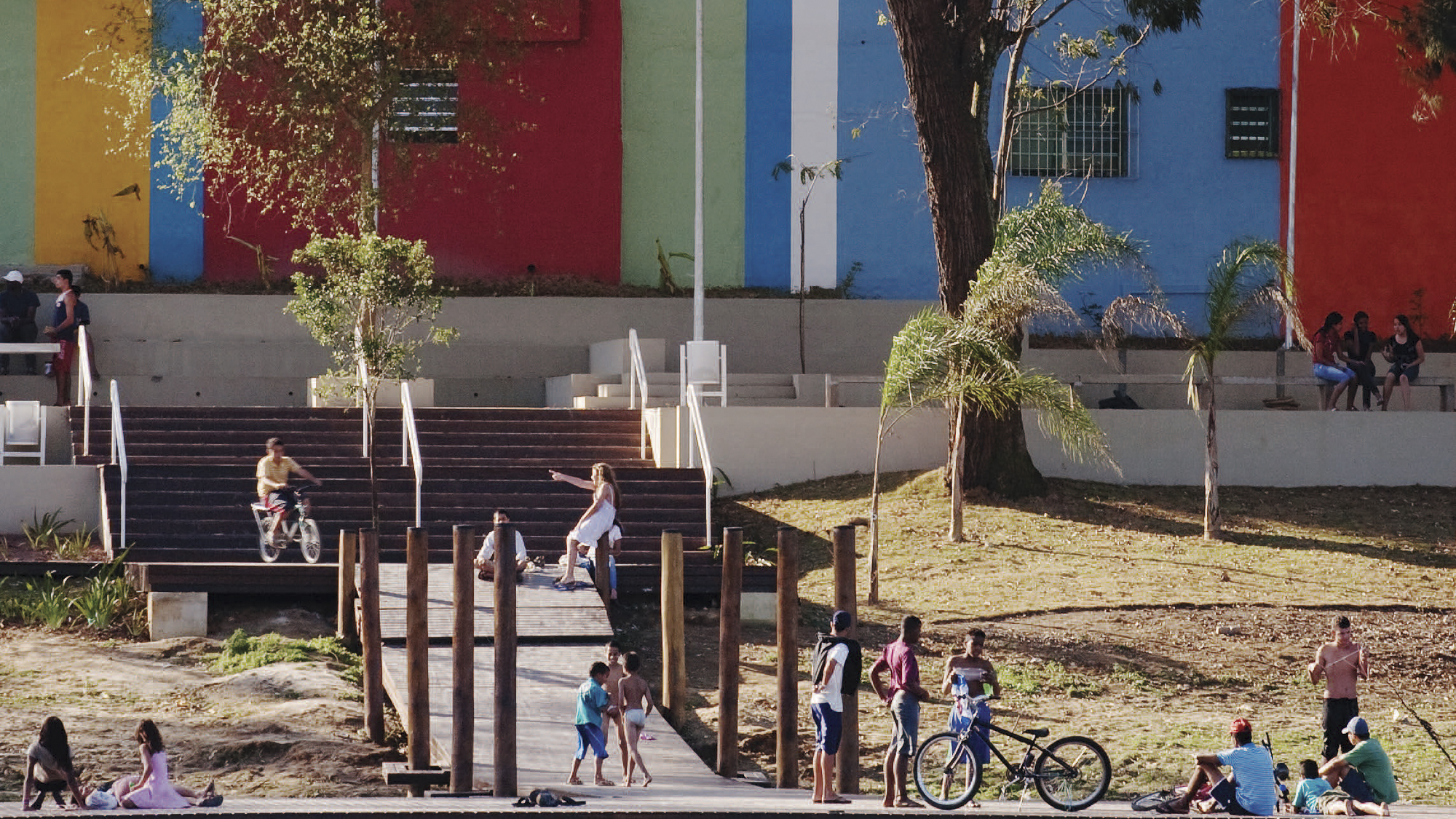
Cantinho do Céu Housing Complex, Sao Paulo, Brazil. Image credit: Daniel Ducci, courtesy Billy Fleming. Building Postcarbon Futures: Land, Justice, and Energy Transitions, by Billy Fleming. Edited by Jennifer Sigler. Designed by Cristian Ordóñez. 480 pages. Published by the Lincoln Institute of Land Policy. Distributed by Columbia University Press
Architecture, Planning, and International Law is an open-ended series bringing legal and built environment experts together to discuss urgent topics at the intersection of their jurisdictions.
In July 2025, the International Court of Justice published a groundbreaking advisory opinion that establishes the legal obligation for states to adopt significant measures to combat climate change—particularly industrialized nations that have contributed most significantly to the crisis. The charge is clear, now scientifically and legally: We must transform infrastructure to ensure the planet’s future for all those who inhabit it. But what does a postcarbon future look like? And how can the infrastructure of that future serve to not only repair and restore environments but fundamentally reimagine the unjust, inefficient, and unsustainable systems that, quite literally, fuel the climate crisis and its inequitable impacts?
The scale of the question—and its consequences—is daunting. But answers can be found all around us, as chronicled in scholar Billy Fleming‘s 2026 book, Building Postcarbon Futures: Land, Justice, and Energy Transitions. Celebrating 29 works of climate justice from around the world, the book foregrounds the tactics and modes of practice being employed, often by marginalized peoples, to create more humane, hospitable places—from a geothermal renewable energy plant in British Columbia, to Indigenous-led wildfire management efforts in Northern Australia, to a Sao Paolo social housing initiative that invests in ecological restoration and community resilience.
A continuation of the League’s Architecture, Planning, and International Law series and co-organized with the Center for Brooklyn History of the Brooklyn Public Library and the Climate and Community Institute, this event will present a selection of case studies, followed by a panel discussion with leading experts at the intersection of climate policy and the built environment to draw a roadmap for building climate justice in our cities, landscapes, and communities.
Panelists
Daniel Aldana Cohen works on the intersections of the climate emergency, housing, political economy, social movements, and inequalities of race and class in the United States and Brazil. Cohen is assistant professor of sociology at the University of California, Berkeley, where he is director of the Socio-Spatial Climate Collaborative and serves as a faculty affiliate in the graduate program on political economy. He is also a founding co-director of the Climate and Community Institute, a progressive climate and economy think tank. Cohen’s research and writing have been published widely in both academic journals and public outlets. He is the co-author of A Planet to Win: Why We Need a Green New Deal (2019).
Keller Easterling is a designer, writer, and the Enid Storm Dwyer Professor of Architecture at Yale University. Her forthcoming book, Your Land, tells the story of land activism in the U.S. after the civil rights movement. Previous books include Medium Design (2021) and Extrastatecraft: The Power of Infrastructure Space (2014), among others. Easterling has lectured and exhibited internationally. Her research and writing were included in the 2014 and 2018 Venice Biennales. Easterling is a 2019 United States Artist in Architecture and Design and the 2026 recipient of the American Academy of Arts and Letters Award in Architecture.
Olúfẹ́mi O. Táíwò is associate professor of philosophy at Georgetown University. Táíwò’s theoretical work draws from the Black radical tradition, anti-colonial thought, German transcendental philosophy, contemporary philosophy of language, contemporary social science, and histories of activism and activist thinkers. The author of Elite Capture (2022) and Reconsidering Reparations (2022), he has published in academic journals including Public Affairs Quarterly, One Earth, and Philosophical Papers, and his articles exploring intersections of climate justice and colonialism have been featured in The New Yorker, The Nation, and Boston Review, among others.
The conversation will be moderated by Billy Fleming, a leading voice on the role of design in responding to the climate crisis in our cities, communities, and landscapes. Fleming is a founding co-director of the Climate and Community Institute and assistant professor of landscape architecture at Temple University’s Tyler School of Art and Architecture in Philadelphia. Previously, he was the inaugural Wilks Family Director of the Ian L. McHarg Center at the University of Pennsylvania and an urban policy advisor to the Obama administration. He is coeditor of Design with Nature Now (2019) and A Blueprint for Coastal Adaptation: Uniting Design, Economics, and Policy (2021).
Support
This event is co-organized with The Center for Brooklyn History of the Brooklyn Public Library.
This event is presented in partnership with the Climate and Community Institute.
The Architecture, Planning, and International Law series is supported by The Graham Foundation for Advanced Studies in the Fine Arts. The League’s work is further made possible by the members and supporters of The Architectural League, the J. Clawson Mills Scholarship Fund, and by public funds from the New York State Council on the Arts with the support of the Office of the Governor and the New York State Legislature.

Explore
Current Work: Capping Highways, Transforming Infrastructure
Landscape architects present in-progress park projects which deck over major roadways and evaluate their reparative potential for communities and the urban public realm.
March 19, 2026
CO Adaptive and Cooperación Comunitaria
Part of the 2026 Emerging Voices lecture series.
To achieve climate justice, don’t leave architecture to architects
Environmental justice pioneer Dr. Robert Bullard believes we need new coalitions to plan and design American cities.