
Stewards of Materials
Bobby Johnston and Ruth Mandl of Brooklyn-based CO Adaptive discuss why the built product is just one phase in a material's life.
The Architectural League’s biennial Emerging Voices award spotlights North American individuals and firms with distinct design voices that have the potential to influence the disciplines of architecture, landscape architecture, and urban design. This year, the League posed a series of questions to the eight practices that received a 2026 award, prompting each firm or individual to reflect on their working theories and methods, the opportunities and challenges of contemporary practice, and what’s next.
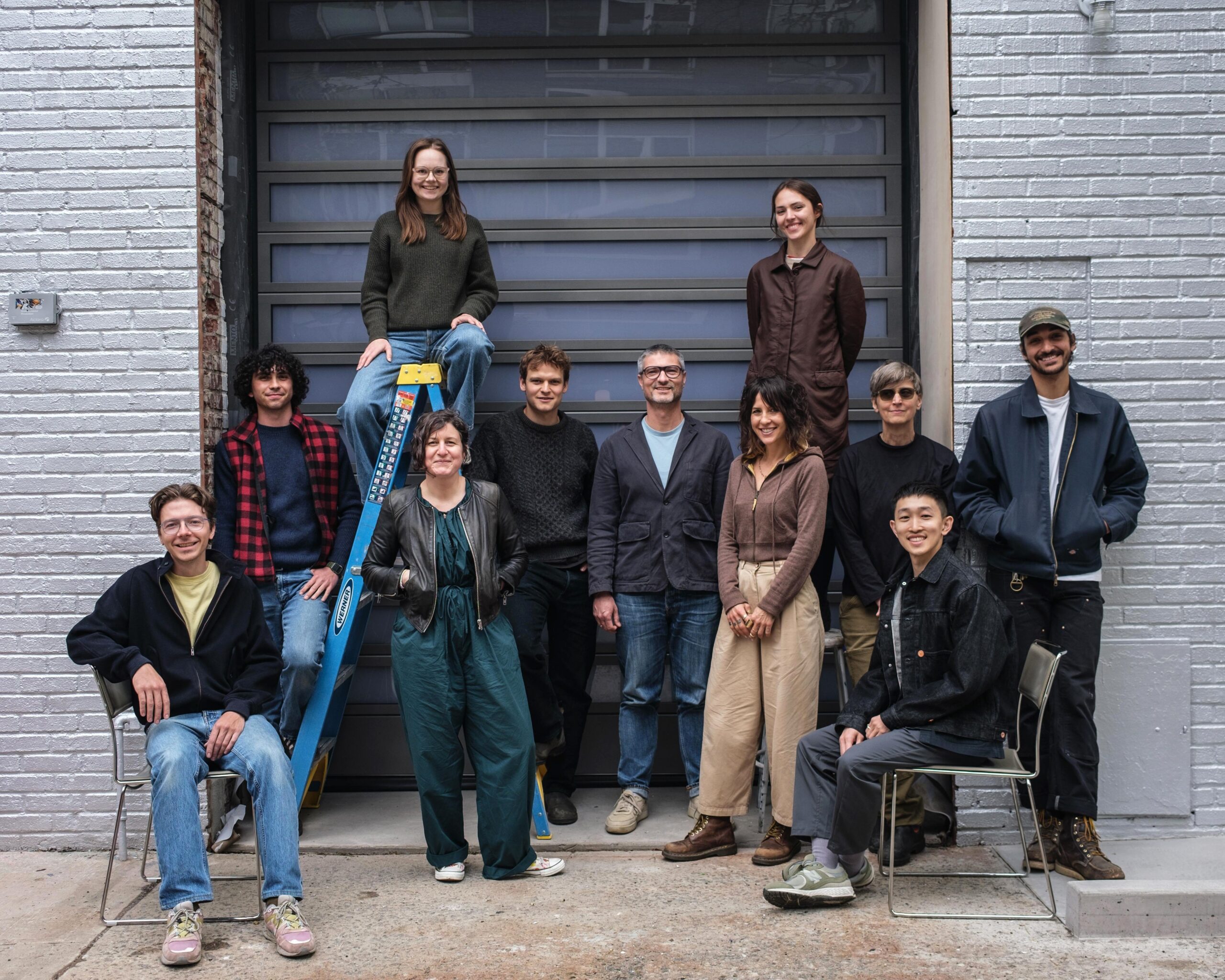
The CO Adaptive team, with Ruth Mandl at center left in a turquoise jumpsuit and a black jacket, and Bobby Johnston at the center in a navy blue jacket and blue jeans. Image courtesy CO Adaptive
Since Bobby Johnston and Ruth Mandl founded CO Adaptive in 2011, the New York City-based firm has progressively expanded the scope of its circularity-focused practice to include not only design but construction, deconstruction, and material salvage services with the establishment of CO Adaptive Building and CO Adaptive Disassembly. In this interview, Johnston and Mandl articulate the ethos, methods, and community that make their tripartite practice work, modeling a way of engaging with the built environment where a building forms just one phase of materials’ lifecycle.
***
As an emerging firm, where do you locate your practice, environmentally, socially, and within the design field?
We frequently talk about ourselves as climate activists within the architectural and building profession—constantly questioning how we can do better by our planet and holding ourselves accountable to practicing what we preach. We are building collaborative relationships around furthering the cause of circularity in New York City, which has enlarged our community to include makers, academics, designers, and policy writers. We also feel strongly that good design should be available and accessible broadly, and that if it is, it has the potential and capacity to address large issues of our time.
What is the main challenge for your practice in today’s economic, environmental, and political climate?
Often, we run into the question of cost. It is more time-intensive to deconstruct than to demolish, or to air-seal and build to a quality that significantly reduces operational energy. In a context in which longevity and environmental impact are not part of development considerations as a matter of course, these costs can be prohibitive. There are, however, significant costs that are often not factored into decisions, and it is disadvantaged communities and future generations who (will) carry the burden of the cost-cutting measures we take today. As such, arguing for transparency in true building costs to expose ingrained inequalities is top of mind for us. This includes not providing fair compensation for labor across the many hands it requires to convert materials into buildings, as well as indirect costs of the environmental impact for virgin material extraction and transportation from far-flung regions of the planet.
At this time of rising energy costs and air quality concerns due to climate events like wildfires, we are committed to doing what we can to solve the equity issue of access to high-quality, affordable housing and building improvements. We strongly believe resilience in a post-petroleum world lies in re-embracing craft and working with the materials that already surround us. We think that through transforming designed assemblies into standardized, marketable products, the use of reclaimed materials, and designing for disassembly, we can work towards affordability and quality.
Cover: CO Adaptive | Timber Adaptive Reuse Theater, Brooklyn, NY, 2021. Image credit: Naho Kubota.
When deciding whether to take on a project or collaboration, what questions do you ask yourselves? What do you ask clients or collaborators?
We generally ask whether the project allows us to push boundaries on reuse, energy efficiency, design for disassembly, and material and ecological health. We do our best work when the project’s goals are clear and performance-driven rather than prescriptive, and the client is actively at the table willing to learn, explore, and problem solve alongside us.
How would you define research in your practice?
Research is ever-present in our practice because of our desire to question and probe the status quo. We started our “Building” arm in large part so that the research we were doing into healthy materials and systems would not be lost in translation between design and building. The process of handling material reuse logistics or healthy material ordering—for things that might not be market standards in the United States yet—are forms of research in practice. We have a shop alongside our studio, in which material experimentation is continuous. We experiment with natural sealants, bio rubbers, and reused materials, and build and test prototypes for design for disassembly, which we ultimately aim to integrate into our built work.
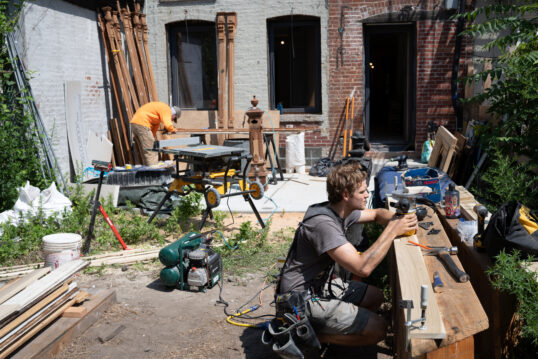
CO Adaptive | Oak Passive House, in progress scene, Brooklyn, NY, 2025. Image courtesy CO Adaptive
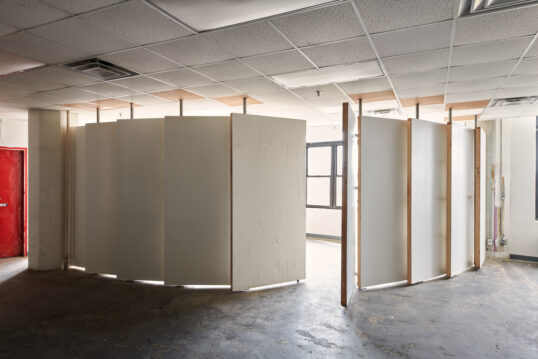
CO Adaptive | Salvaged Material Artist Studio, Queens, NY, 2025. Image credit: Hanna Grankvist
Do you teach? What is the interplay between your teaching and practice?
We enjoy giving talks at various institutions, and we frequently host students at our studio space in the Brooklyn Navy Yard—showing them how we operate.
We taught a studio early on in the launch of CO Adaptive Building, and though we absolutely loved it, it proved to be quite taxing to balance with our architecture and building (and life) responsibilities. We have, however, grown as a practice since then (not in size, but in experience), and we are looking forward to the opportunity of teaching another studio this fall.
Teaching is refreshing in the way that it allows us to step back and take a look at the bigger picture—thinking not only about where we are headed as a practice, but as a profession. It is exciting to be exposed to the passion and urgency that the next generation is bringing to questions of service, care, and repair, and to balance sometimes heavier lessons from practice with the lightness of finding solutions with fewer constraints.
Do you prefer to work in a certain scale or typology, or do your projects range in scope? Is there a project type you would like to design for but have not yet?
Our projects definitely range in scope and size. Our overarching ideas about repair and efficiency are applicable to all building typologies, and we really enjoy exploring how they apply to various sites, budgets, and programmatic considerations.
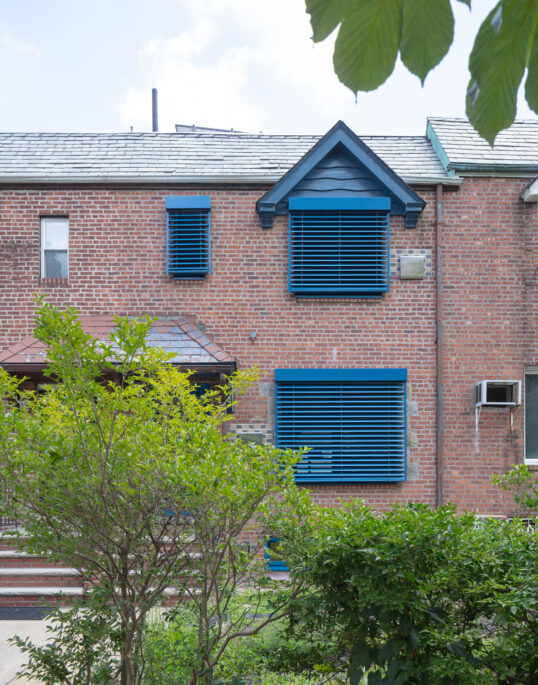
CO Adaptive | Tiny Queens Passive House, Queens, NY, 2023. Image credit: Naho Kubota
We delight in designing spaces for creativity and making, and would love to design for manufacturing—possibly for an innovative, local and circular manufacturing concept, or a space for the creation of visual arts.
When do you consider a project complete?
We love that question, because we know that buildings are merely a phase in a material’s lifecycle. As stewards of these materials, we see our involvement extending far past construction completion and into the usage and end-of-life stages to foster an impactful “cradle-to-cradle” journey. To this end, we want to know about how our projects are used and how they are performing over time—so much so that we have been talking about launching CO Adaptive Maintenance, which would provide scheduled maintenance of both the active and passive systems in our portfolio of projects and centrally monitor the energy use and indoor air quality to identify patterns. We think maintenance is an undervalued part of building; knowing how something performs over time gives fantastic feedback on how it can be improved in the design and building process. As we dive further into design for disassembly, being a partner in the maintenance of a building during its occupancy would be a dream and ultimately would extend the useful life of the broader material ecosystem.
Are there any projects coming up that you’re excited about, and what’s next for your practice as a whole?
CO Adaptive has been actively working on breaking into more public work in order to scale our impact and expose more users to the benefits of high-performance building and careful material specification. We want to expand access to high-performance retrofits through scaling our disassemblable Furr Block wall concept—ideally through multifamily housing retrofits and larger community and arts spaces.
The continual development of our practice is also a truly inspiring project for us. Parallel to our client-driven projects, we look forward to engaging with other architects to learn what materials they are looking for during the design process, and conversely, what materials they can offer for reuse, once alterations of their projects begin and certain materials are no longer needed. Finding creative solutions to both match-making reused materials and developing re-manufacturing processes to modify recovered materials for new uses, or partnering with other institutions and start-ups to re-envision how recovered materials can be productized for reuse, is an exciting trajectory for us.
We can see CO Adaptive Disassembly providing three key services: First, a pipeline of materials for integration within our own projects as well as those of others. Second, to strengthen our industry’s adoption of designing for disassembly through advocacy and proof of concept. Last and most importantly, as a research and community engagement platform on best practices for unbuilding here in New York City, with the goal of getting these ways of engaging with our existing urban material inventory t to spread and scale!
How did you meet your partner? How did you decide to practice together?
We met at grad school—Columbia University GSAPP—in Core I studio. Bobby was shifted to another studio a week later, but that first week really cemented a core group of friends. Early on in our friendship, we found that we had complementary interests, and we understand now how important this is in a partnership. Ruth was passionate about material cycles and reuse, while Bobby was very much in the world of coding and optimization for more adaptive buildings. We went on to collaborate on several occasions throughout grad school and started discussing the idea of starting a practice because of the overlap in our work. CO Adaptive was founded about a year after we graduated on the principles of developing systems that allow buildings to be more adaptable and resilient to the dynamics of climate change.
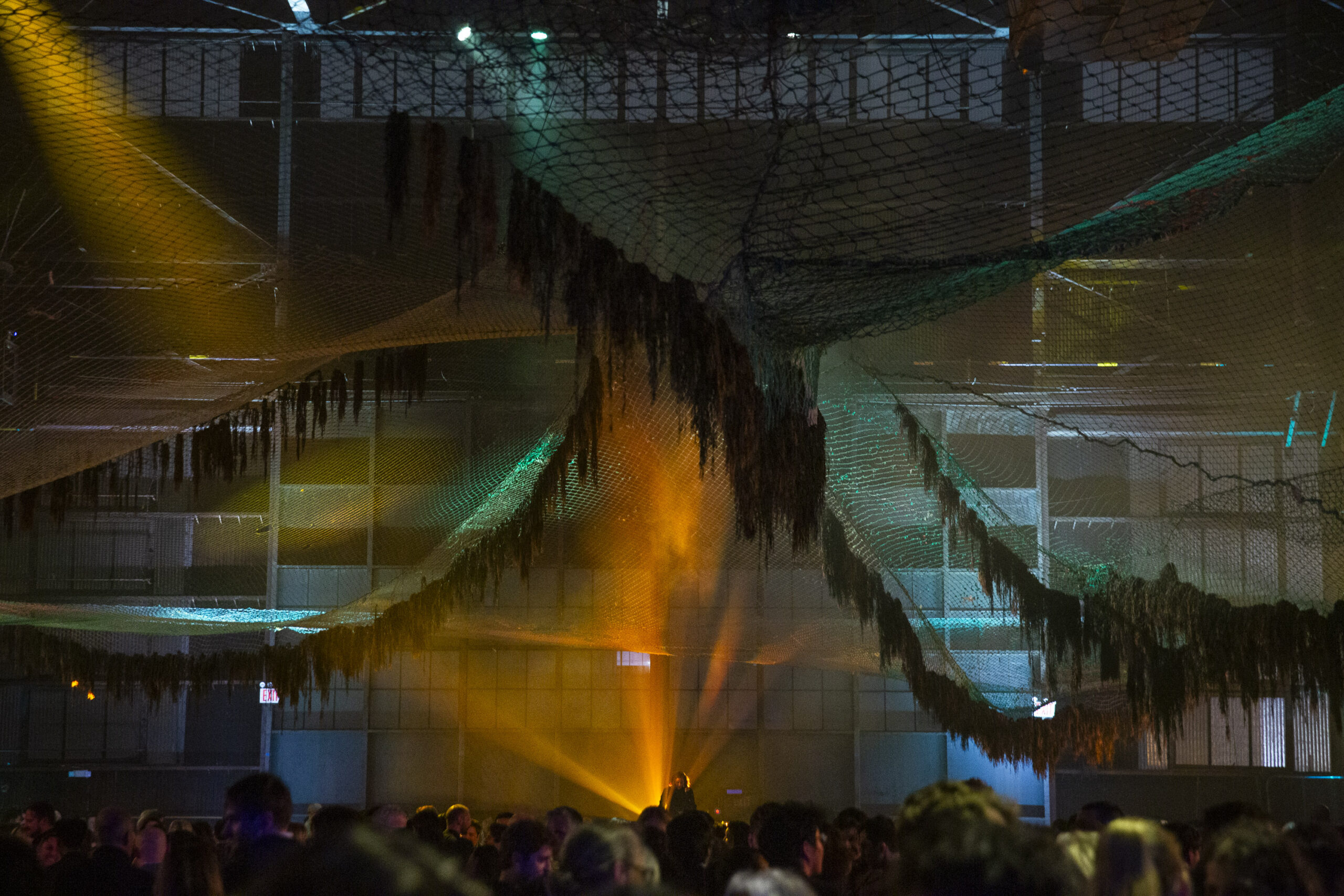
CO Adaptive | Installation for Beaux Arts Ball: Sea Change, Brooklyn, NY, 2023. Image credit: Leandro Viana
What’s one piece of advice you would give a young architect who wants to start their own firm?
First, find and express the things that you are passionate about, and be open to the journey.
When first starting out and throughout practicing, be a great listener above all so that you can identify the most pressing issues that require your creative problem-solving, and then ask critical questions. Have as much dialogue as possible with founders of practices you respect; we often speak with young architects who have great business-oriented questions, which we love and address with as much transparency as we can.
Can you name a person, book, film, or other source of inspiration?
We are inspired by Tipping Point East in London—a space that combines material reuse and low-carbon construction with training opportunities and community engagement.
Steward Brand’s 1994 classic How Buildings Learn is a wonderful acknowledgement that buildings are evolving entities that learn through continuous adaptation by their occupants. We are excited to start reading his new book that was just released a few months ago, Maintenance of Everything: Part One (2026).
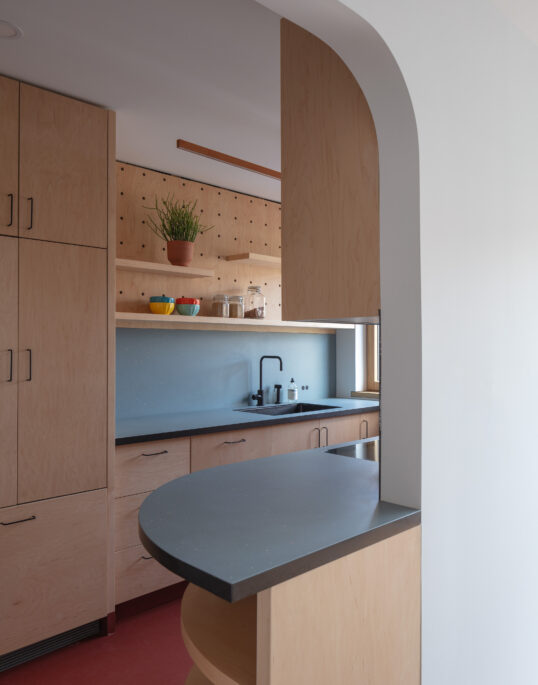
CO Adaptive | Tiny Queens Passive House, interior, Queens, NY, 2023. Image credit: Naho Kubota
What did you last draw?
Ruth Mandl: The earth from above.
Bobby Johnston: Our latest Design for Disassembly concept sketch for our Clay Block insert and tie-back system.
What do you need to do your best work?
Collaboration, trust, and a healthy lifestyle, including plenty of sleep (and a good HRV—Heart Rate Variability—score)!