
Rebuilding from Within
Isadora Hastings García and Lizet Zaldivar López on rebuilding homes in rural Mexico after natural disaster, and why lasting resilience begins with ancestral knowledge.
The Architectural League’s biennial Emerging Voices award spotlights North American individuals and firms with distinct design voices that have the potential to influence the disciplines of architecture, landscape architecture, and urban design. This year, the League posed a series of questions to the eight practices that received a 2026 award, prompting each firm or individual to reflect on their working theories and methods, the opportunities and challenges of contemporary practice, and what’s next.
Cooperación Comunitaria works with rural Mexican communities to rebuild homes and communal facilities after natural disasters, inviting community participation throughout the design process and integrating local ancestral knowledge with technical expertise. Below, two of the firm’s five partners, Isadora Hastings García and Lizet Zaldivar López, assert the necessity of collaboration and knowledge-sharing at every stage of the design and construction process to ensure environmental and social resiliency, and share how their unique partnership was formed.

The Cooperación Comunitaria, with Lizet Zaldivar López at far left, and Isadora Hastings García at the center. Image courtesy Cooperación Comunitaria
***
As an emerging firm, where do you locate your practice, environmentally, socially, and within the design field?
We are a non-profit organization that works with marginalized rural communities in the most vulnerable regions of Mexico, particularly in states that are highly threatened by natural hazards and the growing impacts of the climate crisis.
Our work focuses, on the one hand, on improving habitability through participatory processes to create adequate living spaces and, on the other hand, on reducing vulnerability to natural hazards through comprehensive risk management.
Through different dimensions of human habitation—including construction, production, territorial-environmental management, and sociocultural development—we develop projects in collaboration with organized and active collective groups. We provide them with technical advice and comprehensive support in order to promote low-impact architecture based on participatory risk analysis and participatory design. Our goal is to develop buildings using traditional construction systems and natural, locally sourced materials, reinforced for resiliency.
As a result, we achieve family and community construction at lower economic cost due to the use of local materials, while also reducing CO2 emissions by between 45% and 62% [in comparison with standard building practices]. Additionally, the reinforced elements make these structures more resilient to natural hazards. Throughout the process, community members learn improved construction techniques and strengthen their community organization, increasing their overall social resilience.
Cover: Cooperación Comunitaria | Bahtzel Community Center of Adobe, Chilón, Mexico, 2025. Image credit: Cooperación Comunitaria. Video editor: Darlena Chiem
What is the main challenge for your practice in today’s economic, environmental, and political climate?
From an economic perspective, the loss of traditional knowledge has led to the replacement of local construction techniques with industrialized systems that increase the cost of housing and infrastructure, and therefore the cost of living, while also failing to adapt to local climatic and cultural conditions.
At the same time, political parties and organized crime groups weaken community governance structures, undermining local economies as well as solidarity networks and collective forms of organization.
From an environmental perspective, the climate crisis intensifies natural hazards and, consequently, socio-natural disasters in the most vulnerable regions of Mexico, which are precisely the communities with whom we work.
Finally, the lack of public policies that recognize and finance adequate housing for rural and Indigenous areas, self-management practices, and traditional knowledge disrupts community-based ways of building and producing. For this reason, our work goes beyond construction processes alone; we also focus on knowledge exchange processes that help make these initiatives sustainable and allow them to evolve into comprehensive risk management practices.
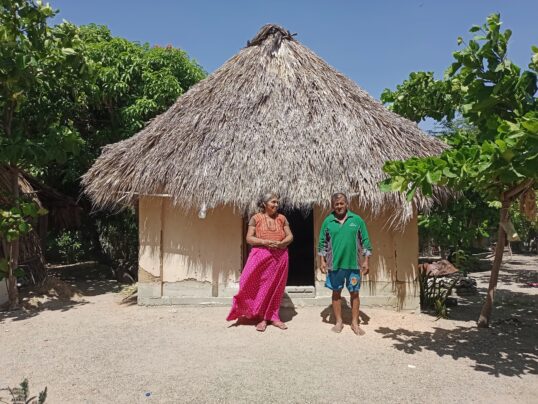
Cooperación Comunitaria | Reinforced Bajareque Kitchen, San Mateo del Mar, Mexico, 2021. Image credit: Cooperación Comunitaria
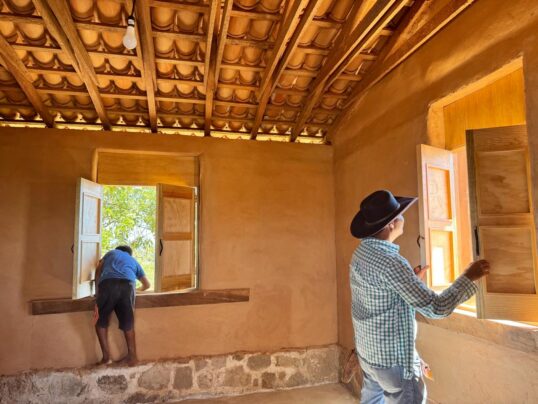
Cooperación Comunitaria | Reinforced Adobe House, Cacahuatepec, Mexico, 2025. Image credit: Cooperación Comunitaria
When deciding whether to take on a project or collaboration, what questions do you ask yourselves? What do you ask clients or collaborators?
It is essential that the community already have an organization in place, or at least the willingness to establish one. Furthermore, it is important that they embrace a participatory approach to the work, through which they can learn and strengthen their self-reliance for construction, food, and water—both in technical terms and in the community-based management of materials and supplies.
How would you define research in your practice?
It resembles what is known as “participatory action research.” It is not an academic process, but rather a participatory assessment that helps us understand the collective subject’s relationship with its territory, its historical memory, and the challenges it currently faces.
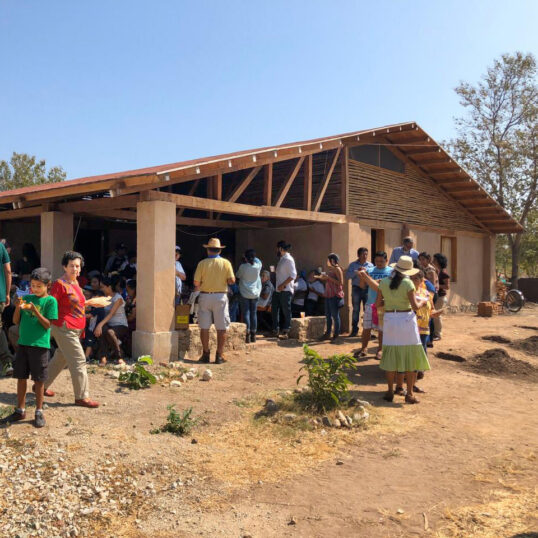
Cooperación Comunitaria | Center of Arts and Crafts of Bajareque Ceren, Ixtepec City, Mexico, 2019. Image credit: Cooperación Comunitaria
Do you teach? What is the interplay between your teaching and practice?
As an organization, our processes include training opportunities, but we refer to them as knowledge exchange. Our role within the organization is to facilitate workshops that encourage reflection on practice and build capacity to foster transformative practices.
As individuals, both Isadora—who holds a master’s degree in architecture from the National Autonomous University of Mexico (UNAM)—and Lizet—who holds a bachelor’s degree in Architecture from UNAM and a master’s degree in Sustainable Architecture from the University of the Environment (UMA)—are professors, and what we share with our students comes from the practical experience and lessons learned from each of the projects in which we have participated.
Do you prefer to work in a certain scale or typology, or do your projects range in scope? Is there a project type you would like to design for but have not yet?
Our projects vary in scale, ranging from the family level to the community as a collective entity, and up to the regional level—whether based on agricultural hubs or at the watershed level. We are particularly excited about the latter due to its transformative potential across multiple communities.
When do you consider a project complete?
A project is never truly finished because the environment is a living entity that is constantly changing. However, we consider our work to be complete when the community has mastered the techniques and processes and achieved self-sufficiency—that is, when we are no longer needed.
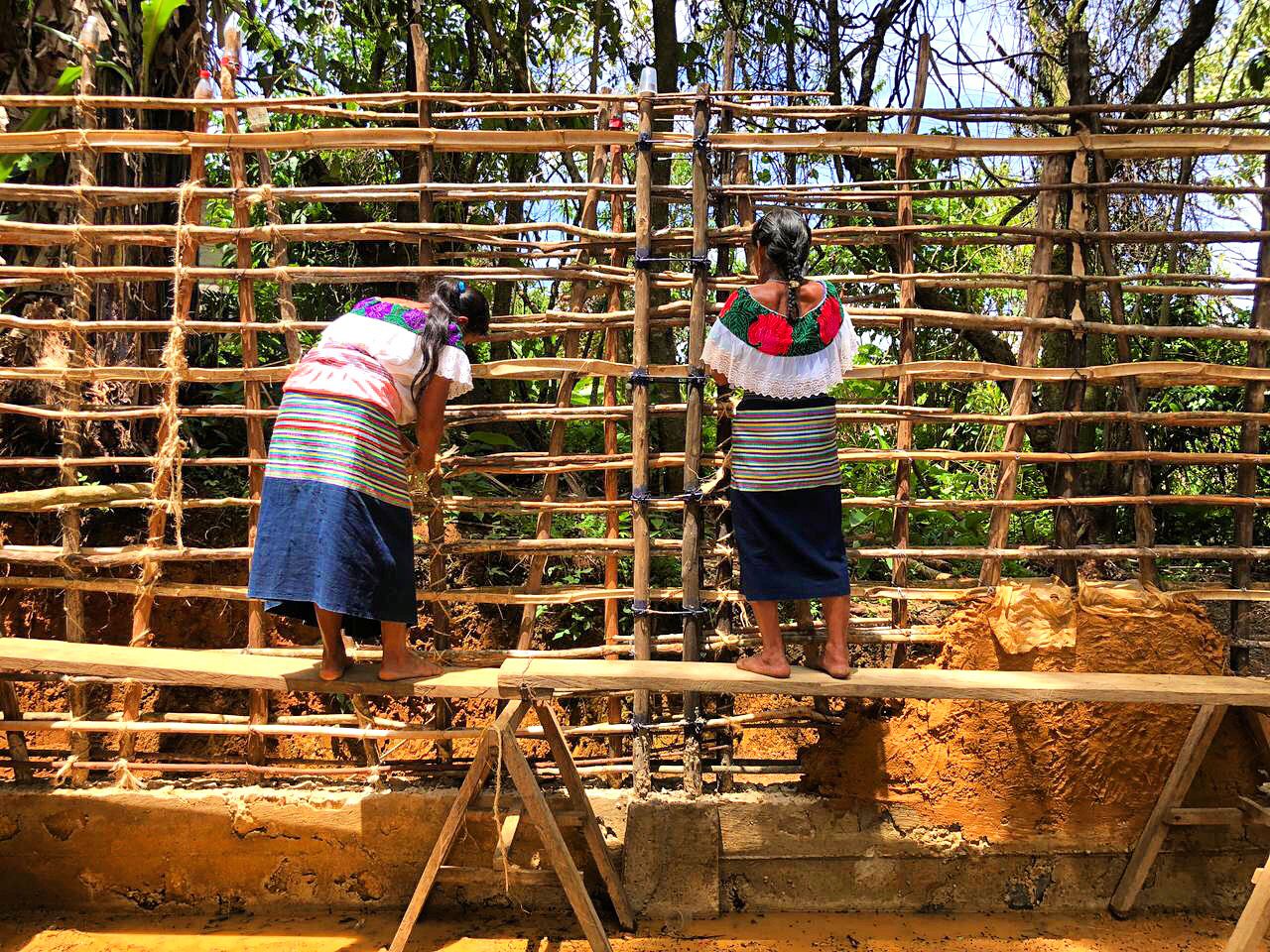
Cooperación Comunitaria | Kaquemte’el Community Center of Bajareque Ceren, Chilón, Mexico, 2024. Image credit: Cooperación Comunitaria
Are there any projects coming up that you’re excited about, and what’s next for your practice as a whole?
We are excited to continue working with community groups on comprehensive risk management with a gender-sensitive approach. Looking ahead, we plan to establish training networks with young people at training centers or universities in the areas where we work, so they can help strengthen their own communities.
How did you meet your partner? How did you decide to practice together?
Isadora met Gerson in 2011 whilst looking for an engineer to create the structural design of a house for a community, and together they set up Cooperación Comunitaria. Later, Elis and Jesús joined the team to work on our first reconstruction project in the mountains of Guerrero, and three years later, they became partners. Liz met Isadora in 2018.
Lizet Zaldivar López: I had just finished my bachelor’s degree and was interested in focusing my master’s thesis on the topic of women in rural housing. A lecturer on the postgraduate course recommended that I work on that first before deciding on a topic, and then passed on Isadora’s contact details to me; she happened to be looking for an architect to join the reconstruction effort in Oaxaca.
What’s one piece of advice you would give a young architect who wants to start their own firm?
We must unlearn what we are taught at university—that the architect is a solitary artist—because, in reality, the built environment has its own masters. And we must remember that architecture serves life, when practiced from a critical and conscious perspective.
Can you name a person, book, film, or other source of inspiration?
Architect Lina Bo Bardi (an Italian architect in Brazil who designed interesting communal spaces and revived traditional building techniques); Architect Hassan Fathy (in Egypt, he revived the architecture of Nubian culture and, based on that, built an adobe village); Architect Enrique Ortiz Flores (Mexican, former president of the Habitat International Coalition and a pioneer in the field of participatory architecture); Architect Juan Ogorman (who began his career designing modernist architecture in Mexico but, as he became more familiar with the country’s popular architecture and diverse materials, ended up designing architecture that utilized local materials and was much more closely tied to local culture); Photographer Mariana Yampolsky who, together with the architect Oscar Hagerman, produced the book Casas Acariciadoras, which showcases the diversity of indigenous housing in Mexico.
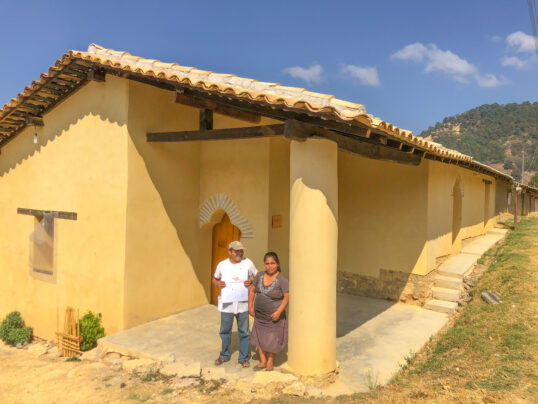
Cooperación Comunitaria | Restoration of Adobe Houses, Moyotepec, Mexico, 2021. Image credit: Cooperación Comunitaria
What did you last draw?
Zaldivar López: A guide on how to use a dry toilet and a community center for 13 communities in Guerrero Mountain.
What do you need to do your best work?
To build connections with communities and with our team. To give ourselves time for dialogue, decision-making, and collaboration… and step away from the immediacy demanded by the modern world.