
Prototyping the Future
At Future Firm, Ann Lui, Craig Reschke, and Linda Chávez Baca expand architecture to build a more equitable city.
The Architectural League’s biennial Emerging Voices award spotlights North American individuals and firms with distinct design voices that have the potential to influence the disciplines of architecture, landscape architecture, and urban design. This year, the League posed a series of questions to the eight practices that received a 2026 award, prompting each firm or individual to reflect on their working theories and methods, the opportunities and challenges of contemporary practice, and what’s next.
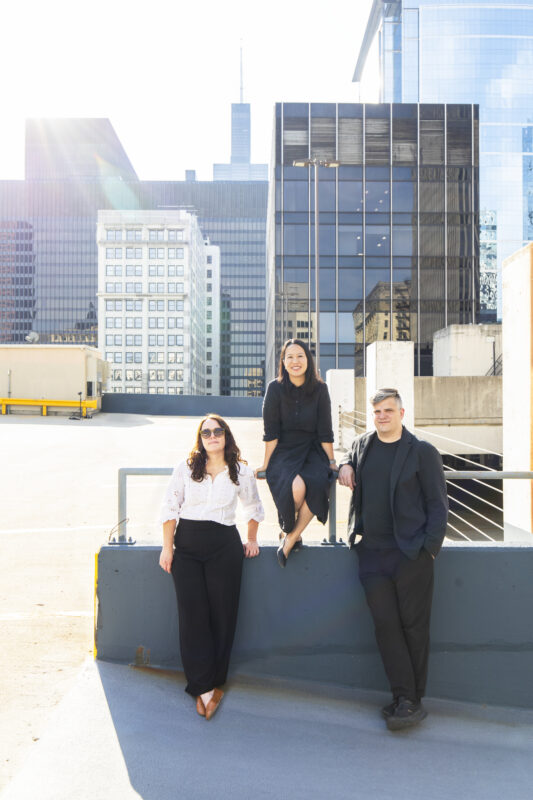
Image courtesy Future Firm
Future Firm is a 2026 Emerging Voice.
Led by founding principals Ann Lui and Craig Reschke, with Linda Chávez Baca joining the leadership in 2023, the self-described “architecture and design research office” Future Firm expands the traditional scope of an architectural practice beyond the design of buildings and spaces to include the mobilization necessary to fund, approve, and construct components of a more equitable city. In this interview, the three principals break down their approach to practice in the context of the discipline of architecture, the firm’s home in Chicago, and their own career trajectories.
***
As an emerging firm, where do you locate your practice environmentally, socially, and within the design field?
Future Firm is committed to what we see as the ongoing work of building more vibrant, equitable, and messy cities. Maximum heterogeneity per square mile as a concept, in the model of thinking of biodiversity, creates both resiliency and the unexpected encounters that make life worth living. All our work is with people and institutions actively trying to reshape civic life—nonprofits, cultural organizations, and mission-driven developers and businesses. We’re inspired by thinkers like Michael Sorkin; we think of the city as a collective work of art: messy, social, political, and alive. Architecture, for us, is less about isolated objects and more about creating frameworks for public life, participation, and possibility at the intersection of those conditions.
We also position the practice between speculative thinking and the boots-on-the-ground effort to “get it done.” On one hand, our work has been engaged in research- and future-oriented questions—how cities might be more responsive to climate change (Storm-Speed City), transformations in construction and project delivery (Readymade Row, Office of the Public Architect), and changing ideas of public space (Midnight Palace). On the other, we are equally committed to fighting the day-to-day battles that make projects happen: permits, value engineering, and building relationships with the folks who, like us, want to get things built. This reflects the name of the practice, “Future,” the way that architecture catalyzes change, and “Firm,” the way elegant and well-built buildings are a pleasure that everyone deserves.
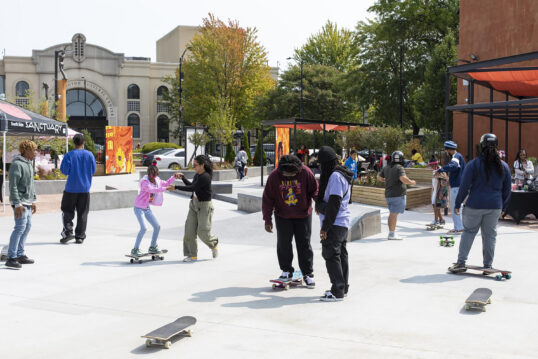
Future Firm, Nation Builders | South Side Sanctuary, Chicago, IL, 2023. Image credit: Annkathrin Murray
What do you see as the main challenges for your firm’s practice in today’s economic, environmental, and political climate?
The biggest challenge is that we are working in cities which are facing the ongoing challenges of segregation in disinvestment, which has produced extremely uneven conditions, particularly in communities of color. This is very visible in Chicago, where our clients who are doing the most socially and culturally meaningful work are fighting development challenges on multiple fronts: from contaminated soils due to unthinking demolitions decades ago, to challenges in raising capital in neighborhoods where assessors claim there are no “comps”—real estate lingo for comparable sales which help define a project’s value and also set loan amounts. As team members on these projects, Future Firm has found that to make projects happen, we have to work outside the bounds of traditional practice: helping to win and then release public funding—which often requires complex paperwork around compliance, navigating layered approvals, conflicting regulations, and fighting rising construction costs in a highly volatile lending and labor environment. At the same time, climate realities demand new approaches to reuse, energy, infrastructure, and long-term stewardship—and even these goals face uneven challenges in disinvested communities where, for example, even three-phase power (commercial-grade electrical service required for most renovation projects) is often not readily available.
We also think there is a larger crisis of imagination in the built environment. Too many systems reward caution, risk management, short-term thinking, and pro forma responses over collective ambition. We are interested in fighting for a more optimistic and future-oriented vision of the city: denser, more verdant, more public, more experimental, and more filled with those moments that take your breath away—in exhilaration, pleasure, and surprise.
When you are deciding whether to take on a project or collaboration, what questions do you ask yourself? What questions do you ask the client or collaborator?
We have a “go, no-go” process that considers pragmatic questions like team capacity, expertise, and profitability. But most significantly, we usually start from the question of whether a project contributes something meaningful to the future of its community or the city at large. Does it create new forms of public life, experiences, or a new way of doing business, or even some quotidian thing? Does the potential client see architecture as a collaborative process rather than simply a service transaction? E.g., we have never competed through a race to the bottom on price or speed, which, while this is an approach that is generally shunned by design- and ideas-focused Architectural Prize winners, is becoming more and more the norm in professional practice. Broadly, we are less interested in scale than in whether a project has curiosity, ambition, potential for impact, and openness built into it. And of course, we have a rule that we only work with good people, and we’ve been immensely lucky that this rule has produced a rhizomic network of good people, great business partners, and many allies fighting shoulder-to-shoulder. Lastly, we are especially drawn to projects where architecture can create prototypes for futures that are still, today, a whisper.
Cover: Future Firm, Revolution Workshop | Revolution Workshop, Chicago, IL, 2025. Image credit: Daniel Kelleghan. Video editor: Darlena Chiem
How would you define research in your practice?
We try to integrate research, understood as the pursuit of new knowledge and a sense of relentless inquiry, into our design practice and process day-to-day. It can be that a project draws from archival research, triggers provocations around zoning or building code, takes a pause to listen to stories through community conversations, or situates a building’s engineering within broader systems (literally) through infrastructure mapping. An underground excavation permit and its complex requirements can produce acts of research just as much as an exhibition or publication that has a more architecture-focused audience. That being said, research also should have some form of discourse or dissemination, so we do continue to participate in the disciplinary conversations that can advance conversations in design at a different register than what is possible on projects with strict deadlines and budgets.
Research is ultimately a way of staying curious about possible futures, and the complexities of overlapping histories. We often approach projects by looking for hidden opportunities within existing systems and ordinary urban conditions—trying to see how architecture might support new ways of living, gathering, learning, or sharing resources in the city.
Do you teach? What is the interplay between your teaching and practice?
Yes. Teaching has always been deeply connected to the practice. Craig and Ann, independently and together, have taught studios focused on speculative futures, housing, climate, urbanism, and civic infrastructure. Ann will also be joining the University of Chicago as an Associate Professor of Practice in July, and as director of Undergraduate Architectural Studies. Teaching is also an act of future-ing, as students are a kind of “antenna of the [human] race,” with a sense of the concerns, urgencies, and challenges that will face society and the built environment in the coming decades. At the University of Chicago, in particular, there is an opportunity to create a mode of architecture education that exists outside of the demands of professional practice and accreditation—an urgent concern when practice itself needs to transform to respond to dramatic changes in technology, economy, and environment rather than continuing to enforce the same modes of design and project delivery that have dominated in the U.S. for the last half century.
At the same time, practice keeps teaching grounded in the realities of budgets, permitting, collaboration, and construction. We are interested in helping students understand architecture not only as formal experiments, but as a political, social, and organizational practice that shapes how people live together over time.
Do you prefer to work in a certain scale or typology, or do your projects range in scope? Is there a project type that you would like to design for but have not yet?
Our projects range widely in scale and typology, from installations and interiors to housing, adaptive reuse, public space, and cultural buildings, as well as policy proposals and urban-scale speculations. We are generally more interested in the questions and opportunities a project catalyzes than in a specific building type. Many of our projects explore how architecture can support collective life, cultural exchange, and new civic futures. We polled the team and our dream projects include: a pool, a tower, a space of worship, an “odd couple” (like boba shop and laundromat), an early childhood center, a train station, and—the future National Museum of Asian American History & Culture (Ann’s dream since she was a child).
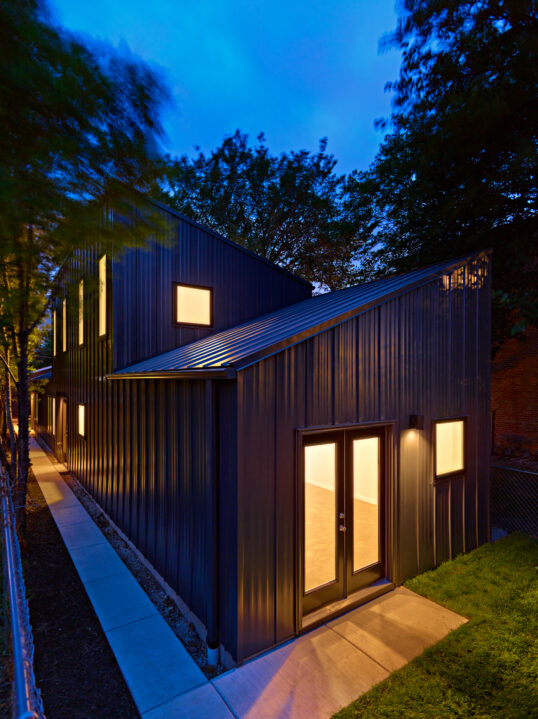
Future Firm, CoHab Construction | Hem House, Chicago, IL, 2021. Image credit: Daniel Kelleghan
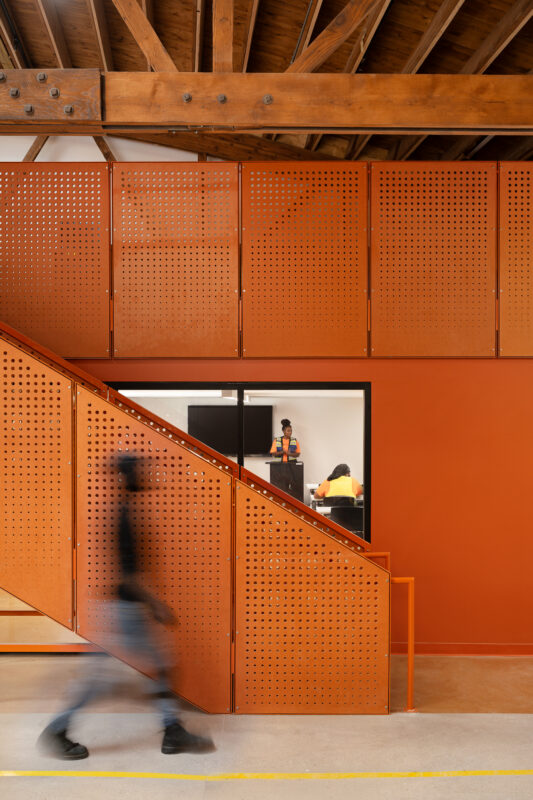
Future Firm, Revolution Workshop | Revolution Workshop, interior, Chicago, IL, 2025. Image credit: Daniel Kelleghan
When do you consider a project complete?
On one hand you could say: A project is never fully complete. Buildings continue to evolve as people inhabit them, reinterpret them, and create memories within them. And, in a way, simultaneous disintegration and maintenance begins the second a material or assembly is installed, from its origin in a factory or a field or a quarry to its final resting place, ideally not in a landfill.
On the other hand, there’s probably a series of pragmatic things that we shouldn’t lose track of, even when thinking about the expanded life of buildings. These markers are more urgent to us at Future Firm in a day-to-day way. They include: When the general contractor and all their subcontractors are fully paid. When the owner moves in, receives a certificate of occupancy if they need it, and their business license is approved. When you pop the champagne or open the beers or do a shot of tequila, and the last reimbursement comes in from the City or State or grant. When someone you know goes and visits, and sends you a text to say, “This place is amazing! I had no idea!”
Are there any projects coming up that you’re excited about, and what’s next for your practice as a whole?
Short term: South Side Community Art Center is under construction and will complete by the end of 2026. Our biggest project to date, the DFSS Bronzeville Regional Senior Center, will break ground this fall and be completed by the end of 2027. Long term: Growth, change, and the infinite possibilities of everything that hasn’t happened yet.
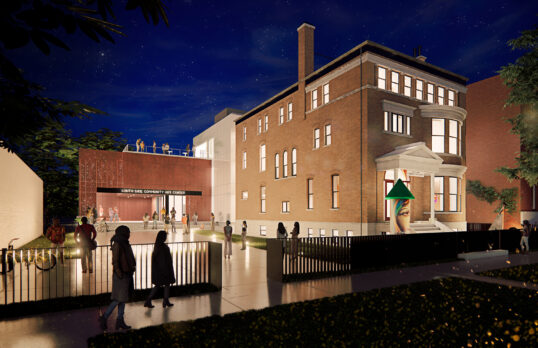
Future Firm | South Side Community Art Center renovation, rendering, Chicago, IL, under construction. Image credit: Future Firm
How did you meet your partner? How did you decide to practice together?
Craig Reschke: We worked together at SOM. Ann kept demanding more responsibility in making the renderings.
Ann Lui: We’re still deciding every day to practice together, ha ha.
What’s one piece of advice you would give a young architect who wants to start their own firm?
Reschke: There are three ways to start a firm: 1. Have your own money. 2. Steal clients from your current firm, or 3. Fight your way up from the bottom. If you fall into category three, it’s an entirely undignified experience but worth it, I think.
Lui: I will quote what Stanley Tigerman said to me and Iker Gil, ten years ago: “You know the character you need to be an architect? You need to be brave. You need to be strong. You have to have a very strong backbone. You have to have very thick skin because you’re going to get beat to shit by others, without question. You have to have that quality in you to take the criticism that will come your way no matter what.” In the end, it is a test of endurance, rather than skill or talent. Endurance takes a deep well of joy, optimism, and resilience, so do whatever it takes to cultivate those things for yourself as an individual, so your cup is full to build for others.
Linda Chávez Baca: I read these words by Amanda Yates García many years ago, and it is a really good piece of advice for our profession: You just have to do your work. You have to keep making it and keep creating it. You cannot really plan for how it’s going to come together, but if you keep making it and keep refining it, and keep focusing, and keep doing it, eventually something will open up for you.
Can you name a person, book, film, or other source of inspiration?
Reschke: The Devil Wears Prada—You’ve got to work for excellence.
Lui: Strauss, The Four Last Songs, No. 4, Im Abendrot – Jessye Norman recording. Only Lovers Left Alive—there’s always beauty in the world, if you look. Words in Air: The Complete Correspondence Between Elizabeth Bishop & Robert Lowell—halfway through, in a manic letter from Cal [Lowell], the most exquisite declaration of the other loves and lives we could have lived.
Chávez Baca: Book: Pedro Paramo by Juan Rulfo. People: the matriarchs of my family, restless unstoppable women.
What did you last draw?
Reschke: Doodles on the side of a contract we’re negotiating.
Lui: Diagrammatic section of our installation coming up at Concéntrico [urban innovation festival], in Logrono, Spain.
Chávez Baca: A curtain wall detail that I still cannot resolve.
What do you need to do your best work?
Reschke: The space and supplies to work across mediums: models, drawings, printmaking, projections, mock-ups, electronics.
Lui: A playlist with frisson. Flexible childcare (thank you Bobo & Gogo). Builders that believe in the projects. Double boba. Being part of a team that wants to strike while the iron is hot.
Chávez Baca: Time for rest, a good coffee, and some Mexican bread.