
The Building is the Thing
David Costanza discusses his Polycarb House retrofit, from 20 initial details to the project’s scalable tactics for a low-carbon future.
August 11, 2025
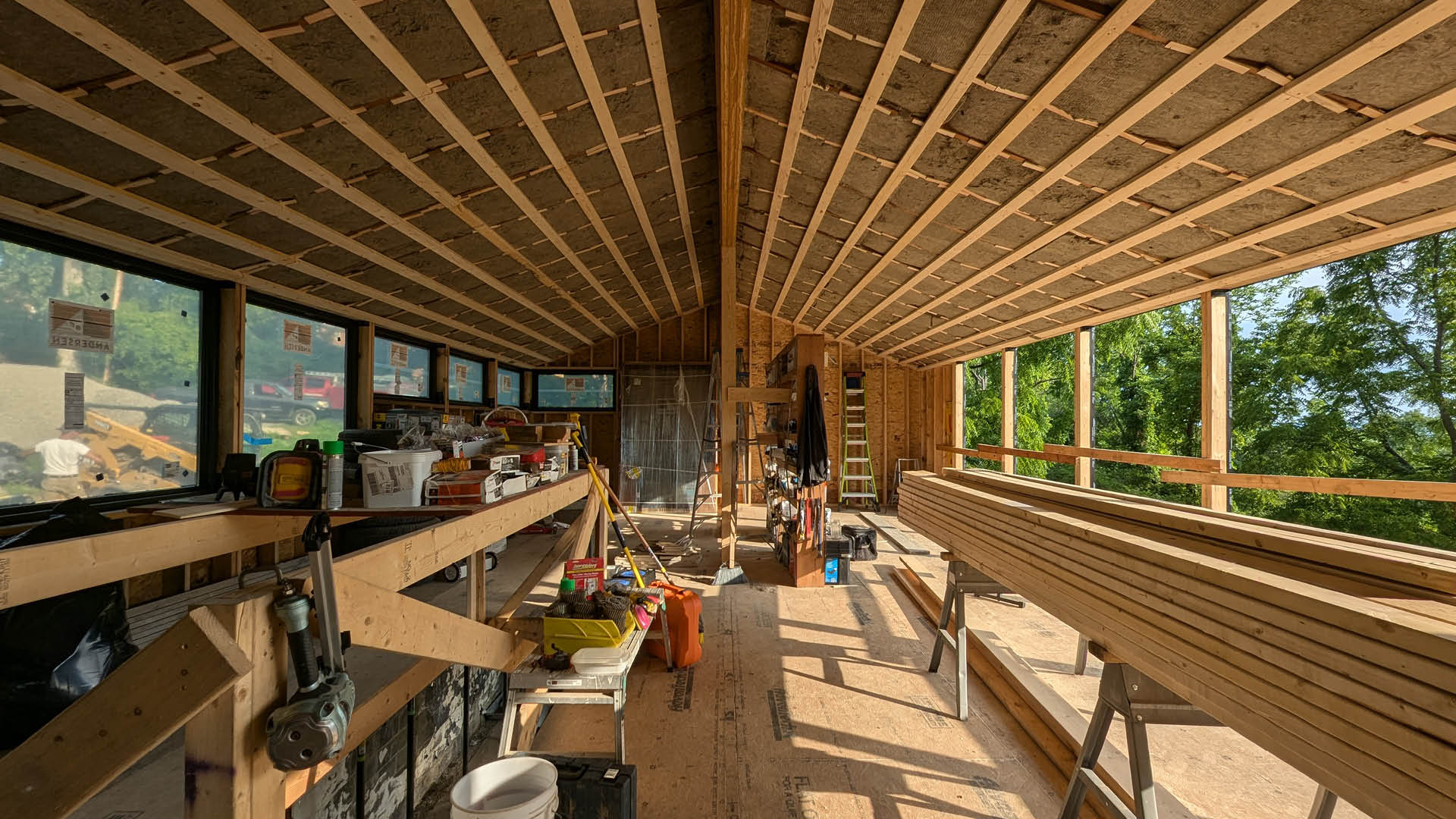
The interior of the new addition is taking shape. Insulation has been installed between the exposed rafters of the vaulted ceiling, and large windows have been added, creating a bright, spacious room. Strapping is placed perpendicular to the joists at 16 inches on center to allow for a thinner ceiling finish and a more regular fastening pattern, as the 1950s rafters vary significantly from the usual 24 inches on center spacing. David Costanza Studio | Polycarb House, Ithaca, NY, 2025. Image credit: David Costanza
David Costanza is a 2025 League Prize winners.
David Costanza is the principal of David Costanza Studio, a design-build practice based in Ithaca, New York, and director of the Building Construction Lab at Cornell University AAP, which he founded in 2020. Through practice, research, and teaching, Costanza aims to “question how architects can operate as engaged participants in the act of making,” in his own words. For his League Prize installation, Costanza created a series of videos exploring the construction site of Polycarb House, his studio’s energy-conscious, research-informed retrofit of a house in Ithaca.
Costanza spoke with the League’s development and operations manager Daniel Cioffi about the project and its documentation in a wide-ranging conversation that extends from the film’s woodblock-based score to the disciplinary expertise of architects.
*
Daniel Cioffi: Plot surfaces in so many ways in your installation. There’s the physical plot of land on which this home renovation is being carried out, and it’s also tempting to read a plot into your chosen medium of film. Can you tell us how you developed your installation in response to the competition brief?
David Costanza: There are a lot of plots happening [in my work] but I think the concept of scheming is the most important. A project requires the construction of narrative and framing to shape and guide the work. There’s a lot of scheming involved in trying to position oneself and the work in a broader context: a disciplinary context, and an academic and professional practice context. A lot of scheming is at play to try to make some of the larger arguments that I’m advocating for in the decarbonization project, which in some ways is pretty simple, and in other ways is quite radical in changing the way that we design and construct buildings.
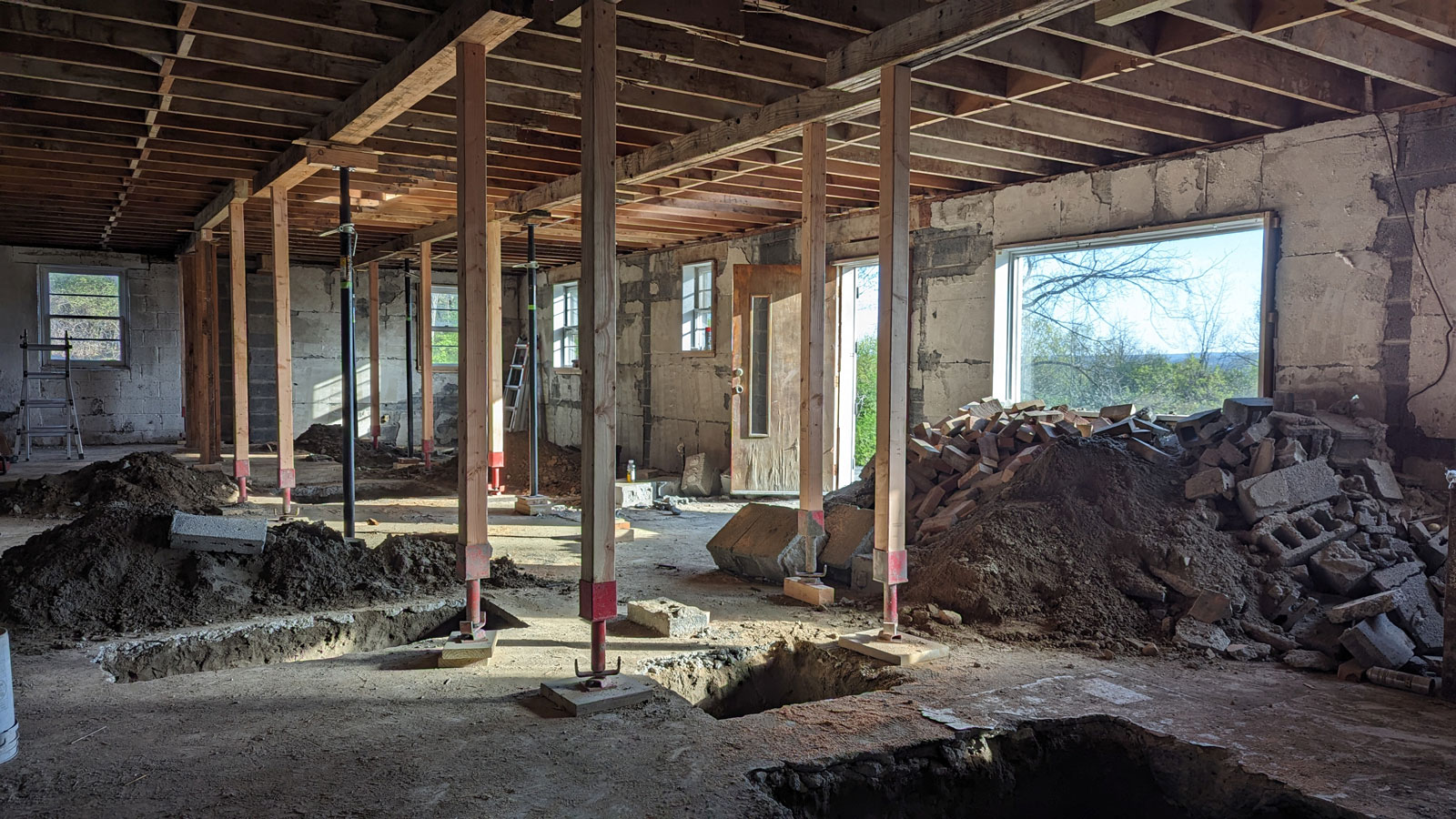
Significant structural work is underway on the lower level, where the slab has been excavated for new concrete footings. Adjustable steel and wood posts temporarily support the floor joists above during the pouring of the new footings. David Costanza Studio | Polycarb House, Ithaca, NY, 2025. Image credit: David Costanza
Cioffi: Tell us about the formal approach you took to the film you created for the installation, both visually and in terms of the music you composed.
Costanza: Over the last two decades, I’ve gotten into the practice of documenting everything as I work. A lot of that practice has to do with the experimental nature of my projects—there’s a lot of testing, iterating, and I need to be able to evaluate iterations against each other to understand what was productive, what was a failure, and for what reasons. But this exhaustive documentation has folded into more conventional work like Polycarb House. Every time I went to the site, it was with a small suitcase of cameras, batteries, cables so that everything could be documented meticulously. The construction site is littered with tripods.
There were different types of documentation that I thought were important. The time lapse, which is featured in each of the four parts of the installation, is the central figure. Time lapses are usually shot from a distance to capture a whole scene evolving at an accelerated rate. From an architectural representation perspective, I relate it to the isometric where we’re up in the sky somewhere looking at the whole project. I juxtaposed that kind of documentation with first-person perspective—putting the camera in the concrete mold as the concrete is being poured in, or on the ground as we’re excavating layers of shale. Sometimes the camera is following the subject in the scene in real time, and that gives the viewer a visual respite from the intensity of the timelapse.
When we slow down to those real-time videos, we’re hearing the beeping of the excavator, hearing the chainsaw turn on or the hammers trying to nudge the wall into place before pinning it down. The woodblock music is an abstracted sound that complements the sounds of construction but also sets a different tone and pace for the overall piece. I wrote a simple Python script and was able to visualize it with the MIDI controller and then customize it to the four different parts of the installation. Rather than a melodic song, the repetition of the block made it easier to kind of splice and couple the videos into different sequences.
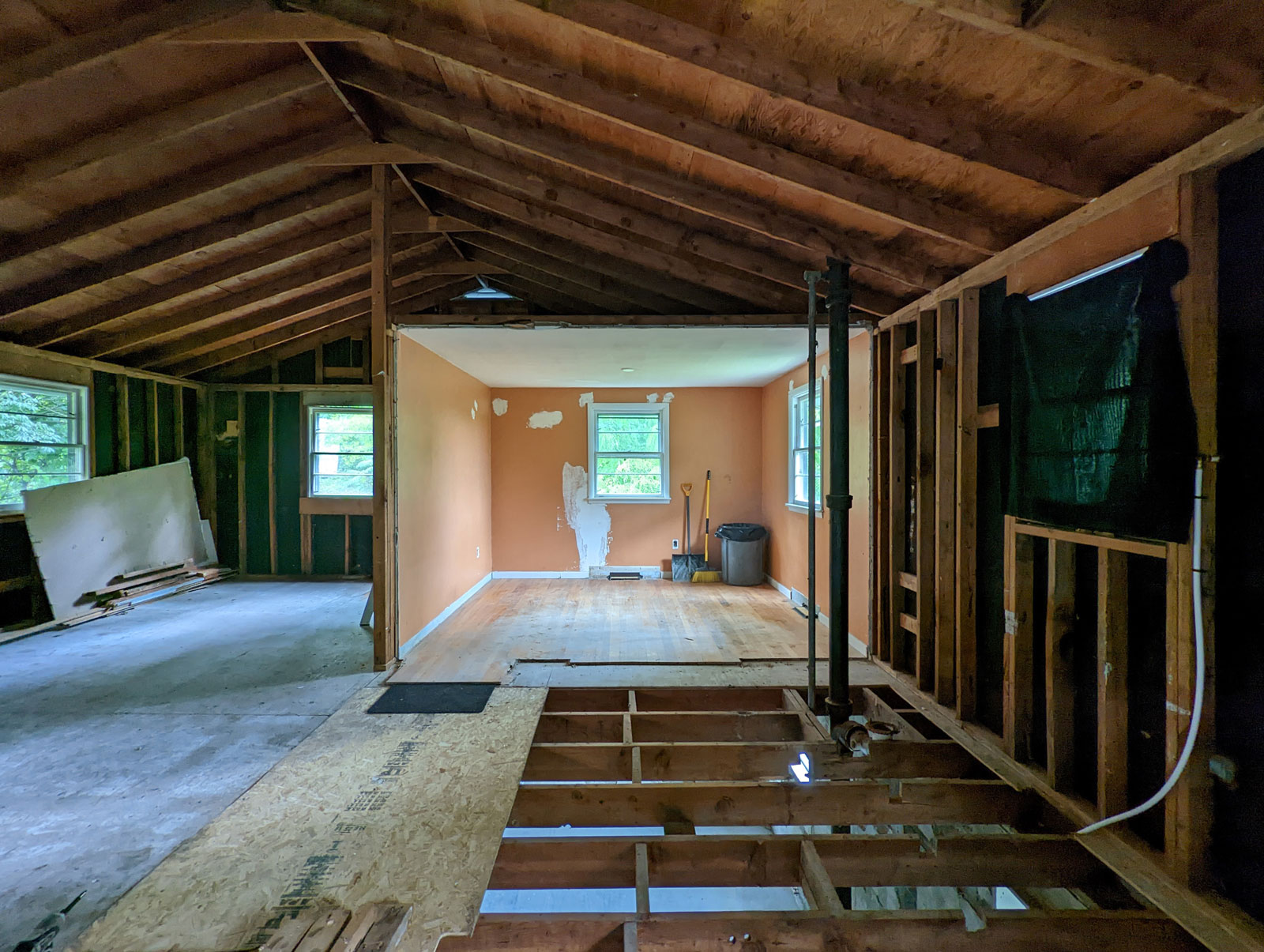
An early stage of the renovation, with the interior completely gutted to expose the original roof and wall framing. The last bedroom is the final space to be demoed and acts almost as a stage set in the construction process. David Costanza Studio | Polycarb House, Ithaca, NY, 2025. Image credit: David Costanza
Cioffi: You make—somewhat critical—allusions to the Ithaca Green New Deal in your installation text. What is the Ithaca Green New Deal, and how do you see your renovation project in Ithaca as addressing its goals or striving to go beyond its ambitions?
Costanza: The Ithaca Green New Deal includes a building code supplement [the Ithaca Energy Code Supplement] that supersedes and expands the New York State Building Code to include stricter requirements primarily focused around energy reduction. As a baseline, I think it’s a fantastic first step towards energy reduction in residential construction and retrofits, which is necessary and should be expanded. I’m careful with those word choices because, on the surface, producing more energy efficient buildings seems like a great idea, but it’s a much more complex, nuanced topic than the building code addresses.
The mode of energy production has shifted over the last 15-20 years where the reduction of energy is not a direct reflection of a reduction of carbon, because the sources of energy are now quite widespread, and many of them renewable. For example, Polycarb House has a solar array design for the back deck that offsets all the energy use in the house. My ambition now is to reduce carbon, not to reduce energy. Sometimes those things align, but often they do not.
For example, it’s very easy to meet the standards of the Ithaca Energy Code Supplement—and similarly, Passive House Standards, which is a very comparable regulation—using carbon intensive materials like concrete and spray foam. It will take decades or centuries for the energy that’s reduced by the building’s high performance standards to offset the amount of carbon that was embedded in the material. It’s a little bit paradoxical, but sometimes it’s better to have a lower performing house with worse assemblies if the alternative is to use high carbon materials that cannot offset their own energy savings.
That’s where you start to hear a bit of critique of the Ithaca Green New Deal; it’s not meant to take something away but to expand it further by saying we should have carbon [reduction] goals in addition to energy reduction goals that can shape our decisions around material assemblies in new construction and renovations. That’s something I’ve overlaid as a constraint to guide more nuanced decisions about the Polycarb House project.
Cioffi: Your practice engages with invisible systems of all kinds—physical laws, social and labor relations, ecological cycles, computed environments, supply chains, and legal regimes, to name a few. How do you see your own work as situated within these systems, and how are you seeking to expose or influence them?
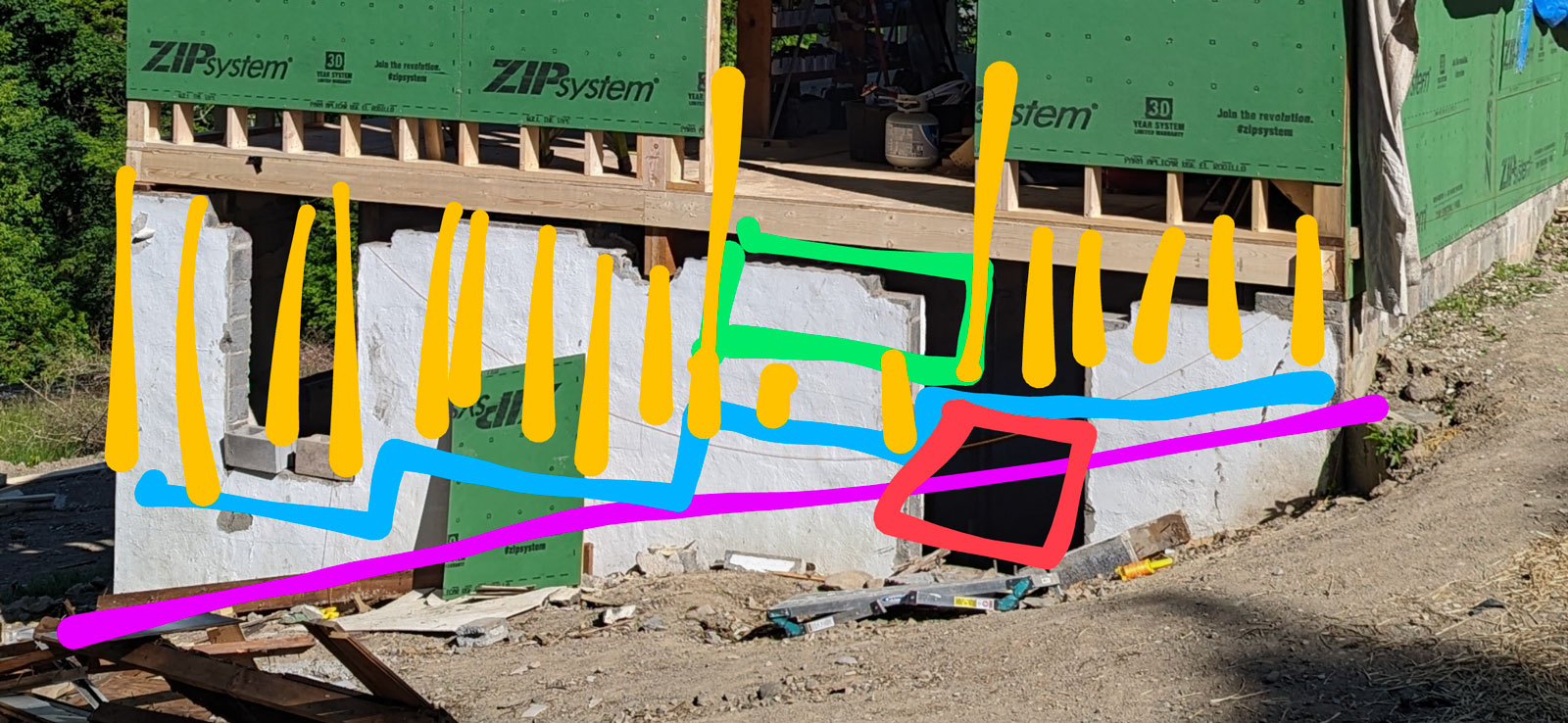
This annotated photo illustrates the process of transforming the existing concrete block foundation into a timber structure. The onsite sketch emphasizes the flexibility required for renovations, as designs are adapted to fit existing and newly discovered conditions during the work. David Costanza Studio | Polycarb House, Ithaca, NY, 2025. Image credit: David Costanza
Costanza: The way I’ve tried to tie all of my work together—and how I came about the name of the Lab—was by finding the relationship between my interests in, for example, steel bolt connections and their efficiency from a labor perspective and robotics work and recycled plastics work and stone work at quarries. It took me a few years to coalesce these interests into a framework—or plot—and that ended up being building construction.
Building construction has the capacity to go across different material mediums, material cultures, and methodologies of working, from robotics and computer programming to analog assembly with off-the-shelf tools for residential work, to working with straw and other natural materials, to really zooming into a detail—I started Polycarb House by designing 20 details and understanding how they could shape the overall design. Building construction allows us to talk about all of these things within enough of a structure that the ambition is always to make better, more informed design decisions that address the impacts the building of buildings has on the planet, people, and on the construction of culture and society.
I really want my research to directly impact building practice so that it doesn’t get pulled into an art practice or another form of practice and get further away from the discipline of architecture. I strongly believe our disciplinary expertise [as architects] should be around buildings and how buildings come together. This should be in the broadest sense—from where the materials come from down to who’s assembling them on site and how we perceive those assemblies as individuals or occupants later—but in the end, the building is the thing that ties it all together.
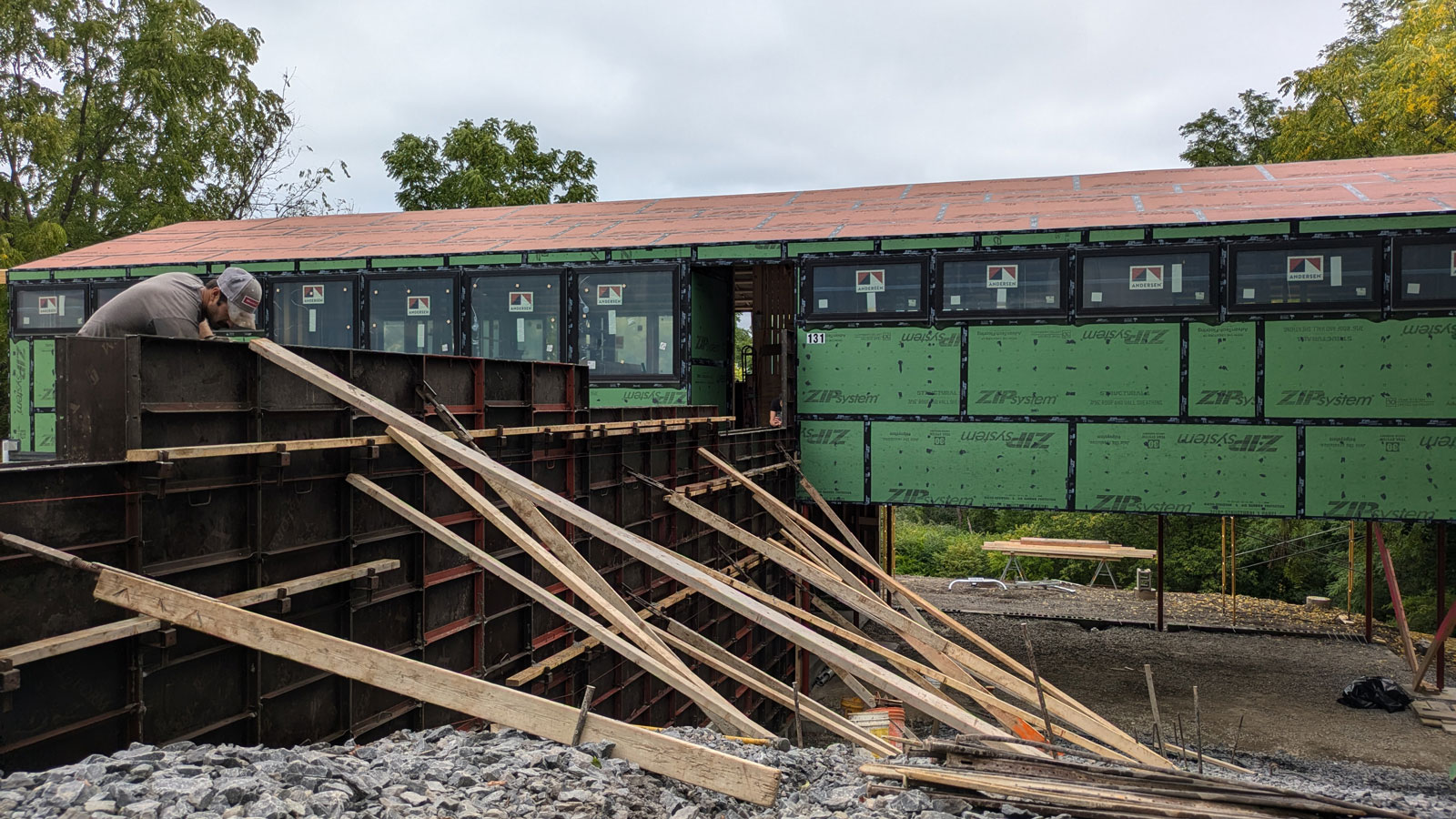
The renovated structure's exterior is framed and enclosed with ZIP System wall and roof sheathing. In the foreground, formwork is being constructed for a large, poured concrete retaining wall, essential for the sloped site. David Costanza Studio | Polycarb House, Ithaca, NY, 2025. Image credit: David Costanza
Cioffi: If you’re developing methods at the level of construction details, how do those scale, and how can they be adapted in different ways? After the case study is performed, what’s the next step?
Costanza: I hope this “case study” will lead to subsequent houses. Not to build the practice—because I primarily think of myself as an academic that experiments through practice—but mostly because we need to renovate the 6,000 existing houses in Ithaca and continue to build housing to address the housing shortage, and any work that reaches a particular price point has to meet the new Energy Code Supplement. Whether it’s my practice doing that work or others in the area, I hope that this demonstration can give some transparency to the process of trying to meet this performance requirement and different low carbon options for how one might go about that. The scalable tactics within this work are public, which is not something you see often. Part of the project is about disseminating the work so it can have a wider impact.
The complementary Building Construction Lab project [to Polycarb House] is called Scalable Tactics for Affordable, Low Carbon Residential Construction and Retrofits. Those 20 details were a design project that we took on in the Lab, looking at assemblies from various perspectives from durability to recyclability to a carbon perspective to thermal and vapor performance. These are the places where our disciplinary expertise as architects is on full display, because there’s no other discipline you can ask how these assemblies should go together, how these materials come together into thoughtful instructions.
This interview has been edited and condensed.