
Farm to Shelter
For B L D U S co-founders Jack Becker and Andrew Linn, healthy architecture begins with local materials and vernacular construction.
The Architectural League’s biennial Emerging Voices award spotlights North American individuals and firms with distinct design voices that have the potential to influence the disciplines of architecture, landscape architecture, and urban design. This year, the League posed a series of questions to the eight practices that received a 2026 award, prompting each firm or individual to reflect on their working theories and methods, the opportunities and challenges of contemporary practice, and what’s next.
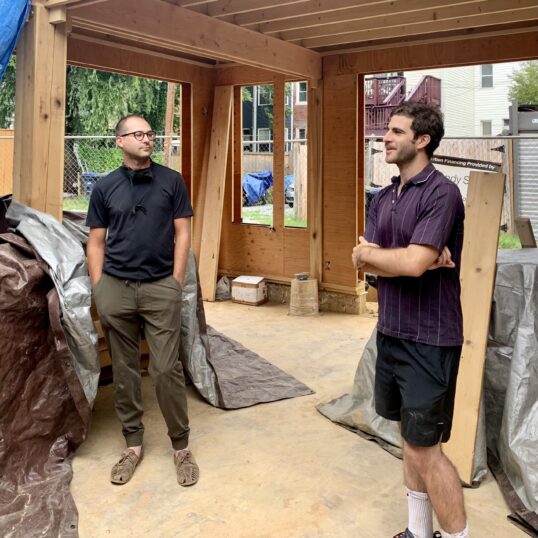
Image courtesy B L D U S
B L D U S is a 2026 Emerging Voice.
Co-founders of B L D U S Jack Becker and Andrew Linn describe their firm’s work in Washington DC as “healthy domestic architecture fit for the Mid-Atlantic climate,” uniting local architectural vernacular with natural and renewable materials such as cork, bamboo, and black locust hardwood. In this interview, the partners explore the opportunities of regionally focused practice and the ways in which their “farm-to-shelter” approach might scale.
***
As an emerging firm, where do you locate your practice, environmentally, socially, and within the design field?
B L D U S’s work is rooted in American vernacular construction. We translate lessons from adjacent industries like food, fashion, and art into architectural economy. Our use of the term “farm-to-shelter architecture” is a way for people outside architecture and design to locate our work relative to the farm-to-table culinary movement that they’re likely already familiar with. We made a book called Home on Earth: Recipes for Healthy Houses that uses short-hand recipes, sketches, details, drawings, and photographs to describe how this attitude can take form. We hope our architecture can introduce people to ancient traditions while suggesting new paths into the future.
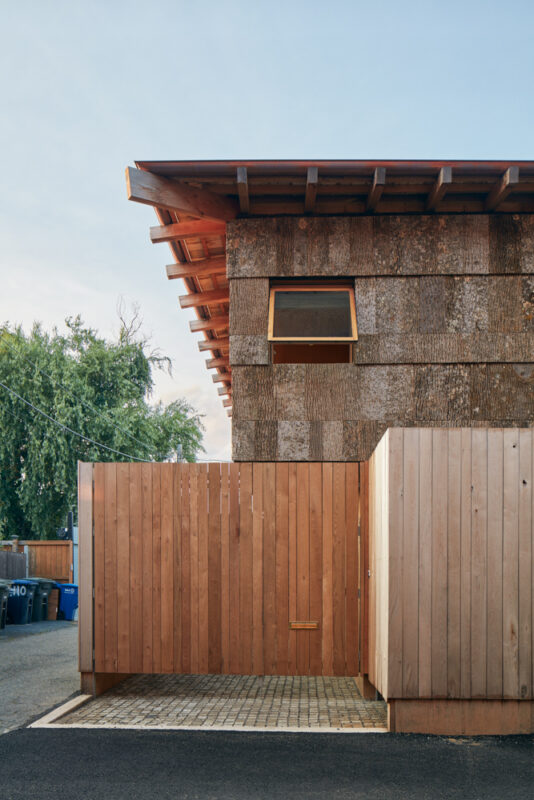
B L D U S | Adelaide Alley, Washington DC, 2021. Image credit: Ty Cole
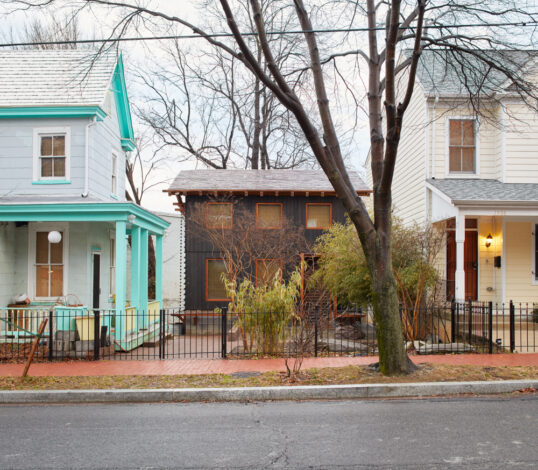
B L D U S | Grass House, Washington DC, 2019. Image credit: Ty Cole
What is the main challenge for your practice in today’s economic, environmental, and political climate?
Our ethos appeals to families and we’re passionate about designing houses. And we think farm-to-shelter makes as much sense in the public realm as it does in private. Despite our interest in and desire to contribute at a public scale—affordable housing, civic, federal, education—and despite past professional experience at this scale with other offices, B L D U S’s lack of prior experience as a practice has limited our built work to houses and housing. Ignoring their inherently exploitative nature, Europe’s open competitions give small practices a chance to prove themselves at different scales and typologies. America’s invited competitions and RFP’s filter out upstart practices like ours. Despite these market pressures, we seek new opportunities.
When deciding whether to take on a project or collaboration, what questions do you ask yourselves? What do you ask clients or collaborators?
We consider issues ranging from the prosaic—Does our office need the work financially? Do we have the capacity to execute the project with care? Do our skills complement the brief?—to the more abstract—Is there an architectural challenge that might foster a special response? Does the client have, or seem to have, integrity? What motivated the client to solicit our involvement?
In our experience, it’s impossible at the outset to definitively gauge a project’s promise. Our general tendency is to extract as much architectural merit as possible from the project’s constraints, however meager or generous. Working with clients who are kind, curious, and willing to trust our discretion matters more to us than expansive budgets and prominent locations.
How would you define research in your practice?
Experience. Visiting, walking, climbing, hearing, touching. Glimpsing, looking, seeing, inspecting, remembering. Asking, listening, considering, talking, comparing. Photographing, measuring, drawing, mapping, building.
Cover: B L D U S | Adelaide Alley, Washington DC, 2021. Image credit: Ty Cole. Video Editor: Darlena Chiem
Do you teach? What is the interplay between your teaching and practice?
Locally, we’ve taught at the University of Maryland, Catholic University, and currently at Virginia Tech’s satellite campus in Alexandria, Virginia. Teaching allows us to consider new scales and programs—housing for congressmembers around the Capitol, affordable housing tracing the boundary of Washington, DC, a relocated Supreme Court. At the same time, we can share our ethos with young architects who are likely to work in DC. As we focus on the minutiae of our practice and projects, our students keep us attuned to what’s next in architecture.
Do you prefer to work in a certain scale or typology, or do your projects range in scope? Is there a project type you would like to design for but have not yet?
We work in a language of porches, balconies, fences, palisades, patios, skins, shells, courts, atriums, awnings, terraces, decks, loggias, lanais, engawas, vestibules, and verandas. Although we design for a wide range of scales and scopes, our built work is primarily residential. We’d like to bring our language of “in-between spaces” to buildings that play larger roles in their communities, particularly schools, municipal buildings, and multifamily affordable housing.
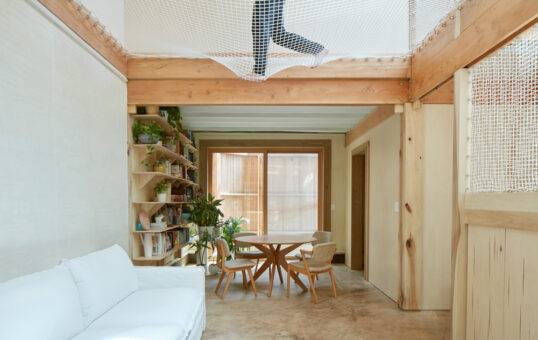
B L D U S | Adelaide Alley, interior, Washington DC, 2021. Image credit: Ty Cole
When do you consider a project complete?
When a contract is fulfilled. The product of that contract lives on, ideally for centuries, sometimes with our care or guidance but often totally on its own, beyond our influence, out in the world, finding its way.
Are there any projects coming up that you’re excited about, and what’s next for your practice as a whole?
Over the last decade, B L D U S has explored the use of rapidly renewable building materials in residential architecture—wood, bark, cork, hemp, bamboo, willow, straw, whey, wool—whatever we can get our hands on that grows quickly and is locally accessible. We’re working on new projects that necessitate the use of masonry, so we’re spending time understanding ways in which stone and brick can be used with minimal environmental impact—unhewn stone, remainder brick, scrap piles, demolition reclamation, rammed earth, etc. We’re fascinated by the movement of stone and earth around the country over time and appreciate Washington, DC, as a resting place for much of that stone.
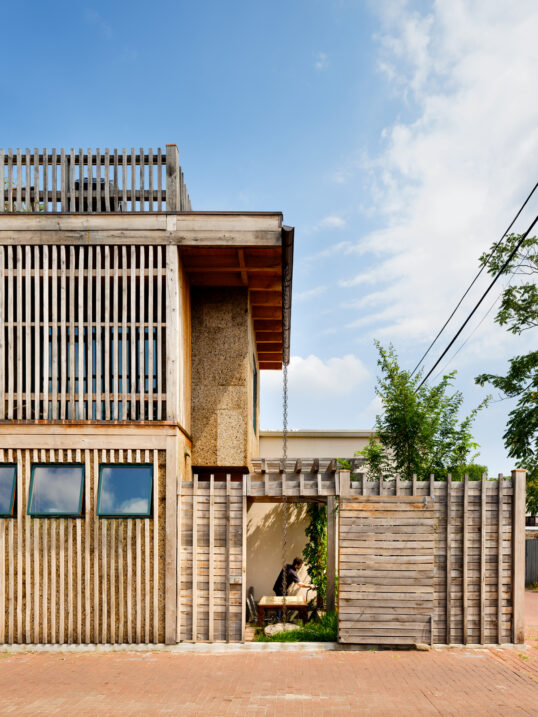
B L D U S | Overbeck Alley, Washington DC, 2023. Image credit: Jennifer Hughes
How did you meet your partner? How did you decide to practice together?
We met in person on the first day of architecture school, and digitally before that on a school-run social media platform. We have similar values and tastes in architecture (and music and film and art and books), and we get along as both friends and collaborators, so the potential for partnership was obvious early on.
What’s one piece of advice you would give a young architect who wants to start their own firm?
Be open-minded about how your skillset applies to your context and vice versa. Live and work in a place that you have a connection to, ideally a place with fewer architects and more opportunities to make a difference in your community.
Can you name a person, book, film, or other source of inspiration?
Hejduk. Frida. Future. Furness. The Iron Heel. Vidal. Yo La Tengo. House of Seven Gables. Scully. Sullivan. Hugh Hayden. Shara Hughes. REM. Wright Ferry Mansion. The Unsettling of America. Kahn. Rudolph. Progress and Poverty. Rainbow Brainskull. Amy Weinstein.
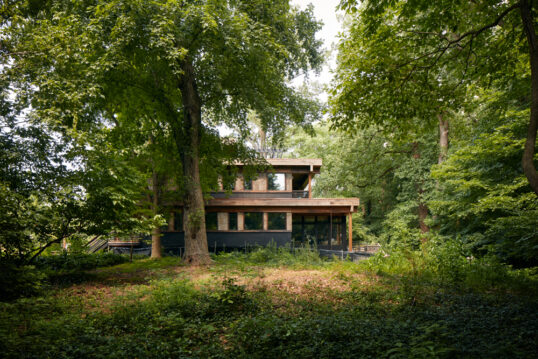
B L D U S | Poplar Cloud, Washington DC, 2021. Image credit: Ty Cole
What did you last draw?
Hatches and stipples, of varying lineweights.
What do you need to do your best work?
Nature.